


Most articles about cracked heels are written for people who can feel them. This one is not. If you have diabetes and peripheral neuropathy, a cracked heel is not a minor nuisance you notice once it starts to hurt. It is a break in the skin you may not feel at all, opening a little further each day while nothing tells you it is happening. Understanding why, and what to do about it, is the purpose of this guide.
What Peripheral Neuropathy Does to Your Feet
Peripheral neuropathy is nerve damage that affects the hands and feet. In people with diabetes, it comes from years of high blood sugar gradually damaging the long nerve fibers that carry sensation from the feet to the brain. According to the American Diabetes Association, neuropathy is one of the most common complications of diabetes, affecting up to half of people with the condition over time.
The damage is not simply numbness, though numbness is part of it. There is a point at which a foot can no longer reliably register small injuries — a scrape, a shoe rubbing, a crack starting to open. Podiatrists call that point loss of protective sensation, usually shortened to LOPS. Below it, the pain signals that would normally make you look at your foot, change your shoe or call your care team are absent or badly muted.

Podiatrists screen for it with the 10-gram monofilament test — a thin filament pressed against set points on the sole of the foot. Someone who cannot feel it at several of those points has crossed into the clinical risk zone. If you have diabetes and have not been tested recently, it is worth raising with your care team.
Sensation is only half of what the nerves do down there. The same disease also damages the autonomic nerves — the branch of the nervous system that runs the things the body handles without being asked, sweating among them. That second piece is what explains why diabetic feet crack.
Why Diabetic Skin Cracks: Feet That Sweat Too Little
Here is the part that surprises most people: the soles of your feet have no oil glands. Not one. Everywhere else on the body, oil glands help keep skin supple. The soles do that job with sweat instead, and they carry more sweat glands than any other part of you.
Diabetes damages the nerves that tell those glands to work. They do not switch off all at once — output falls gradually, often long before you would notice anything. Doctors call it hypohidrosis while sweating is only reduced, and anhidrosis once it has stopped altogether. Most people with diabetic nerve damage sit somewhere in between, and you cannot tell where by looking. In one community study reported in The Diabetic Foot Journal, only just over a quarter of people with diabetes had normal sweating on the feet, most of the rest had partial loss, and the researcher's own eye did not match what the test found. Skin that looks fine is not proof that nothing has changed.
This is not the same as dry skin from cold weather or hot showers. Ordinary dryness responds to a moisturizer because the skin underneath is still doing its part. Here the supply itself has fallen, so the skin dries from the inside out, whatever is put on the surface.
And sweat is not only water. It carries the natural moisturizing compounds that let the outer layer of skin hold onto water and stay pliable. So as the sweat falls away, your feet lose the water and the compounds that would have held it there, together. High blood sugar adds to it: skin tends to measure drier in people whose glucose runs higher. The result on a heel is the same either way. The skin stiffens, and it starts to split where the load is highest.
For more on why this particular kind of dryness behaves so differently, see our articles on why diabetic feet stay dry and understanding dry diabetic feet.
The Danger of a Crack You Cannot Feel
In a foot with normal sensation, a deepening heel crack announces itself. There is soreness on standing, a sharpness walking barefoot, discomfort that points you at the problem well before it turns serious. With LOPS, none of those messages arrive.
It is worth knowing what the depths actually mean, because the words get used loosely. The hardened layer you can see on a heel is the stratum corneum, and it is the top of the epidermis rather than something sitting on top of it. A crack that stays within that hardened layer has damaged the barrier but not the living skin underneath, and this is the stage where daily care does the most good. A crack that goes through the epidermis is a break in the skin — not a cosmetic problem, whatever it looks like. And a crack reaching the dermis below, where the blood supply sits, will bleed, would normally hurt, and meets the clinical definition of a foot ulcer: a break in the skin of the foot that extends through the epidermis and into part of the dermis.
Without pain to mark the stages, a heel crack can travel down through all three of them unnoticed. Once the dermis is exposed, bacteria have a direct route into living tissue.
There is a second problem sitting underneath the first. When diabetes is poorly controlled, the body's response to an injury is slower and quieter than it should be. The white blood cells that deal with bacteria are slow to arrive, the body is slower to build new blood vessels into the area, and the signals that normally produce the obvious warning signs — redness, heat, swelling — are muted. An infected heel crack on a diabetic foot can therefore show none of the classic signs of infection while the bacteria advance.
The escalation path is well documented: a heel crack deepens past the surface layer, bacteria enter through the opening, a local infection develops with no reliable pain and little visible inflammation, cellulitis spreads through the surrounding tissue, and osteomyelitis — infection in the bone — takes hold, at which point surgical debridement or amputation may be on the table. Every step of that can happen without the person feeling that anything is wrong. Our article on how long a diabetic foot ulcer takes to heal gives a sense of how long the road back is once a wound is established.
This is the reality most general skin articles are not written for. The danger is not the crack. It is the silence around it.
Why Standard Skin Care Falls Short
The usual advice for cracked heels — apply a thick moisturizer, use a heel balm, try petroleum jelly — was written for a different problem. It assumes the skin is dry because of what is going on around it: cold weather, low humidity, hot showers, harsh soaps. Fix the external cause and the skin recovers.
Diabetic neuropathic skin is dry for another reason entirely: the nerves that sustain its moisture supply are damaged. Putting a surface moisturizer on it is like misting the leaves of a plant whose roots have stopped drawing water. The surface may feel softer for a while, but the shortfall underneath is untouched.
Skin that sweats less is not short of water alone. It is short of what arrived with the sweat — and it has no way of making the shortfall up on its own.
Petroleum jelly is the common example. It is an effective occlusive — it sits on the surface and slows water escaping from the outer layers. What it does not do is replenish anything the skin has lost. On healthy skin with mild dryness that is a reasonable short-term fix. On diabetic neuropathic skin it covers the symptom and leaves the cause alone. Our article on why Vaseline falls short for diabetic feet goes through this in detail.
High-strength urea creams (40% and above) go the other way. At that concentration the goal shifts from softening hard skin to stripping it back — the chemical version of debridement, which is what a podiatrist does with a blade in the office. Under podiatric supervision that has a place in callus management. It is not built for daily use, and on skin that is already fragile it can irritate or over-exfoliate. We look at where that line sits in is 40% urea too strong for diabetic skin.
What Holds the Skin Barrier Together
The outer layer of your skin works like a brick wall. The cells are the bricks, each holding water. Between them sits a mortar your skin makes out of lipids. Lose either and the wall goes stiff, and stiff skin splits under pressure.
Water only stays if something holds it, and the mortar is what does that. On skin that is already dry and cracking, added water leaves about as fast as it arrives.
Neither a moisturizer nor a urea cream replenishes the lipids the barrier is short of, and the wall needs water and mortar together, so the skin stiffens again and the crack reopens.
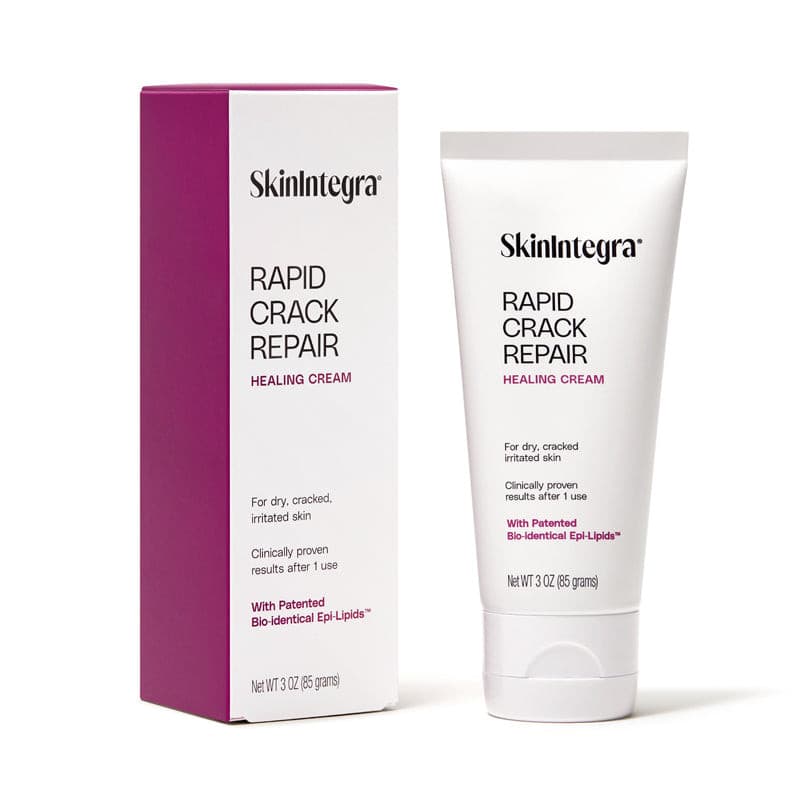
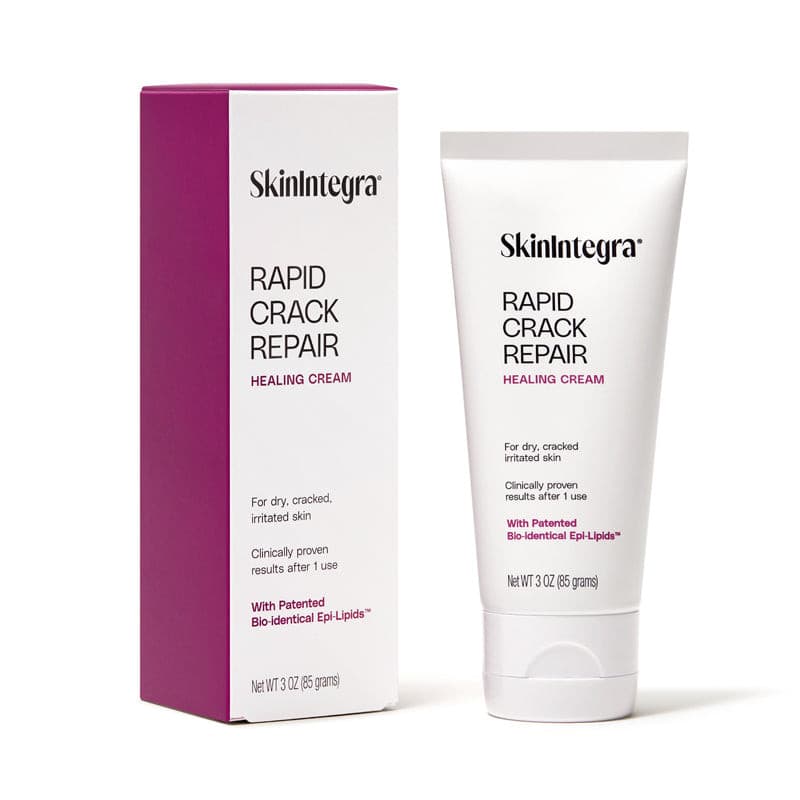
SkinIntegra® Rapid Crack Repair Cream was developed for exactly this gap. It is not a stronger exfoliant. It replenishes what is missing.
At its core is SkinIntegra B.I.O.™ (Bio-Identical Oils) — a patented blend of five plant-derived oils (Sacha Inchi, Sea Buckthorn, Rice Bran, Sesame Seed and Jojoba Seed) matched in balance and composition to the skin's own lipids. We profiled what a healthy skin barrier is made of, then selected oils to match it. That is what SkinIntegra B.I.O.™ does.
It also contains 25% urea with lactic acid — a concentration that softens and loosens hardened skin and is widely used on dry, sensitive and diabetic skin, with the lactic acid adding hydration and gentle exfoliation. Unlike 40% urea, which works aggressively and can leave skin feeling dry, SkinIntegra absorbs quickly and leaves skin feeling immediately moisturized.
It is formulated without salicylic acid, and is fragrance-free, paraben-free, alcohol-free, petrolatum-free and dye-free.
What the clinical evidence shows
In a head-to-head trial published in the Journal of the American Podiatric Medical Association, 48 adults with deeply cracked feet used either Rapid Crack Repair or a 40% urea cream, twice a day for four weeks.
Rapid Crack Repair did as well as 40% urea — at a lower strength, and well tolerated throughout. Among the 22 adults who used it, 91% showed some improvement within two weeks. By four weeks, podiatrists were seeing less dryness in 82% and less cracking in 73%, and no one had new or worsening redness, burning, stinging or itching.
SkinIntegra Rapid Crack Repair Cream carries the Seal of Approval from the American Podiatric Medical Association (APMA). Medical professionals at major hospitals across the United States also recommend it.
For skin that stays dry and cracked, or that looks better for a few days and then looks the same again, the missing piece is usually not more exfoliation. It is replenishing what the barrier is short of.

Apply it after washing, while the skin is still slightly damp, and work it into the hardened area around the crack — the skin on either side is what has to change.
What Safe Daily Skin Care Looks Like
For people with diabetes and peripheral neuropathy, looking after the skin on the feet is not optional maintenance. Keeping it supple, and looking at it every day, is what gives you the chance to notice something while it is still small — because the usual alarm, pain, is not going to sound.
Daily inspection
Since LOPS means you cannot rely on pain to flag a developing problem, looking becomes the way you find things. Check both feet every day — soles, heels and between the toes — with a mirror if bending is difficult, or ask a family member or caregiver if vision or mobility gets in the way. Look for new cracks, changes in skin color, swelling, or any break in the skin. Anything that has not closed within a few days should be seen by a podiatrist.
Washing
Wash the feet daily with lukewarm — not hot — water and a mild, fragrance-free cleanser. Do not soak. Long submersion weakens the skin barrier and draws what is left of the oils out of the outer layer. A brief wash followed by careful drying is the safe routine, and drying between the toes matters, because moisture left there sets up the conditions for fungal infection. Our guide to cleaning diabetic feet safely covers the whole routine.
Barrier cream
Apply a barrier cream straight after washing, while the skin is still slightly damp. The choice of product matters more here than it does on healthy skin, because what is missing is the lipids the barrier is short of, not something on the surface. Look for plant oils whose composition matches the skin's own lipids, to replenish what the barrier is short of, alongside urea to soften hardened skin and help the outer layer hold water. Why skin barrier repair is essential in diabetic foot care explains why this step carries more weight on a diabetic foot than on any other.
Footwear
Never walk barefoot, indoors included. With LOPS you cannot feel sharp objects, rough surfaces, or the early pressure of a blister forming. Properly fitted shoes with cushioning reduce the mechanical stress at the heel and sole, which are the sites where the skin cracks first. Avoid open-back footwear that lets the heel meet surfaces unprotected.
When to See a Podiatrist
Daily care at home is the foundation. But for people with diabetes and peripheral neuropathy, some situations need a professional rather than home management:
• Any heel crack that has not closed or improved within 3–5 days
• Redness, warmth or swelling around a crack — even mild — which may point to infection in a foot where the usual inflammatory signals are already muted
• Any wound, blister or break in the skin you cannot see clearly or reach to clean and dress
• Thickened callus on the heels or soles, which can hide skin breakdown underneath — and a callus that has already split or darkened, which needs prompt evaluation rather than home care
• Any change in skin color — darkening, bluish or grey tones — which may point to impaired circulation at the site
• You have not been screened for LOPS recently — ask your podiatrist about the monofilament test
The threshold for seeking care is lower here than for the general population. The absence of pain is not reassurance. It is the problem.
Frequently Asked Questions
Can peripheral neuropathy cause cracked heels?
Yes — through two separate mechanisms. Sensory neuropathy causes loss of protective sensation, which means a heel crack can deepen without being felt. Autonomic neuropathy damages the nerves that tell the sweat glands to work, so sweat output falls — hypohidrosis where it is reduced, anhidrosis where it has stopped altogether, with most people somewhere between the two. Since the sole has no oil glands, sweat is its only supply, and it carries more than water — it delivers what keeps the outer layer pliable. As that supply falls the skin becomes chronically dry and brittle, and it cracks under the mechanical pressure of walking. Together those two make peripheral neuropathy one of the most significant risk factors for serious heel cracks in people with diabetes.
Why doesn't my heel hurt if the crack is that deep?
Because the nerves that would carry the message have been damaged. A deep heel crack in a foot with normal sensation is painful enough that it is hard to ignore; the pain is what sends most people to a podiatrist. Neuropathy removes that prompt. The crack is doing the same thing to the skin — it is the reporting that has stopped, not the damage. This is exactly why the daily look matters more than how the foot feels.
At what stage of diabetes does neuropathy start?
Peripheral neuropathy can begin early, and in some cases is already present at the time of diagnosis — particularly in people with type 2 diabetes whose blood sugar was elevated for years before anyone measured it. Regular screening, the monofilament test included, is recommended as part of annual diabetic foot care regardless of symptoms, because the nerve damage usually develops gradually and without obvious warning.
Can diabetic neuropathy be reversed?
Diabetic peripheral neuropathy is not fully reversible once established, though its progression can be slowed considerably through tight blood sugar control, blood pressure management and cardiovascular risk reduction. Some early small-fiber nerve damage may recover partially with sustained glucose improvement. The practical implication for skin care is that even where the neuropathy itself cannot be undone, its most dangerous consequence — skin breakdown nobody notices — can be managed through consistent daily inspection, appropriate daily skin care and timely podiatric attention.
What cream is safe for diabetic cracked heels?
The creams best suited to diabetic cracked heels are the ones formulated for a compromised skin barrier, rather than general moisturizers or high-strength exfoliating products. Look for plant oils whose composition matches the skin's own lipids, along with urea — ideally in the 10–25% range, where it softens hardened skin rather than stripping it. A fragrance-free and dye-free formulation is preferable on sensitive skin. High-strength urea creams of 40% and above are better used under podiatric supervision than daily at home, and petroleum-based products such as Vaseline do not supply the lipids neuropathic skin is short of.
How often should people with diabetes check their feet for cracks?
Daily. A visual check of both feet — soles, heels and between the toes — belongs in the daily routine, ideally at the same time as washing and applying cream. For anyone with limited flexibility, a long-handled mirror makes the sole visible without bending. Any crack, color change, swelling or wound that has not closed within a few days should be looked at by a podiatrist. The daily check matters most for those already diagnosed with LOPS, where the pain signal that would otherwise prompt attention is gone. For more on neuropathic symptoms in the feet, see our article on itchy feet at night and neuropathy.
Related Articles
• How to Clean Diabetic Feet — and Why It Matters
• Cracked Callus on the Ball of Your Foot: Why It Splits and When to Worry
• Why Cracked Heels Keep Coming Back
• Itchy Feet at Night and Neuropathy
• Why Vaseline Falls Short for Diabetic Feet
• Why Skin Barrier Repair Is Essential in Diabetic Foot Care


