


It takes you half an hour to get dressed in the morning, and most of that is the garment.
Somewhere in that routine you moisturize. You were told to, and you do it properly — after washing, before anything goes on, every day. You have been through more than one product by now. The one the clinic suggested. The one that was on the shelf beside it. The thick one someone swore by, which took so long to sink in that you nearly gave up on the whole morning.
And the skin is still scaly. Still tight. Still shedding onto the bathroom floor.
It is easy to conclude that you are doing something wrong, or that your skin is simply like this now. Neither is likely. What is far more likely is that nobody has told you what the choice is actually about — and that the advice you were given was written for a different kind of skin than the one you have.
This article is about how to make that choice: what matters, what it depends on, and how what you use interacts with the garment you have to put on afterward.
Two Questions That Decide Which Product You Need
Before any product is worth discussing, two things settle most of the decision.
First: is the skin dry but smooth, or has it thickened? Run your hand over it. Skin that is dry, tight and slightly flaky, but still feels like skin, is one situation. Skin that has built into a hard, raised, plated layer — the texture people describe as tree bark, and that clinicians describe the same way — is a different situation with a different answer.
That thickening has a name, hyperkeratosis, and it means the outer layer has overgrown. It is worth knowing that this is an expected part of how the condition progresses rather than a sign you have neglected anything. In the earliest stage the skin stays essentially normal. Once the swelling becomes persistent — the stage most people with lymphedema are living with — the skin starts to change: it firms up, loses some of its give, and the surface turns rough and scaly. That is where thickening begins, and it is also the point at which it is most worth acting on. Left to continue, it becomes the dominant feature in the most advanced stage, where the skin turns profoundly thick and folds deepen.
If your therapist has given you a stage number, that is the pattern behind it: the thicker and more scaly the skin, the further along the staging tends to be. It is a useful shorthand to have, though you do not need it to answer the question in front of you, which is what your skin is doing right now.
Second: when do you apply it — morning or night? This sounds like a detail. For anyone wearing compression it is half the decision, because it determines how much time a product has to absorb before fabric goes over it.
Almost everyone with lymphedema is advised to wear compression, so the question is rarely whether you have a garment. It is when your skin is bare.
Neither question has an easy answer to look up. Most general advice recommends something gentle and fragrance-free, which is sound as far as it goes, and the rest is genuinely harder to find. Your lymphedema therapist knows this territory well and is worth asking directly — but it is not something most people are handed in a leaflet, and it is rarely explained in one place.
If Your Skin Is Dry but Smooth
This is the earlier situation, and the product itself matters less than two things people are rarely told: how quickly it absorbs, and when you put it on.
If you moisturize in the morning, before the garment: choose something lighter and faster-absorbing. You have a short window, and whatever is still sitting on the surface when you start dressing is what meets the fabric. A lotion or a light cream that sinks in is worth more here than a richer product that does not.
If you moisturize at night, after the garment is off: you can go richer. The skin has hours and nothing over it, so this is where a heavier cream or an ointment earns its place, and where the slow-absorbing product that was wrong at eight in the morning becomes the right choice.
Many people end up using both, and that is not indecision. It is the correct answer to two different situations in the same day.
Whichever you use, keep it plain. Fragrance-free and dye-free matter just as much here as they do on more damaged skin, and for a simple reason: a swollen limb spends twelve hours a day under fabric, which gives anything irritating a long time to work. There is a fuller list of what to avoid further down.
If your skin is dry but intact and your routine is working, you do not need to change the product. You may only need to change the hour.
If Your Skin Has Thickened and Scaled
Here is the part nobody tends to explain, and it is why the diligent routine stops producing results.
A moisturizer softens the surface. That is what it is designed to do, and on ordinary dry skin it is enough, because the surface is all there is to soften. When the outer layer has built into a plate, softening the top of that plate does not remove it. The plate is still there in the morning, and still there next month.
So the skin feels better for a few hours and looks the same by the end of the week, and you reasonably conclude the product has failed. It has not failed. It was never built for this job.
Thickened skin needs two things together.
Gentle removal of loose scale. Washing the limb regularly with a gentle, soap-free cleanser — the kind sold as a non-soap wash or a cleansing lotion, rather than a regular bar of soap, which strips more than it needs to — and letting a soft washcloth lift what is already loose. Slow and cumulative rather than dramatic. It is also where being gentle matters most: scrubbing damages this skin, and broken skin on a swollen limb is what you are trying to avoid.
Something that works on the thickened layer itself, rather than only softening what sits on top of it. This is where urea comes in, and where strength starts to matter.
Urea Strengths, and What Each One Actually Does
If you have not come across urea before, it is worth a sentence. It is not a harsh additive or an unusual one: your skin makes urea itself, as part of what keeps the outer layer holding on to water. It is also one of the most studied ingredients there is for dry and thickened skin.
It does two things at once. It draws water into the skin and holds it there, and it loosens built-up skin so that what has hardened can gradually come away. The balance between those two shifts with strength, and that is the whole reason the number on the tube matters.
Urea appears on a great many labels at a great many strengths, usually with no explanation of the difference. The number is not a measure of quality. It changes which of those two jobs the product is mainly doing.
Below about 20% — urea works mainly by drawing water into the skin and holding it there. That is genuinely useful for skin that is dry and flaky. It will not do much to a thickened layer, because softening is not the same as breaking it down, and breaking it down is not what urea is doing at this strength.
Between 20% and 25% — urea starts to loosen and break down the thickened layer itself, while still drawing in water. It is doing two jobs rather than one. This is the range that acts on built-up skin at a strength most people tolerate for regular use.
Above 25%, up to 40% — more aggressive, and more useful over a short course than as a daily habit. At these strengths urea can irritate with extended use, particularly on fragile skin, so it is worth asking your lymphedema therapist or doctor before using one routinely. We go through the trade-off in when 40% urea works and when it does not.
So if your skin is dry but smooth, a lower-strength urea product or a plain moisturizer is the sensible choice. If it has thickened, the lower strengths are unlikely to shift it, and the question becomes how much strength you need and how well your skin tolerates it.
None of this applies to skin that is broken, weeping or raw. Anything that breaks down thickened skin stays off those areas entirely.
And if the scale is heavy or long-established, it is worth saying plainly that this may be beyond what any product does alone. Lymphedema therapists and podiatrists remove thickened skin as a clinical procedure, safely and far faster than you can at home. If your limb has reached that point, asking about it is sensible, not an escalation.
Why Both Still Leave Lymphedema Skin Short
Here is the part that explains why even the right product, used properly, often stops short.
A moisturizer adds water and softens the surface. It works, and it wears off, because nothing is holding the water in. A urea cream brings the plate down, which is real progress — but it is subtraction. It removes what has built up without putting back what was missing underneath.
Both are doing their jobs. Neither is doing this one.
What the Skin Is Actually Short Of
The outer layer of your skin works like a brick wall. The cells are the bricks, each holding water. Between them sits a mortar your skin makes out of lipids. Lose the mortar and water escapes as fast as it arrives, the wall goes stiff, and stiff skin cracks, flakes and thickens under pressure.
Lymphedema keeps that wall under strain. Swelling stretches it thinner than it should be, the surface builds up faster than it sheds, and under a garment the skin spends its days warm and damp and its evenings drying out. Wet, dry, washed, re-wrapped — that cycle takes the mortar out of any skin, and here it happens daily, on a wall that is already stretched. Age works in the same direction, because the skin makes less of those lipids than it used to, which is why the same limb can be harder to manage in your sixties than it was in your fifties with nothing about your routine having changed.
This is the skin side of the problem, and it is worth being clear that it sits alongside the swelling rather than instead of it. Controlling the fluid is what your compression and your therapy are for. Replenishing the barrier is what skin care is for. Neither substitutes for the other.
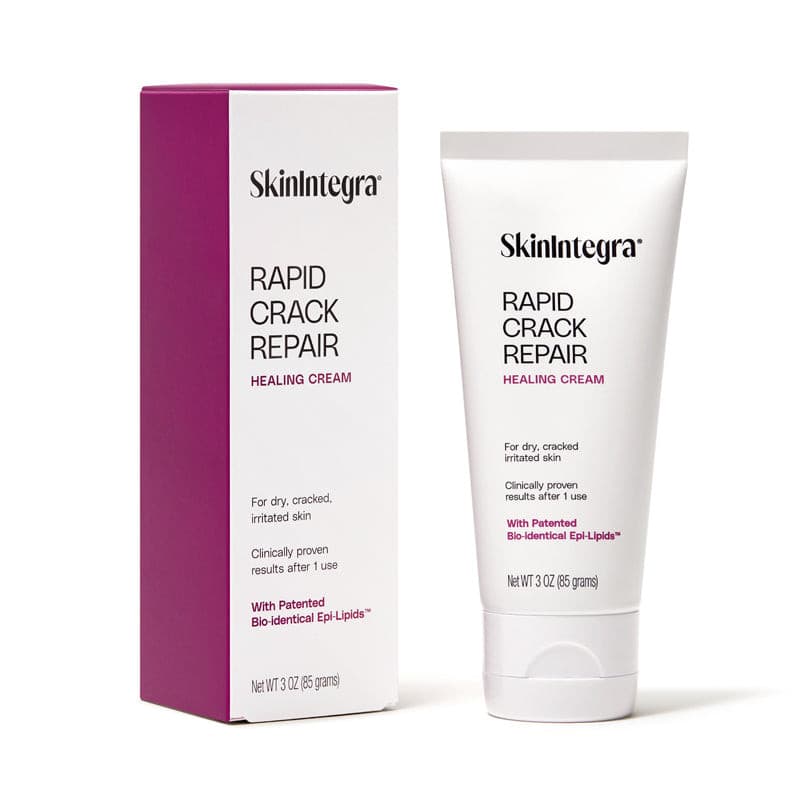
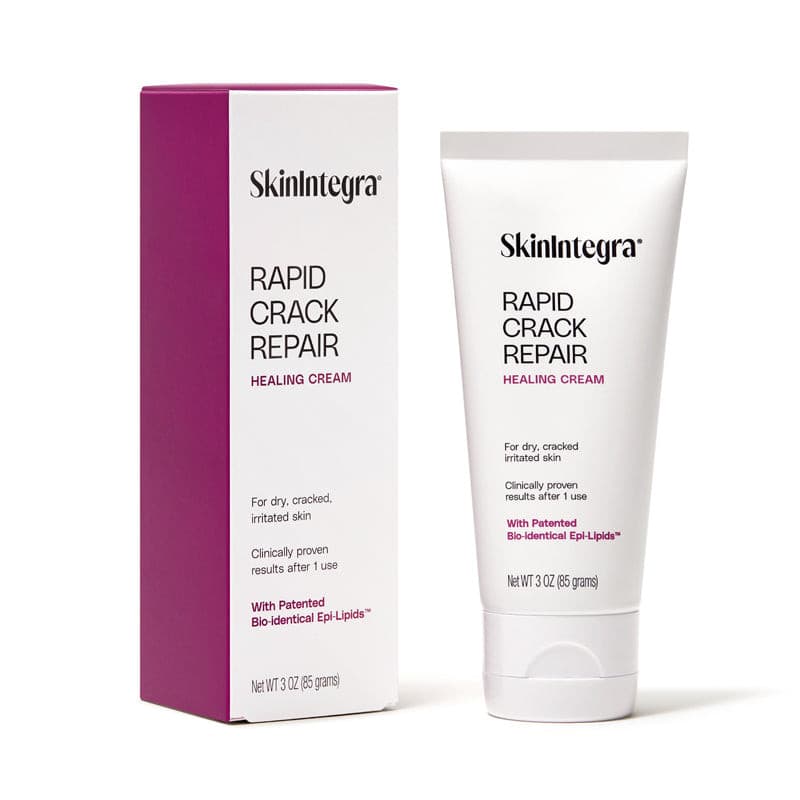
SkinIntegra® Rapid Crack Repair Cream was developed for exactly this gap. It is not a stronger exfoliant. It replenishes what is missing.
At its core is SkinIntegra B.I.O.™ (Bio-Identical Oils) — a patented blend of five plant-derived oils (Sacha Inchi, Sea Buckthorn, Rice Bran, Sesame Seed and Jojoba Seed) matched in balance and composition to the skin's own lipids. We profiled what a healthy skin barrier is made of, then selected oils to match it. That is what SkinIntegra B.I.O.™ does.
It also contains 25% urea with lactic acid — a concentration that softens and loosens hardened skin and is widely used on dry, sensitive and diabetic skin, with the lactic acid adding hydration and gentle exfoliation. Unlike 40% urea, which works aggressively and can leave skin feeling dry, SkinIntegra absorbs quickly and leaves skin feeling immediately moisturized.
That combination is why it suits skin that has thickened and sits under a garment: it works on the buildup chemically rather than by abrasion, and it absorbs rather than sitting greasy under the fabric.
It is formulated without salicylic acid, and is fragrance-free, dye-free, paraben-free, alcohol-free and petrolatum-free.
What the clinical evidence shows
In a head-to-head trial published in the Journal of the American Podiatric Medical Association, 48 adults with deeply cracked feet used either Rapid Crack Repair or a 40% urea cream, twice a day for four weeks.
Rapid Crack Repair did as well as 40% urea — at a lower strength, and well tolerated throughout. Among the 22 adults who used it, 91% showed some improvement within two weeks. By four weeks, podiatrists were seeing less dryness in 82% and less cracking in 73%, and no one had new or worsening redness, burning, stinging or itching.
SkinIntegra Rapid Crack Repair Cream carries the Seal of Approval from the American Podiatric Medical Association (APMA). Medical professionals at major hospitals across the United States also recommend it.
That trial was run on feet, where thickened, cracked skin is most often studied. What it measured is dryness and scaling, which is the problem this page is about.

Work it into the thickened area and the skin around it — the skin that has gone hard is what has to change. Keep it off any skin that is broken, weeping or open, and keep it out of deep folds and from between the toes, where skin stays damp.
It is a skin care cream, not a wound product, and it does not replace anything your lymphedema therapist or doctor has told you to do.
What to Avoid in Any Lymphedema Moisturizer
A short list, and it applies to both:
- Fragrance. The most common cause of irritation on skin that is already stretched and sensitive, and the one worth being strictest about.
- Dyes. No benefit to the skin, and another avoidable source of irritation.
- Alcohol high in the ingredient list. It helps a product feel light and dries skin that cannot afford it.
- Active ingredients your skin does not need. Anything added for a purpose that is not yours is one more thing held against your skin for twelve hours under a garment.
You will also see low or neutral pH recommended, on the basis that it matches the skin's own slight acidity. It appears often enough in lymphedema guidance to be worth knowing about, though most manufacturers do not publish a figure, so it is rarely something you can check on a label.
Why Thickened Skin Matters More Under a Garment
If you wear compression, scale is not only an appearance problem.
A garment works by applying pressure evenly across the limb. Thick scales are rigid, so the garment presses hardest on them, and softer swollen tissue pushes up through the gaps between them. The pressure stops being even. The garment is still on, and it is no longer doing quite what it was fitted to do.
There is a loop here worth naming. The garment contributes to the dryness in the first place — skin under compression dries and scales quickly, which is one reason this problem is so persistent in people doing everything they were asked to do. The treatment that controls the swelling is hard on the skin. That is not an argument against compression, which remains the single most useful thing most people with lymphedema do. It is an argument for taking the skin side seriously rather than treating it as an afterthought.
Deep folds matter for the same reason. As the limb swells around hardened skin, creases deepen, and they trap moisture where it is difficult to dry — which is where infection tends to start.
When to Apply It Around Your Compression Garment
For anyone in compression, when you apply a product matters as much as what is in it.
Night is the simplest option where it fits. Most people are advised to put the garment on first thing and remove it at bedtime, and lymphedema services generally recommend moisturizing at night, after it comes off. The skin has hours to take the product up with nothing over it.
If you moisturize in the morning, absorption is the whole issue. Many people do, because that is when the limb is bare and the routine happens in one go. You do not need to rearrange your day. You need to be more careful about what you use, because anything still sitting on the surface when the garment goes on causes three problems at once.
It makes the garment harder to pull on, over a limb that is already difficult to dress. It can irritate skin that is held against it for hours. And it can damage the garment itself: guidance for people wearing compression is specific that moisturizer should be fully absorbed before a garment goes on, because the ingredients can break down the elastic fibers.
That is worth taking seriously given what garments cost and how often they have to be replaced.
Which brings up the trap. When skin looks thick and damaged, the instinct is to reach for the thickest thing available — the heavy healing ointment, the one that feels most serious. For someone dressing in the morning, that is close to the worst available choice, and not because it is a bad product. An ointment is built to sit on the surface and seal. That is the point of it. So it is still there when you start dressing, and it is exactly the residue that ends up between your skin and the fabric.
What to look for on the label. The ingredients that do the sealing are petrolatum (sometimes listed as petroleum jelly or white soft paraffin), mineral oil, and paraffin wax. Seeing one of them low down an ingredient list is not a problem. Seeing one of them at the top, where ingredients are listed in order of how much is in the product, tells you it is built to sit on the skin rather than sink into it — which makes it a poor choice for the morning and a reasonable one for a night with nothing going on over it. The same reasoning explains why petroleum jelly stops making progress on skin that is dry and hardened: it holds moisture in without putting anything back.
And if you wear compression at night as well, as some people with more advanced swelling are prescribed, there is no uncovered window at all. Then absorption is not a morning problem, it is the only problem, and a product that sinks in quickly stops being a preference and becomes the requirement. It is worth asking your therapist how they want you to fit skin care around a night garment, because they will have a view.
One safety point while we are here: daytime garments are designed to be removed at night unless your specialist has told you otherwise. Night compression is a different, lower-pressure system that is prescribed deliberately. A daytime garment is not a substitute for one.
In practice:
- At night where you can, after the garment is off
- In the morning, choose something that absorbs rather than sits on the surface, and give it time to sink in fully before dressing
- Keep heavy ointments for nights when nothing goes on over them
- If you are applying close to dressing, a cotton liner protects both skin and fabric
- Dry carefully between the toes and inside deep folds, and keep product out of them
One more, easy to miss: paraffin-based products that have not absorbed are a fire risk against fabric. Not a reason to avoid them at night. A reason not to dress over them.
When It Is Not a Skin Care Problem
Some of what shows up on a swollen limb needs a clinician rather than a better product.
The same day, if the limb becomes red, hot, swollen beyond its usual state or painful, or if you feel unwell or feverish. Cellulitis is common in lymphedema and moves quickly. Do not wait to see whether it settles.
Soon, if the skin is broken or leaking fluid through the surface. Products that break down thickened skin do not belong on broken skin, and standard advice is not to wear a compression garment over skin that is fragile, damaged or leaking until a specialist has seen it.
At your next appointment, if the scale is heavy enough that you are not making progress, if the skin is cracking, or if you are unsure which of the two situations above describes your limb. It is also worth knowing that a good share of leg swelling involves the veins as well as the lymphatics, and swelling and itching that comes from poor circulation behaves differently and is managed differently. Someone who can look at it will tell you in a moment what is hard to judge yourself. If the skin is also itching persistently or has started to crack, what itchy, cracked lymphedema skin leads to is worth reading alongside this.
Frequently Asked Questions
Why doesn't moisturizer help my lymphedema legs?
Most likely because the skin has thickened rather than simply dried out. A moisturizer softens the surface, which is all that is needed on ordinary dry skin — but when the outer layer has built into a hard plate, softening the top of it does not remove it. Thickened skin needs gentle removal of loose scale plus something that works on the thickened layer itself, such as urea at a strength high enough to do that job, rather than a product that only adds moisture.
Can I put cream on before my compression stocking?
Yes, as long as it has absorbed fully first. The problem is not the cream, it is the residue: anything still on the surface makes the garment harder to get on, can irritate skin held against it for hours, and can break down the elastic fibers. If you moisturize in the morning, choose something that absorbs rather than sits on top, and leave time before dressing. A cotton liner helps if you are applying close to dressing. Applying at night, after the garment comes off, avoids the question entirely.
Is urea safe to use on lymphedema skin?
Urea is not a harsh or unusual ingredient — your skin produces it itself, as part of what keeps the outer layer holding on to water, and it is among the best-studied ingredients for dry and thickened skin. Lymphedema skin care guidance names it specifically as useful for hydrating skin and lifting away dead scale. What matters is the strength and where you put it: higher strengths work harder and can irritate fragile skin with extended use, and no strength belongs on skin that is broken, weeping or raw. If you are unsure, your lymphedema therapist can tell you what suits your limb.
What strength urea should I use on lymphedema skin?
It depends what you need it to do. Below about 20%, urea mainly draws water into the skin, which suits skin that is dry but not thickened. Between 20% and 25% it also starts breaking down the thickened layer itself, which is the range that acts on built-up skin while staying tolerable for regular use. Above 25% it works more aggressively and can irritate with extended use, so it suits a short course better than a daily habit, and is worth discussing with your therapist or doctor first. No strength belongs on skin that is broken, weeping or raw.
Does thick, scaly skin affect how my compression garment works?
It can. A garment is designed to apply pressure evenly. Thick scales are rigid, so pressure concentrates on them while softer tissue pushes up through the gaps between them. The result is uneven pressure across a limb fitted for even pressure. It is one of the practical reasons for dealing with scale rather than living with it.
What's the difference between a lotion, a cream and an ointment for lymphedema skin?
The useful difference is not richness but whether a product is designed to sink in or to sit on top. A lotion is mostly water, feels light and absorbs quickly, but does less. An ointment is built around sealing ingredients — petrolatum and mineral oil are the usual ones — which form a barrier on the surface rather than being taken up by the skin. That is exactly what makes an ointment useful overnight and impractical under a garment: not being absorbed is the point of it. A cream sits between the two. If you dress in a compression garment during the day, whether a product absorbs matters as much as what is in it.
Is it safe to scrub or file thickened skin off my leg?
No. Skin on a swollen limb is fragile, and any break in it is a route to infection — which in lymphedema can mean cellulitis. Gentle washing with a soft cloth to lift what is already loose is appropriate; scrubbing, filing and abrasive tools are not — the metal foot files sold for hardened skin are a bad idea on any fragile limb. If the thickening is heavy, a lymphedema therapist or podiatrist can remove it safely, which is faster and lower risk than anything you can do yourself.
What kind of soap should I use on a lymphedema limb?
Regular bar soap is harsher than this skin needs, and it strips oils that a swollen limb is already short of. What is usually recommended instead is a gentle, soap-free cleanser — sold as a non-soap wash, a cleansing lotion or a sensitive-skin body wash — used with warm rather than hot water. Fragrance-free is worth insisting on here too, since a wash covers the whole limb. Dry carefully afterward, particularly inside any deep folds and between the toes, because skin left damp in a crease is where problems tend to begin.
How long before I see a difference?
Give it a few weeks rather than a few days, and judge it on the skin rather than on how it feels straight after applying. Thickened skin took months to build and comes down gradually. If there is no change at all after several weeks of consistent care, raise it at your next appointment rather than working through another product.


