


The routine is already in place. Feet washed every night, lotion applied before bed, the same brand used for months because someone recommended it for people with diabetes. Blood sugar is reasonably managed. Water intake up. And still, every morning: skin that feels tight and rough, heels that catch on socks, a dryness the cream touches for a few hours and then gives up on.
You have tried everything. The problem is that the advice — moisturize daily — is not wrong, only incomplete. Diabetic skin does not respond the way other dry skin does, and the reason has nothing to do with how often or how carefully you apply the cream.
Understanding that reason is the first step to getting a different result.

Why Your Feet Stopped Making Their Own Moisture
Not all dry skin works the same way, and the distinction decides what helps.
Ordinary environmental dryness — from cold weather, low humidity, or frequent washing — responds well to moisturizer. The skin's own production capacity is intact. Apply a cream, slow the water loss, and the skin recovers. Moisturizers do exactly what they promise on healthy skin.
Diabetic dry skin runs on a different mechanism entirely.
Here is the part that surprises most people: the soles of your feet have no oil glands. Not one. Everywhere else on the body, oil glands help keep skin supple. The soles do that job with sweat instead, and they carry more sweat glands than any other part of you.
Diabetes damages the nerves that tell those glands to work. They do not switch off all at once — output falls gradually, often long before you would notice anything. Doctors call it hypohidrosis while sweating is only reduced, and anhidrosis once it has stopped altogether. Most people with diabetic nerve damage sit somewhere in between, and you cannot tell where by looking. In one community study reported in The Diabetic Foot Journal, only about a quarter of people with diabetes had normal sweating on the feet, most of the rest had partial loss, and the researcher's own eye did not match what the test found.
So this dryness does not come from outside. It comes from within, and that is why the cream keeps letting you down. Adding moisture to the surface does not restore a supply that has fallen away underneath. The moment the cream absorbs, the shortfall sits exactly where it was.
And sweat is not only water. It carries the natural moisturizing compounds that let the outer layer of skin hold onto water and stay pliable. So as the sweat falls away, your feet lose the water and the compounds that would have held it there, together. High blood sugar adds to it: skin tends to measure drier in people whose glucose runs higher. The result is skin that turns brittle and inelastic, and cracks under the everyday pressure of walking.
For a fuller explanation of how nerve damage drives this, see our guide on how neuropathy affects the skin and why diabetic feet crack.
Why Standard Moisturizers — and Even Urea Creams — Fall Short Here
Once you understand the mechanism, the limits of standard products become obvious. Those limits apply not just to ordinary lotion, but to the urea-based foot creams marketed specifically for people with diabetes.
Standard moisturizers

A standard moisturizer adds water to the outermost skin layer and slows its evaporation with an occlusive ingredient — glycerin, petrolatum, shea butter and similar compounds. On skin that is still sweating normally this does well enough, because the skin keeps topping up its own supply between applications. Feet that have largely stopped sweating cannot do that. The moisturizer does its temporary work on the surface while the real shortfall goes untouched. Come morning, it can feel as though nothing was applied at all.
Urea creams
Urea creams go further, and diabetic foot care guidelines have long included them for good reason. Urea at 10–25% acts both as a humectant, drawing water into the skin, and as a softening agent that loosens thickened, callused skin. It also replenishes some of what the sweat is no longer delivering. For managing callus build-up and surface texture, urea creams genuinely deliver. Where the concentration stops helping and starts stripping is a separate question, and we go through it in is 40% urea too strong for diabetic skin.
But urea creams work at the outermost layer. They soften what is already there. What they do not do is supply lipids. The spaces between your skin cells are filled by lipids the cells make for themselves as they mature and travel up to the surface — a separate job from softening. Urea does not replenish that. You can soften the surface with a urea cream and still leave the barrier short of what holds it together. The improvement is real. It is just partial, and the dryness cycle continues.
For why that cycle keeps producing the same cracks in the same places, see our article on why dryness and cracking recur.
This is precisely what makes diabetic dry skin so frustrating to manage. The recommended product does its job. It just does not do the whole job.
For a deeper explanation of how the skin barrier works and why keeping it intact matters here, see our article on why skin barrier repair matters for diabetic feet.
What Your Skin Is Actually Short Of
The outer layer of your skin works like a brick wall. The cells are the bricks, each holding water. Between them sits a mortar your skin makes out of lipids. Lose either and the wall goes stiff, and stiff skin splits under pressure.
Water only stays if something holds it, and the mortar is what does that. On skin that is already dry and cracking, added water leaves about as fast as it arrives.
Moisturizers add water to the surface. Urea creams soften the hardened layer. Both help — but neither replenishes the lipids the barrier is short of, and the wall needs water and mortar together, so the skin tightens again overnight and the dryness returns.
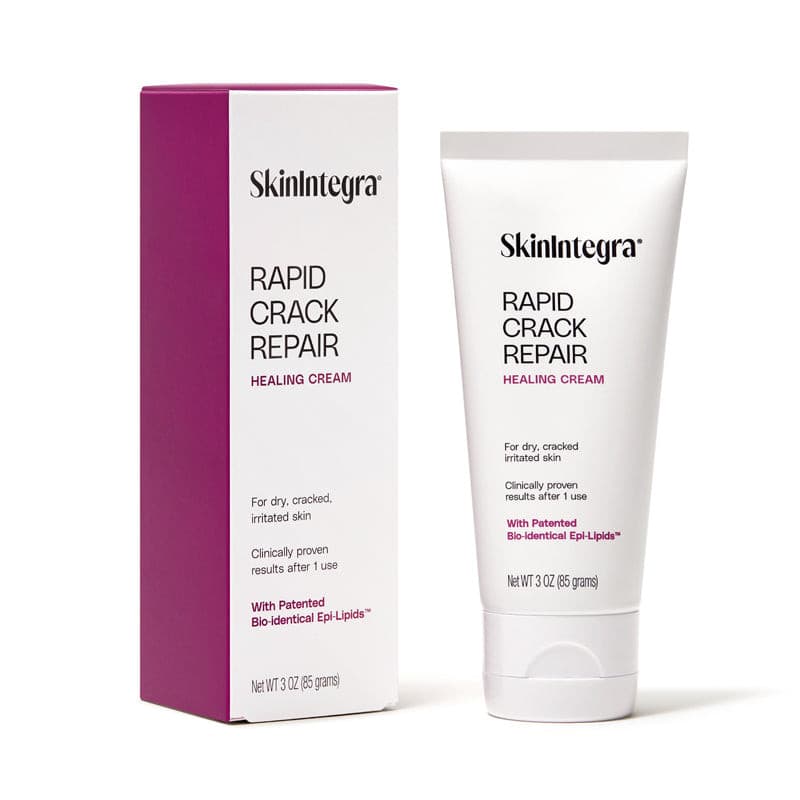
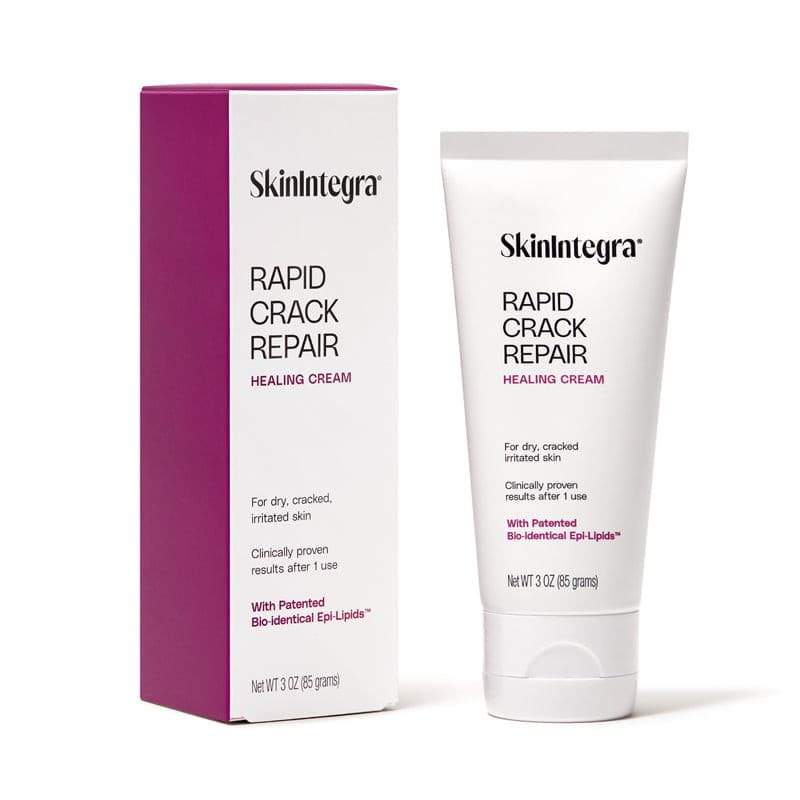
SkinIntegra Rapid Crack Repair Cream was developed for exactly this gap. It is not a stronger exfoliant. It replenishes what is missing.
At its core is SkinIntegra B.I.O.™ (Bio-Identical Oils) — a patented blend of five plant-derived oils (Sacha Inchi, Sea Buckthorn, Rice Bran, Sesame Seed and Jojoba Seed) matched in balance and composition to the skin's own lipids. We profiled what a healthy skin barrier is made of, then selected oils to match it. That is what SkinIntegra B.I.O.™ does.
It also contains 25% urea with lactic acid — a concentration that softens and loosens hardened skin and is widely used on dry, sensitive and diabetic skin, with the lactic acid adding hydration and gentle exfoliation. Unlike 40% urea, which works aggressively and can leave skin feeling dry, SkinIntegra absorbs quickly and leaves skin feeling immediately moisturized.
It is formulated without salicylic acid, and is fragrance-free, paraben-free, alcohol-free, petrolatum-free and dye-free.
What the clinical evidence shows
In a head-to-head trial published in the Journal of the American Podiatric Medical Association, 48 adults with deeply cracked feet used either Rapid Crack Repair or a 40% urea cream, twice a day for four weeks.
Rapid Crack Repair did as well as 40% urea — at a lower strength, and well tolerated throughout. Among the 22 adults who used it, 91% showed some improvement within two weeks. By four weeks, podiatrists were seeing less dryness in 82% and less cracking in 73%, and no one had new or worsening redness, burning, stinging or itching.
SkinIntegra Rapid Crack Repair Cream carries the Seal of Approval from the American Podiatric Medical Association (APMA). Medical professionals at major hospitals across the United States also recommend it.
For skin that stays dry and cracked, or that looks better for a few days and then looks the same again, the missing piece is usually not more moisture. It is replenishing what the barrier is short of.

How to Use It, and Why Consistency Is the Whole Game
Because the oils match the skin's own lipid profile and are used in whole plant form, the cream absorbs quickly — no greasy residue, no heavy texture. The routine matters more than the amount.
- Twice a day, on slightly damp skin. After washing is ideal — our guide to cleaning diabetic feet safely covers that half of the routine. Creams absorb far better when the skin is damp than when it is dry and hardened.
- A generous layer at night. Overnight is when the skin is least disturbed, and socks over the cream hold it against the skin.
- Every day, not only on bad days. Barrier care is cumulative. Applying it only when the skin feels particularly rough is what keeps people on the same cycle.
- Not between the toes. Excess moisture in that area raises the risk of fungal infection.
The shift worth aiming for is from adding moisture each morning to maintaining a barrier that holds its condition between applications. That takes steady daily use rather than a burst of effort — and because the cause of the dryness is ongoing, so is the care. You are managing a tendency, not finishing a course.
When to See a Podiatrist or Foot Care Nurse
Daily home care is the right foundation, and for most people with diabetic dry feet it keeps the skin in a stable, protected state. Some situations need professional eyes rather than continued home management.
See a podiatrist or foot care nurse if:
- A crack on your foot is not improving with consistent daily care
- You notice redness, warmth or swelling around a crack — even mild. On diabetic skin these can signal infection in a setting where the usual inflammatory warning signs are already muted
- The skin is peeling, breaking open, or showing white, darkened or discolored areas
- Your feet have reduced sensation, feel numb, or have areas you cannot feel clearly — loss of protective sensation means checking your own feet may no longer catch problems early enough
- You have not had a foot examination in the past 12 months. Annual screening, including the 10-gram monofilament test for loss of protective sensation, is a standard of care for adults with diabetes, regardless of symptoms
People with diabetes need a lower threshold for seeking care than the general population. The absence of pain is not reassurance — in a neuropathic foot it is sometimes the problem. Dry skin that gets attention early rarely becomes a wound care situation. The goal of daily skin care is to stay on the right side of that line.
For guidance on professional foot care options, see our article on safe pedicure options and professional care for diabetic feet, and on what safe callus care looks like at home.
Frequently Asked Questions
Why do my feet stay dry even though I moisturize every day?
Because standard moisturizers work on surface water, not on the underlying cause. Your soles have no oil glands — sweat was always the supply there — and autonomic neuropathy, a form of nerve damage that diabetes causes, turns that supply down. Sweat carries more than water, so the skin loses both the moisture and what holds it, and no topical moisturizer restores a supply that has fallen away underneath. A formula that replenishes the lipids holding the barrier together, matched to the composition of a healthy skin barrier, alongside urea and lactic acid, covers the part ordinary creams leave untouched.
What does diabetes do to the skin that makes it so hard to keep hydrated?
Two shortfalls working together. First, autonomic neuropathy turns down the nerve signal to the sweat glands, so the feet's own moisture supply falls — hypohidrosis where it is reduced, anhidrosis where it has stopped altogether, with most people somewhere between the two. Since the soles carry no oil glands, sweat is the only supply there is. Second, sweat delivers more than water, so what the skin loses is not only moisture but what lets it hold moisture. Together they leave diabetic skin drying from the inside while the barrier that slows water loss from the outside is short of what holds it together.
Is dry skin on diabetic feet serious, or just uncomfortable?
It starts as uncomfortable. Left unmanaged it progresses to deep cracking, and a deep crack in diabetic skin is an open break in the body's outer barrier. Because peripheral neuropathy can blunt pain signals, a crack can deepen a long way before you feel it or notice it. Consistent daily care is what keeps a manageable skin condition from becoming a wound care situation.
What kind of cream helps most with diabetic dry feet?
One that helps with both shortfalls: the lipids that hold the barrier together, and what sweat is no longer delivering. A standard moisturizer handles only the surface. A urea cream goes further but supplies no lipids. A formula that does both — plant oils matched to a healthy skin barrier's lipid profile alongside 25% urea and lactic acid — covers both layers of the problem. SkinIntegra Rapid Crack Repair Cream was developed to do exactly that, and is the formula referenced throughout this article.
How long does it take for diabetic dry skin to improve?
The surface usually feels different before it looks different — skin that is less tight after washing is the first thing most people notice. Thickened, callused skin takes several weeks longer, and that is the part that decides whether the cracking returns. Because the cause of the dryness does not go away, the care does not stop either; the aim is skin that holds its condition between applications rather than returning to baseline each morning.


