


When a Small Crack Becomes a Serious Problem
For most people, a small crack on the heel is an inconvenience. For someone with diabetes, it is something else: an opening that bacteria can enter before any pain signal tells you something is wrong.
This is not a worst-case scenario. It is a well-documented pathway. Diabetes damages the nerves that carry sensation from the feet — peripheral neuropathy — so breaks in the skin often go unnoticed. At the same time, high blood sugar slows the immune response, so bacteria that enter through a crack can establish an infection faster than the body contains it.
The chain is short and serious: cracked skin, bacteria entering, infection, deeper tissue involvement, ulceration. The American Podiatric Medical Association includes daily washing and inspection in its diabetic foot care guidance — see APMA diabetic foot care guidance.
This article explains why cleansing matters more for diabetic skin than for healthy skin, what makes a cleanser suitable or unsuitable for this group, and what a sensible daily routine looks like.
What Is Actually Happening Inside the Skin
Understanding why diabetic skin cracks the way it does changes how you approach caring for it.
Healthy skin stays supple partly because it sweats. Sweat carries natural moisturizing compounds to the skin's outer layer, keeping it flexible. Diabetes disrupts that through a specific kind of nerve damage — autonomic neuropathy — which impairs the sweat glands in the feet. The result is skin that runs dry from the inside, regardless of how much water you drink or what you apply on top. For a fuller explanation, see our article on why diabetes causes skin to dry and crack from the inside.
As the outer layer loses moisture and flexibility, it turns brittle. At pressure points — the heel, the ball of the foot, the sides of the big toe — tiny cracks open up. They are often invisible to the naked eye in their early stages. They are not invisible to bacteria and fungi. Organisms that intact skin would hold at the surface now have a path inward.
Three problems converge here:
- Cracked skin provides the physical entry point.
- Reduced sensation means you may not feel the crack forming, deepening, or becoming infected.
- Impaired immune response means an infection can progress further before the body's defenses catch up.
That is the case for treating daily cleansing as a considered step rather than an afterthought.
Choosing the Right Cleanser for Diabetic Feet
Washing with a mild, fragrance-free soap and lukewarm water is a sound foundation for daily foot hygiene, and many podiatrists recommend exactly that. The key word is mild. Heavily fragranced soaps, antibacterial soaps with harsh additives, and hot water all strip the skin's own lipids and irritate skin that is already sensitive. If you use a gentle, unscented soap and dry your feet thoroughly afterward, you have the foundation right.
Some podiatrists add a hypochlorous acid (HOCl) spray as a second step. The two do different things. Soap cleans by removing — it lifts oils, debris and surface organisms away, then rinses off. An HOCl spray is applied to clean, dry skin and left to air dry, including on the areas a quick wash reaches least well, such as between the toes. It contains no alcohol, does not sting, and needs no rinsing, which matters on skin that is already fragile. Alcohol-based sanitizers are a different matter and are best avoided on diabetic feet: they are too drying for this skin.
Order matters. Wash with mild soap first, then rinse thoroughly — soap residue left on the skin can interfere with an HOCl spray. Dry carefully, especially between the toes, then apply the spray and let it air dry before your barrier cream goes on. Wash, rinse, dry, spray, moisturize.
One habit worth addressing directly: foot soaking. Soaking — in plain water, Epsom salts, or anything else — is a common practice many people assume helps diabetic feet. Podiatrists generally advise against it. Prolonged exposure to water softens and weakens the skin, leaving it more prone to cracking once it dries out. For anyone with reduced foot sensation there is also a real risk of burns from water warmer than it feels. A quick wash, dried thoroughly, is generally enough, and without those downsides. For the full explanation, see our article on Epsom salt foot soaks and diabetes.
What Hypochlorous Acid Is

Hypochlorous acid is not an exotic ingredient. Your own body makes it: it is one of the compounds white blood cells produce when they encounter bacteria. That is why it turns up in clinical settings rather than only in consumer products.
The wound care literature describes HOCl as active against bacteria and fungi at concentrations that skin tissue tolerates well — and it is that combination, rather than potency alone, that explains why wound care clinicians use it on fragile tissue. A 2025 review in the Journal of Integrative Dermatology covers its dermatologic applications, and the World Health Organization reviewed it for the Essential Medicines List the same year.
Formulated as a dilute topical spray, it breaks down into salt and water rather than leaving a residue behind. It does not sting and does not need rinsing off — practical advantages for anyone with neuropathy who finds extended bathing routines difficult or cannot reliably judge water temperature.
What it is not is a treatment. HOCl belongs to the hygiene half of foot care. It does nothing about why the skin is cracking in the first place.
The Two-Step Daily Routine: Cleanse, Then Care for the Skin
Cleansing helps with what sits on the skin. It does not do anything for the condition of the skin itself, which is what opened the cracks that made cleansing matter so much in the first place.
Each step helps with something the other does not. Cleansing on its own leaves the skin just as brittle at the next exposure. Barrier care on its own goes onto a surface you have not washed. Used together, they cover more ground than either does alone.
The second step — what you actually put on the skin — is where most routines stop short. More on that in why skin barrier repair is the missing step in diabetic foot care, and on why diabetic feet stay dry no matter what you put on them.
The outer layer of your skin works like a brick wall. The cells are the bricks, each holding water. Between them sits a mortar your skin makes out of lipids. Lose either and the wall goes stiff, and stiff skin splits under pressure.
Water only stays if something holds it, and the mortar is what does that. On skin that is already dry and cracking, added water leaves about as fast as it arrives.
Moisturizers add water to the surface. Urea creams soften the hardened layer. Both help — but neither replenishes the lipids the barrier is short of, and the wall needs water and mortar together, so the skin tightens again and the cracking returns.
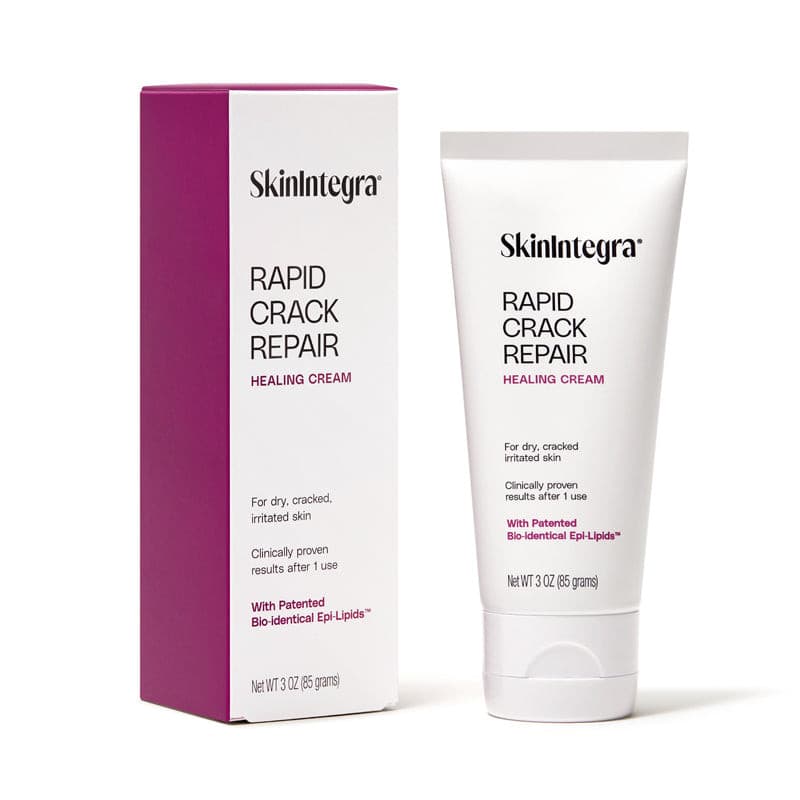
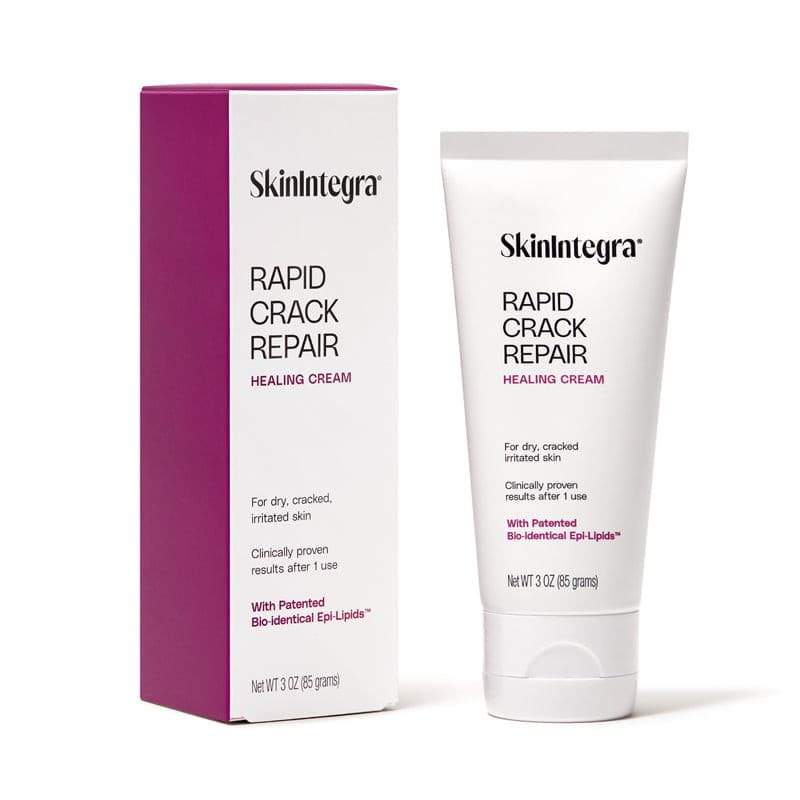
SkinIntegra Rapid Crack Repair Cream was developed for exactly this gap. It is not a stronger exfoliant. It replenishes what is missing.
At its core is SkinIntegra B.I.O.™ (Bio-Identical Oils) — a patented blend of five plant-derived oils (Sacha Inchi, Sea Buckthorn, Rice Bran, Sesame Seed and Jojoba Seed) matched in balance and composition to the skin's own lipids. We profiled what a healthy skin barrier is made of, then selected oils to match it. That is what SkinIntegra B.I.O.™ does.
It also contains 25% urea with lactic acid — a concentration that softens and loosens hardened skin and is widely used on dry, sensitive and diabetic skin, with the lactic acid adding hydration and gentle exfoliation. Unlike 40% urea, which works aggressively and can leave skin feeling dry, SkinIntegra absorbs quickly and leaves skin feeling immediately moisturized.
It is formulated without salicylic acid, and is fragrance-free, paraben-free, alcohol-free, petrolatum-free and dye-free.
What the clinical evidence shows
In a head-to-head trial published in the Journal of the American Podiatric Medical Association, 48 adults with deeply cracked feet used either Rapid Crack Repair or a 40% urea cream, twice a day for four weeks.
Rapid Crack Repair did as well as 40% urea — at a lower strength, and well tolerated throughout. Among the 22 adults who used it, 91% showed some improvement within two weeks. By four weeks, podiatrists were seeing less dryness in 82% and less cracking in 73%, and no one had new or worsening redness, burning, stinging or itching.
SkinIntegra Rapid Crack Repair Cream carries the Seal of Approval from the American Podiatric Medical Association (APMA). Medical professionals at major hospitals across the United States also recommend it.
For skin that stays dry and cracked, or that looks better for a few days and then looks the same again, the missing piece is usually not more moisture. It is replenishing what the barrier is short of.

Apply morning and evening, on skin that is still slightly damp. Barrier care is cumulative, and steady daily use tends to help more than occasional use does. Avoid applying between the toes, where trapped moisture invites fungal infection.
What to Look for in a Hypochlorous Acid Foot Spray
HOCl products are not all formulated the same way. When choosing one for daily foot hygiene, look for:
- A concentration in the 0.01–0.03% range. This is the range used on skin in wound care research.
- A formulation intended for skin. HOCl is also sold for surface disinfection. Skin formulations are pH-balanced and free of added alcohol or harsh preservatives.
- No rinsing required. A spray that air-dries is the most practical format for feet, particularly with limited mobility or reduced sensation.
- A simple ingredient list. Fewer additives means less to irritate skin that is already compromised.
- Directions you follow on frequency. Once or twice daily is the usual guidance for routine foot hygiene. Using it more often than directed, over a long period, leaves some people with mild dryness or irritation. Avoid inhaling the mist.
One podiatrist-developed option formulated for daily foot hygiene is Lighthouse Daily Defense Spray, made for use as part of a regular diabetic foot care routine.

When to See Your Podiatrist
Daily home care is the foundation, and some situations need professional evaluation instead. Contact a podiatrist if you notice:
- Any crack, sore or break in the skin that is not clearly improving after a few days of consistent care — do not wait it out
- Redness, warmth or swelling spreading from a break in the skin — signs of infection, which should not be managed at home
- Any wound with discharge, or a sore that looks darker, deeper or larger than it did yesterday
- Numbness or reduced sensation that has changed recently — worsening neuropathy raises the threshold for what you can reliably detect yourself
For anyone with diabetes the rule of thumb is simple: if you are uncertain, see your podiatrist. The consequences of a missed infection are out of all proportion to the inconvenience of an unnecessary visit. For more on identifying when cracked skin needs more than home care, see when a cracked heel needs more than a moisturizer.
Frequently Asked Questions
Is hypochlorous acid suitable for people with diabetes?
For most people, yes. HOCl is a compound the body already produces — white blood cells make it when they encounter bacteria. As a dilute topical spray it contains no alcohol, fragrance or harsh preservatives, does not sting, and does not dry the skin, which is why wound care clinicians use it on fragile tissue. If you are managing an active foot problem, or you are unsure how it fits alongside anything your clinician has prescribed, ask your podiatrist before adding it.
Can I use regular soap to clean diabetic feet?
Yes. A mild, fragrance-free soap with lukewarm water is a sound foundation, and many podiatrists recommend exactly that. Avoid heavily fragranced soaps, antibacterial soaps with harsh additives, and hot water. An HOCl spray is a step some podiatrists add afterward, on clean dry skin and left to air dry, including on the areas a wash reaches least well. Alcohol-based sanitizers are best avoided on diabetic feet — they are too drying for skin that is already fragile.
When should I not use hypochlorous acid?
HOCl is a hygiene step, not care for an established infection or a deep wound. Those need medical evaluation and may need prescription treatment. If a break in the skin shows signs of infection — spreading redness, warmth, discharge or fever — stop home care and see a podiatrist or your doctor promptly.
Should I cleanse before or after moisturizing?
Cleanse first. Apply the spray to clean, dry skin and let it air dry, then apply the barrier cream while the skin is still slightly damp — creams absorb far better when the skin is damp than when it is dry and hardened. Moisturizing before cleansing puts the cream over a surface you have not washed.
How often should I clean diabetic feet?
Once or twice daily covers routine foot hygiene. A morning routine prepares the skin before shoes and socks create the warm, enclosed conditions that bacteria and fungi favor. An evening routine, after washing and drying, puts the barrier step in place overnight, when the feet are out of shoes and undisturbed.
Does cleansing alone keep diabetic feet healthy?
No, and that is the point worth taking away. Cleansing helps with what is on the skin. It leaves the reason the skin cracks exactly where it was — the barrier running short of the lipids that hold it together, and of what sweat used to supply. Daily inspection, well-fitted shoes, blood sugar management and barrier care all sit alongside it, and an annual foot examination sits above all of them.


