


You shake out your shoe and nothing falls out. You do it again anyway, because there is obviously something in there — a small hard ridge under the ball of your foot that you feel with every step, the way you would feel a pebble that had worked its way under the insole.
Then you sit down and look. No pebble. What you find instead is a pale, thickened patch of skin over the ball of your foot, and running through it, a line. A split. It may be fine enough that you only see it when you flex your toes back, or wide enough to show pink underneath.
That split is not a dry-skin problem in an awkward place. It is a break in your skin barrier. It sits on the part of your foot that carries the most load, and if your feet heal slowly, it needs a different response than a cracked heel does.
Why the ball of the foot splits differently from the heel
Most advice about cracked skin on feet is written about heels, and the mechanics are not the same.
A heel splits because of what happens underneath it. The fat pad beneath your heel bone spreads sideways as your weight lands on it, and the thickened skin around the rim of that pad has to stretch with it. When that skin has become too hard to stretch, it tears at the edge — which is why heel fissures tend to form a ring around the rim.
The ball of your foot works differently. The weight there sits on the heads of the long bones behind your toes, and it does not simply press straight down. As you push off, your foot rolls forward and your toes bend upward while your body weight is still driving through those bones. The skin in between is squeezed from above and dragged forward at the same time.
Compression alone rarely tears skin. Compression plus that forward drag is what does it. So forefoot splits usually run across the pad rather than around it, often following the crease where your toes bend, and they open a little wider with every step you take.
This also changes what actually helps. A heel needs a closed-back shoe and cushioning under the heel. The ball of the foot needs pressure moved off those bones — a roomier toe box, a stiffer or rocker sole that reduces how far the foot has to bend at push-off, and a metatarsal pad placed behind the pressure point rather than on it. Cushioning alone does not solve a shear problem.
Reducing the load matters, and it is not the whole answer. In a 2009 study published in the Journal of the American Podiatric Medical Association, Scirè and colleagues reported that callus returned in 84% of patients with diabetes after treatment, and in 41% even among patients wearing therapeutic footwear. Fixing the shoes changes the forces. It does not restore skin that has lost its flexibility — and inflexible skin is what splits.
If the same split keeps returning to the same spot, the reason it does is worth understanding separately: why a crack keeps coming back to the same place. And if hardened skin is a recurring feature of your feet rather than a one-off, start with managing calluses when you have diabetes.
What a split in a callus actually is
The thickened skin itself has a name — hyperkeratosis, meaning an overgrowth of the outermost layer of the skin barrier. It is not a defect. Your body builds it deliberately, in the places that take repeated pressure, exactly as a hand builds a callus on a tool handle.
The problem is that this layer has no flexibility and no blood supply. When it splits, the crack does not stop at the surface. It runs down through the full thickness of the hardened layer and breaches the barrier beneath it. At that point you have an open route through your body's outer defense, on the underside of a foot, in a place you cannot easily see.
Why it hurts — and why the pain matters more than the discomfort
Here is the part almost every page about painful calluses gets wrong.
The callus itself cannot hurt. It is dead keratin with no nerve endings in it. When a callus hurts, the pain comes from the tissue beneath the barrier — which means the hardened plate has stopped acting as padding and started acting as a pressure point, driving force down into the tissue below, which can feel it. That is what produces the sensation of standing on a stone.
For most people this registers as a nuisance. If you have diabetes or any degree of neuropathy, it is something else entirely.
Reduced sensation in the feet means your warning system has been turned down. You may not feel a shoe rubbing, a seam pressing, or a callus building past the point of usefulness. So when something on that foot does break through and hurt, the signal has had to be strong enough to get past the damping — and that is worth acting on rather than tolerating. A foot you cannot fully feel is a foot you cannot fully protect.
The same logic runs the other way, and it is the more dangerous half. A split that does not hurt is not therefore minor. On a neuropathic foot, the absence of pain tells you about your nerves, not about your skin.
What actually helps a split in thickened skin

A split on a weight-bearing pad is pulled open and pressed closed several thousand times a day. Nothing closes it while that continues unless the skin around it becomes able to move again. So the job is not to seal the crack. The job is to restore flexibility to the hardened skin on either side of it, and that takes two things at once.
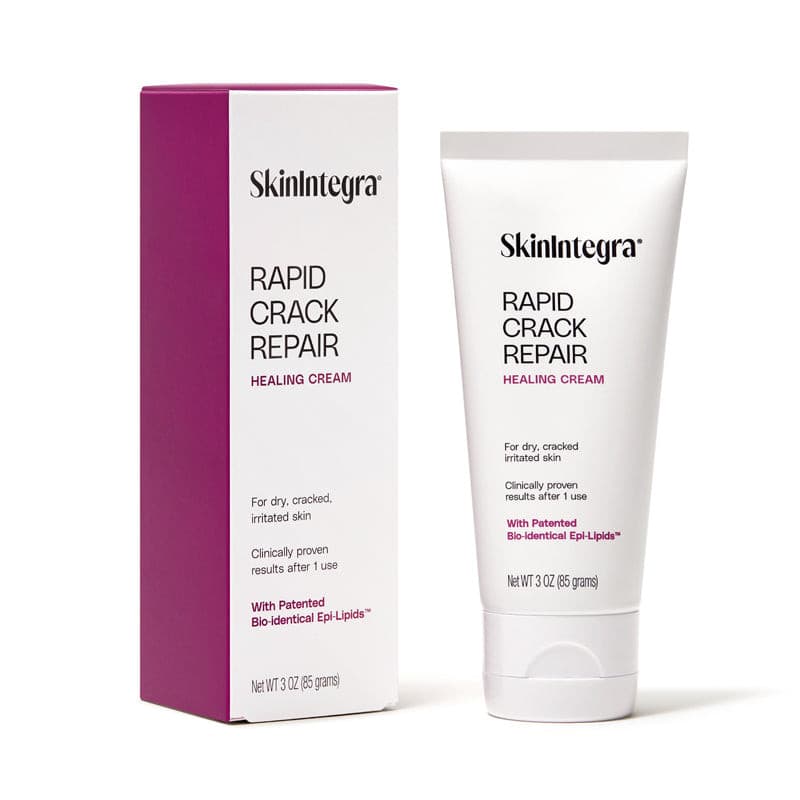
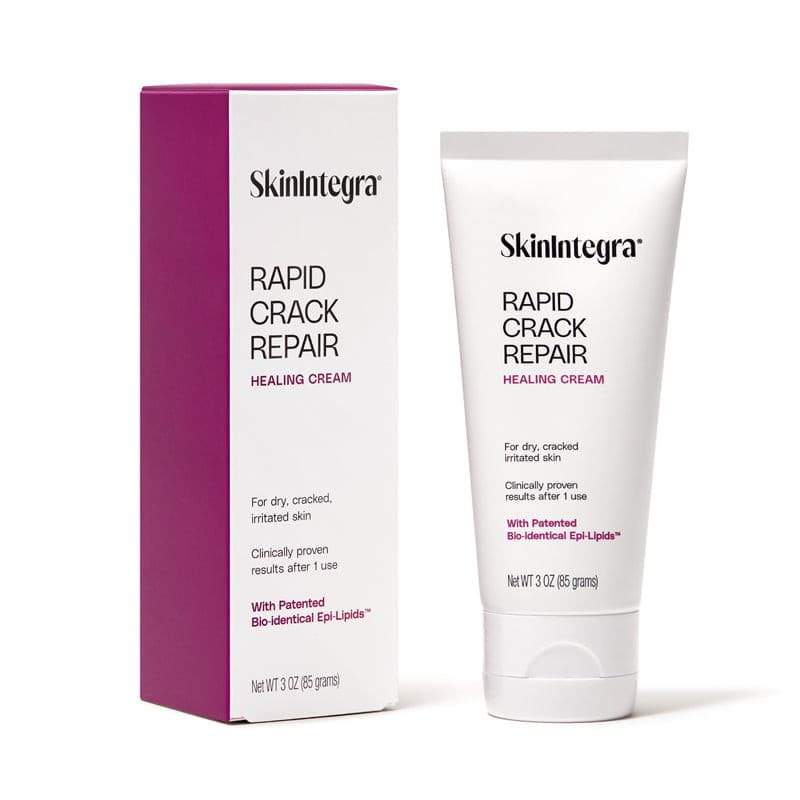
SkinIntegra® Rapid Crack Repair Cream was built for this presentation. Its foundation is Bio Identical Oils™ — a patented blend of five whole plant oils, including Sacha Inchi and Sea Buckthorn, chosen because their composition matches the lipids that healthy skin makes for itself. Skin that has lost its own lipids cannot hold water, cannot flex, and cannot stop thickening. Replacing what is missing addresses the deficiency rather than covering it.
The second half gets those oils where they are needed. The cream carries 25% urea with lactic acid. At that concentration urea works as a keratolytic — an ingredient that exfoliates chemically rather than by abrasion, loosening the bonds holding hardened skin together so the layer thins gradually. That matters on a fissured pad, because it means the hard plate softens without anything being scraped, filed or cut away from a foot that may not feel it.
In an independent clinical study, Rapid Crack Repair delivered significantly faster improvement in dryness and cracking than high-strength Urea-40, assessed by blinded podiatrist investigators at two and four weeks, with less irritation. In a separate clinical trial conducted exclusively with people with diabetes, 100% of participants showed measurable skin improvement within 24 hours.
The cream is fragrance-free, paraben-free, alcohol-free, petrolatum-free and hypoallergenic, and it carries the APMA Seal of Approval from the American Podiatric Medical Association.
Apply it twice a day to damp skin, and work it into the hardened area around the split rather than only into the split itself. The skin on either side is what has to change. More on why barrier repair is the part that lasts.
When the callus has gone dark
Stop and look at the color before you treat anything.
If there is a brown, red or black mark inside the thickened skin — a stain, a bruise, a dark spot that was not there before — that is not the callus changing color. It is blood, trapped between the layers, because sustained pressure has burst small vessels in the tissue underneath. Clinicians treat it as a warning sign rather than a cosmetic change, because the same pressure that caused the bleeding is often in the process of breaking the tissue down.
This has a clinical name — subkeratotic hemorrhage, bleeding trapped beneath the hardened layer — and foot care teams treat it as one of the earliest visible signs that a wound may be forming underneath, where nothing shows on the surface.
The honest answer for this one is not a cream. If you see dark discoloration inside a callus, or a stain on your sock with no obvious cut, call your podiatrist or your diabetes team now rather than at your next appointment. There may be a wound developing underneath the hard skin, where you cannot see it and — if sensation is reduced — cannot feel it either. A clinician can pare the callus back safely and look.
The same applies to any split that is bleeding, weeping or draining. An open break in the skin on a diabetic foot is a reason to be seen, not a reason to wait and watch.
Please don't glue it shut
This comes up constantly, and it is worth taking seriously rather than dismissing — because the instinct behind it is sound.
Surgical skin adhesives are real. Clinicians use cyanoacrylate-based products to close wounds every day, and anyone who has had a cut glued rather than stitched has seen it work. So reaching for the superglue in the kitchen drawer, or a liquid bandage from the pharmacy, is not a stupid idea. It is the right idea with the wrong materials, in the wrong place, on the wrong foot.
Five things go wrong.
The crack is not clean. Surgical adhesive goes onto a wound that has been cleaned, with edges a clinician has brought together. A split on the ball of your foot has been walked on, inside a sock, inside a shoe. Sealing it shuts whatever is in there inside.
It bonds the surface over a crack that is still open underneath. The fissure runs down through the full thickness of the hardened layer. Glue bridges the top of it. The part that matters is now hidden.
Household superglue is not the product a clinician uses. Surgical adhesives are a different cyanoacrylate formulation, made and sterilized for contact with broken skin. The tube in the kitchen drawer was designed to bond materials to each other. Nothing about it was made to sit on a wound.
It irritates, it is toxic to tissue, and it burns as it hardens. Consumer cyanoacrylate causes significant skin irritation and is toxic to the tissue it touches. It also releases intense heat as it cures — which on skin that is already broken is a burn risk, and on a foot with reduced sensation is a burn you may not feel coming.
It is rigid, and the ball of your foot is not. That pad flexes with every step. A hard cap cannot flex with it, so it works loose at the edges — taking skin with it, or leaving a new stiff rim right beside the original crack for the next split to start from.
And the reason this matters more for you than for someone else: under a sealed cap, on a foot with reduced sensation, an infection can establish itself without pain and without anything visible on the surface. You lose the two signals you would otherwise rely on.
Liquid bandage and liquid skin products have the same problem in a milder form, and the over-the-counter liquid callus removers sold beside them are a separate hazard covered below.
There is a broader point hiding in this. Sealing the surface is what every heavy ointment does in gentler form — it holds moisture in and leaves the hardened skin exactly as hard as it was. That is why petroleum jelly tends to plateau on cracked feet. Glue is the extreme version of the same mistake.
What else not to put on a split callus
The American Podiatric Medical Association is direct about this. Its guidance on corns and calluses warns that over-the-counter treatments can do more harm than good, especially if you have a condition such as diabetes, because some contain harsh chemicals that can cause burns or even foot ulcers. That covers medicated corn plasters, liquid callus removers and anything sold to dissolve hard skin at home.
Two additions for skin that has already split:
Salicylic acid. The active ingredient in most medicated pads and removers works by destroying tissue, and it does not distinguish between hardened skin and the healthy skin around a fissure — see why salicylic acid is the wrong tool on at-risk skin.
Very high-strength urea. Urea at 40% suits a thick, intact callus. Applied to a pad that has already split, it acts on tissue that is thinner than it looks — see when 40% urea works and when it does not.
Tools are the same problem by a different route. Files, pumice stones and callus shavers all work by abrasion, and on a foot with reduced sensation the line between smoothing hardened skin and damaging the barrier underneath is one you cannot judge without feeling it — so leave the tools alone and let a keratolytic cream thin the layer gradually instead.
When to stop treating it yourself
If you have diabetes, neuropathy or poor circulation, do not put this on a two-week clock. An open split on your foot is a reason to call now, not something to watch and reassess — reduced sensation and slower healing change what a few days cost you. Cracks that bleed raise the stakes further.
For anyone, contact your podiatrist, primary care doctor, or diabetes team if you find any of these:
- Dark discoloration or dried blood inside the callus
- A split that is bleeding, weeping or draining, or a stain on your sock you cannot account for
- Redness spreading outward from the split, or warmth or swelling in one foot and not the other
- Any odor
- A callus thick enough that you cannot see the base of the split
- On an otherwise healthy foot, no improvement after two weeks of consistent daily care
That second-to-last one is not a failure on your part. A podiatrist can pare the hardened tissue back safely with a blade, in minutes, and inspect what is underneath — and if the callus is thick or the foot is high-risk, that is the thing to ask for rather than something to avoid.
Frequently asked questions
What should I do if my callus splits open?
Wash the area gently with mild soap and water, dry it carefully, and cover it with a clean dressing if it is open. Then start treating the hardened skin around it twice daily so it regains some flexibility. Do not cut it, file it or seal it. If it is bleeding, discolored, or you have diabetes or reduced sensation, call your provider rather than managing it alone.
Why does the ball of my foot keep splitting?
Because two things are producing it and most people only address one. Pressure and shear through the bones behind your toes build the hardened skin, and hardened skin that has lost its lipids cannot flex under that load. Change the footwear and you reduce the force. Restore the skin and you raise what it can tolerate. Doing one without the other leaves you back in the same place.
Can I use superglue on a deep foot crack?
No. Household superglue should never go on a wound — it irritates the skin, it is toxic to tissue, and it gives off intense heat as it hardens. On top of that, the crack has not been cleaned, and gluing the surface hides a fissure that is still open underneath. On a foot with reduced sensation that combination can let an infection develop with no pain and nothing visible. The same applies to liquid bandage products.
How long do foot fissures take to heal?
On an otherwise healthy foot, a shallow split usually closes within one to two weeks of consistent twice-daily treatment, and a fissure showing no improvement at two weeks needs a clinician. If you have diabetes, neuropathy or poor circulation, do not wait that long — an open split should be looked at within days. Either way, the hardened skin around it takes several weeks longer than the crack does, and that is the part that decides whether it returns.
Why do I have a black callus on my foot?
A dark mark inside a callus is almost always blood that has been trapped between the layers after pressure ruptured small vessels underneath. It is treated as an early warning of tissue breakdown rather than a cosmetic problem. A callus with dried blood inside it can be the first sign of a wound forming under the hard skin, so have it looked at rather than treating it at home.
What is underneath a callus?
Your skin barrier, and beneath that the bone that created the pressure in the first place. The callus is a shield your body builds over that pressure point. When the shield grows too thick it stops protecting and starts pressing, which is when it begins to hurt, split, or trap blood underneath.
The short version
A split in the thickened skin on the ball of your foot is an opening in your outer barrier, in a place that takes your full weight and that you cannot easily see. It will not close while the skin around it stays rigid, and it will not stay closed while the pressure that built that skin is unchanged.
Treat the hard skin, not just the crack. Take the load off the front of your foot. And if there is any darkness inside the callus, any bleeding, or any change you cannot explain, let someone look at it — that is the version of this that is worth catching early.


