


Getting dressed takes longer than it used to, and most of that is the garment. By the time it is on, bending down to inspect your own feet is not really an option.
So you notice them in other ways. Hard, built-up skin you can feel through a sock. A toenail that has thickened, or keeps digging into the side of the toe. A pedicure would deal with most of that in an hour, and that is usually where people stop, because somewhere along the way a clinician said to be careful with your feet and nobody explained what careful actually means.
Here is the short answer. Most people with lymphedema can have a pedicure. What happens during it matters far more than whether you have one at all, and a handful of things a standard salon does as a matter of routine carry real risk on a swollen limb. Avoiding foot care altogether is not the safe option either, because untended feet accumulate the exact problems you are trying to avoid.
What follows is why your toenails keep going wrong, what to avoid, who should be cutting them, and what to do about the hard skin in between.
Why Lymphedema Pushes Your Toenails Into the Skin
Most people arrive at this the wrong way round. The toenail hurts. It gets infected. Someone cuts it out. A few months later it is back, and it is natural to conclude that the nail is the problem.
Usually it is not. When swelling reaches the toes, the soft tissue presses up against the nail edges from underneath and from the sides, and inside a shoe that pressure has nowhere to go. The toe effectively closes around the nail. Remove the nail and the swelling is still there, so the one that grows back meets the same pressure and does the same thing.
That is why people go through two or three removals and end up where they started. The nail is the signal. The swelling is the cause. What changes the pattern is getting the swelling under control, which is what compression and the decongestive therapy your lymphedema therapist provides are for. If you have never completed a full course of that therapy, it is worth asking about, because a compression garment maintains the level of swelling you already have rather than reducing it.
Swelling changes nails in other ways too. On a swollen limb they often grow slowly, thicken, ridge or turn dull. Thickened nails are harder to cut, which makes them more likely to be cut badly.
A thick, discolored nail is not automatically a fungal one either, which is worth knowing before anyone spends a year treating it as one. There is more on that in the questions at the end.
What Makes a Pedicure Risky When You Have Lymphedema
All of it comes back to a single fact. Cellulitis is the most common bacterial infection in people with lymphedema, and each episode can damage the lymphatic system further, which makes the next one more likely. The bacteria do not pass through intact skin — they get in through a break: a cut, a scratch, a split at the side of a nail. That is what turns routine salon practice into something worth thinking about.
- Cutting or pushing back the cuticles. The cuticle seals the base of the nail. Cut it and you have opened a doorway at exactly the spot where swelling already makes the skin fragile.
- Blade tools and metal files on hard skin. Razor shavers and grater-style files take off more than anyone intends, and the margin for error on a swollen limb is small — the same reasoning that applies to the metal foot files sold for hardened skin.
- Shared foot baths. A tub not properly disinfected between clients is a route to the infections you are trying to keep away from this limb.
- Hot water. Most people have never been told this one. Heat increases swelling, which is why patient guidance on skin and nail care in lymphedema advises against hot baths and saunas, and a long hot soak at the start of a pedicure works directly against your compression.
- Vigorous hand massage. Manual lymphatic drainage is a deliberate technique your therapist is trained in. A salon leg and foot massage is not that and does not substitute for it.
- Anything that leaves a break in the skin. A nick, a torn hangnail, a nail cut down into the corner. Small on another person. Not small here.
Your compression garment comes off before any of this and goes back on afterward, so plan for that. If you also have diabetes, the hazards overlap and our guide to a safe pedicure for diabetic feet covers the shared ground. None of this makes a pedicure forbidden. It makes it a conversation you have before you book rather than a surprise in the chair.
Where to Get a Pedicure With Lymphedema: Podiatrist, Foot Care Nurse or Salon
Three realistic routes, and they are not interchangeable.
A podiatrist is the answer if your nails have thickened, if one keeps ingrowing, or if you cannot reach your feet safely. They reduce a thick nail quickly with a powered file, and the appointment doubles as someone qualified looking over the whole foot. Two things people learn the hard way: not every practice offers routine nail care, so ask when you book, and most settle into a rotation of roughly every nine to ten weeks.
A foot care nurse suits ongoing maintenance, particularly for older adults who need regular attention rather than treatment for something acute.
A nail salon can work, and plenty of people with lymphedema use one happily. Standard nail training does not cover swollen limbs, so you set the terms: warm rather than hot water or no soak at all, sterile or single-use tools, no cuticle cutting, no blade or grater tools on hard skin. Bringing your own tools removes a whole category of risk. A good technician accommodates all of it without fuss, and one who will not has told you something useful.
One line worth holding on to: if a nail is too thick, too curved or too painful to cut safely, that is not a salon job. Lymphedema guidance says plainly that nails like that need podiatry input.
Caring for the Hard Skin on Your Heels Between Pedicures
For many people the nails are not actually the thing that bothers them most. It is the hard, built-up skin on the heels and the soles, and the fact that it comes back within weeks of being dealt with.

It comes back because of what a swollen limb does to skin. The outer layer of your skin works like a brick wall. The cells are the bricks, each holding water. Between them sits a mortar your skin makes out of lipids. Lose the mortar and water escapes as fast as it arrives, the wall goes stiff, and stiff skin thickens, flakes and splits under pressure.
Lymphedema keeps that wall under strain. Swelling stretches it thinner than it should be. The surface builds up faster than it sheds. Under a garment the skin spends its days warm and damp and its evenings drying out, and that cycle takes the mortar out of any skin. Age works in the same direction, because skin makes less of those lipids than it used to.
So a moisturizer softens the surface and wears off, because nothing is holding the water in. A urea cream loosens the thickened layer, which is real progress, but that is subtraction: it takes away what has built up without putting back what is missing underneath. Both do their jobs. Neither does this one.
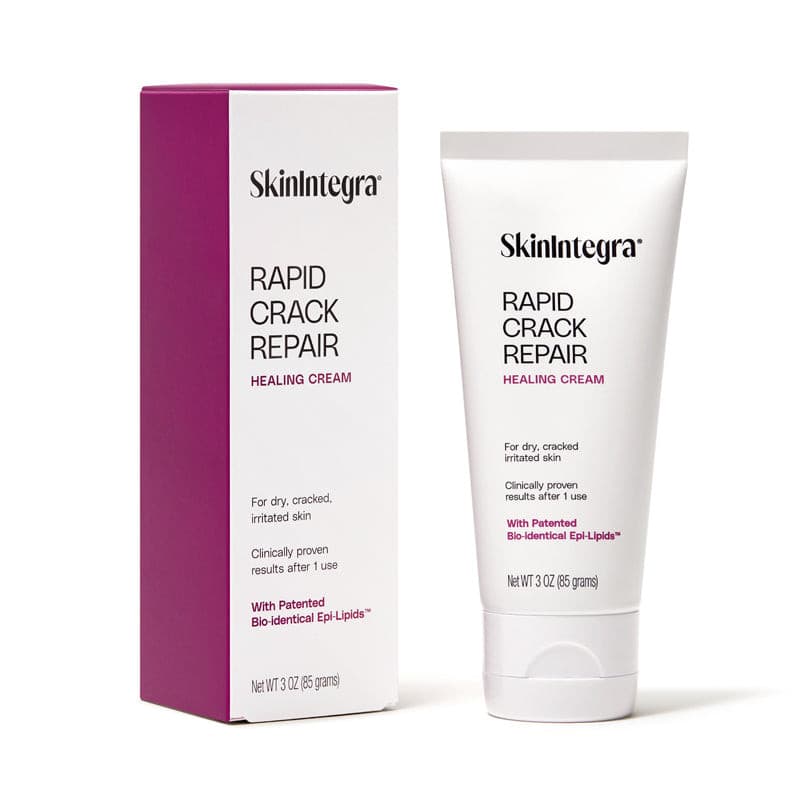
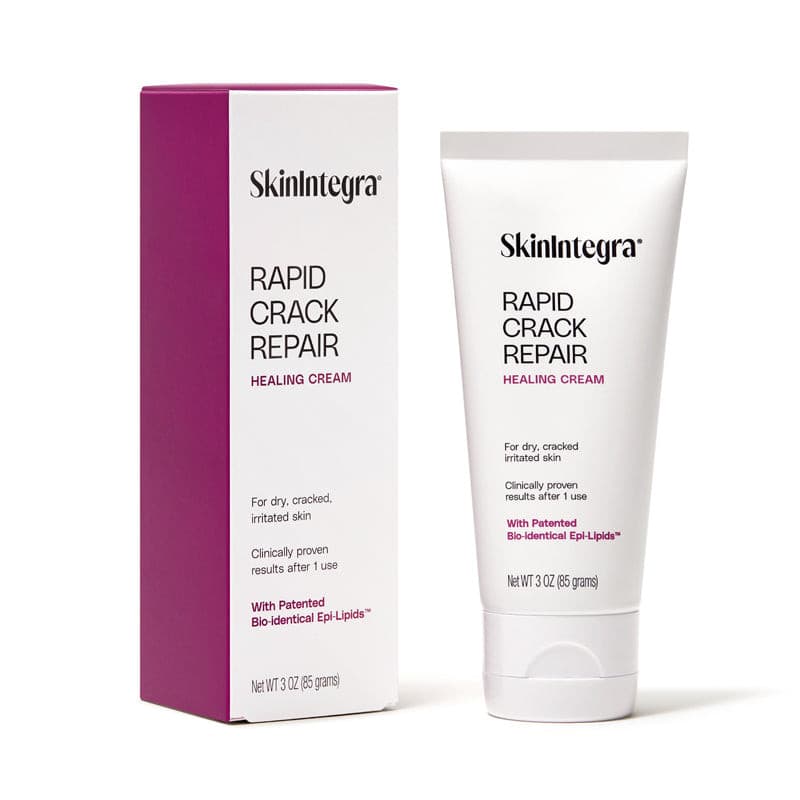
SkinIntegra® Rapid Crack Repair Cream was developed for exactly this gap. It is not a stronger exfoliant. It replenishes what is missing.
At its core is SkinIntegra B.I.O.™ (Bio-Identical Oils) — a patented blend of five plant-derived oils (Sacha Inchi, Sea Buckthorn, Rice Bran, Sesame Seed and Jojoba Seed) matched in balance and composition to the skin's own lipids. We profiled what a healthy skin barrier is made of, then selected oils to match it. That is what SkinIntegra B.I.O.™ does.
It also contains 25% urea with lactic acid — a concentration that softens and loosens hardened skin and is widely used on dry, sensitive and diabetic skin, with the lactic acid adding hydration and gentle exfoliation. Unlike 40% urea, which works aggressively and can leave skin feeling dry, SkinIntegra absorbs quickly and leaves skin feeling immediately moisturized.
That combination matters on a limb that spends the day under fabric: it works on the buildup chemically rather than by abrasion, and it absorbs rather than sitting greasy under the garment.
It is formulated without salicylic acid, and is fragrance-free, dye-free, paraben-free, alcohol-free and petrolatum-free.
What the clinical evidence shows
In a head-to-head trial published in the Journal of the American Podiatric Medical Association, 48 adults with deeply cracked feet used either Rapid Crack Repair or a 40% urea cream, twice a day for four weeks.
Rapid Crack Repair did as well as 40% urea — at a lower strength, and well tolerated throughout. Among the 22 adults who used it, 91% showed improvement within two weeks. By four weeks, podiatrists were seeing less dryness in 82% and less cracking in 73%, and no one had new or worsening redness, burning, stinging or itching.
SkinIntegra Rapid Crack Repair Cream carries the Seal of Approval from the American Podiatric Medical Association (APMA). Medical professionals at major hospitals across the United States also recommend it.
That trial was run on feet, where hardened, cracked skin is most often studied, and what it measured was dryness and cracking — which is the skin problem that builds up between professional visits.

Work it into the hardened skin on the heel and sole and the skin around it. Keep it off any skin that is broken, weeping or open, off any area that is red, discolored or does not look right, and out of deep folds and from between the toes, where skin stays damp. Let it absorb fully before a compression garment goes on. It is a skin care cream, not a wound product, and it does not replace anything your lymphedema therapist or doctor has told you to do.
If you want more detail on choosing between a lotion, a cream and an ointment for a limb in compression, our guide to choosing a moisturizer for lymphedema skin goes through it.
A Safe At-Home Foot Care Routine for Lymphedema
Between appointments, a short daily routine does more than any single treatment.
- Wash with a gentle, soap-free cleanser and warm rather than hot water. Regular bar soap strips oils this skin cannot spare.
- Dry carefully, especially between the toes and inside any deep fold. Skin left damp in a crease is where problems start.
- Work on hard skin gently and often, not hard and occasionally. Lymphedema guidance suggests a pumice stone on corns and calluses after bathing, while the foot is still wet, followed by moisturizing. Gentle and cumulative. Scrubbing, filing and abrasive tools damage fragile skin, and a break in the skin is the thing you are trying to avoid.
- Moisturize daily — twice a day on dry skin, and at night on skin that is intact.
- Mind the garment. Do not apply a product immediately before putting compression on. Beyond the irritation of having unabsorbed cream held against your skin for hours, moisturizer ingredients can break down the elastic fibers in the garment itself, which matters given what they cost.
- Look at both feet every day, or ask someone to. A mirror helps if reaching is the problem. You are looking for anything new: a split, a red area, a nail edge pressing in.
- If you trim your own nails, cut straight across and not too short, file rough edges rather than cutting them back, and leave the cuticles alone entirely. Clean your tools in warm soapy water.
If reaching your feet safely is the barrier, that is not a failure of effort. It is the point at which a foot care nurse or podiatrist becomes the appropriate standard of care rather than a workaround.
When to Stop and Call Someone About Your Feet
The same day, if the limb turns red, hot, more swollen than usual or painful, or if you feel feverish or unwell. Cellulitis moves quickly and does not improve by waiting.
Soon, if the skin is broken or leaking fluid through the surface. Products that work on thickened skin do not belong on broken skin, and standard advice is to moisturize around a leaking area rather than on it.
Promptly, if a nail is lifting from the nail bed, if a toe needs draining, or if an ingrown nail keeps returning despite treatment. The last one is a swelling conversation, not only a nail conversation.
At your next appointment, if thickened skin has not improved after two weeks of consistent care, or if the skin is cracking. It is also worth knowing that a good share of leg swelling involves the veins as well as the lymphatics, and swelling and itching that comes from poor circulation behaves differently and is managed differently. If the skin is also itching or has started to split, what itchy, cracked lymphedema skin leads to is worth reading alongside this.
Frequently Asked Questions
Can you get a pedicure if you have lymphedema?
Yes, for most people, provided you set the terms. The risk is not the pedicure itself but specific practices within it: cutting the cuticles, blade or grater tools on hard skin, shared foot baths, and hot water, which increases swelling. Ask for warm water or no soak, sterile or single-use tools, no cuticle cutting and no blade tools, or bring your own. If a nail is too thick or too curved to cut safely, see a podiatrist instead.
Can you get a pedicure if your feet are swollen?
Swelling is the reason for the precautions rather than a reason to avoid foot care. A swollen limb clears infection less efficiently, so any break in the skin carries more weight, and heat makes swelling worse. Keep the water warm rather than hot, keep tools away from the cuticles and from hard skin, remove your compression garment beforehand and put it back on afterward.
Is massage good for lymphedema in the legs?
Manual lymphatic drainage is a specific technique performed by a trained therapist, and it is a recognized part of lymphedema treatment. A salon leg and foot massage is a different thing and is not a substitute for it. Ask your lymphedema therapist what they are comfortable with before anyone massages the affected limb.
Why do my toenails keep ingrowing?
Most often because swelling in the toes presses the surrounding tissue against the nail edges, and a shoe gives that pressure nowhere to go. Removing the nail does not remove the pressure, which is why the problem returns. Getting the swelling under control through compression and decongestive therapy is what changes the pattern. A podiatrist can also correct an ingrowing nail without surgery in many cases.
What should I do about the hard skin on my heels if I can't reach my feet?
Two things together. A podiatrist or foot care nurse can reduce built-up skin safely and far faster than you can at home, and most people settle into a visit every nine to ten weeks. Between those visits, a daily cream that works on hardened skin and replenishes the lipids the skin is short of keeps it from rebuilding to the same degree. If reaching is the difficulty, a long-handled applicator or help from someone else makes the daily half of it possible.
Is my thick, discolored toenail fungal?
It may not be, and appearance alone will not settle it. In a large analysis of abnormal toenail samples in the United States, roughly 59 percent of nails diagnosed as fungal by appearance tested positive in the laboratory — and almost exactly the same share of nails judged to be non-fungal tested positive too. That cuts both ways, and it is why people sometimes spend a year on an antifungal and see nothing change. It is not a reason to avoid treating fungus, which matters here more than in most places, since fungal infection of the foot and nail is one of the commonest ways bacteria get into a swollen limb. It is a reason to ask your doctor or podiatrist to test the nail rather than treat it on sight.
Is urea safe to use on lymphedema skin?
Urea is not harsh or unusual — your skin produces it itself as part of what keeps the outer layer holding on to water, and it is among the best-studied ingredients for dry and thickened skin. What matters is the strength and where you put it. No strength belongs on skin that is broken, weeping or raw. If you are unsure what suits your limb, your lymphedema therapist can tell you.
The Bottom Line on Pedicures With Lymphedema
The advice to be careful with your feet is not wrong, but it has been delivered so broadly that many people have stopped getting any foot care at all, and their feet are worse for it. Precision beats avoidance. Know which practices carry genuine risk, choose a provider who will work the way you need them to, and look after the skin yourself in the weeks in between.
Your feet carry everything. They are worth the appointment.


