


Soak your feet in vinegar. It is advice that travels well — it is short, it costs almost nothing, and the bottle is already under the sink.
What rarely travels with it are the two details that decide whether it helps or harms: how much water to add, and how long to stay in. Advice is easy to carry home in pieces, and by the time this particular suggestion reaches most people, those two have fallen away. So the basin gets filled straight from the bottle, and an hour goes by with the television on.
Then the feet come out feeling softer than they have in months. That softness is the part everyone remembers. It is also the part that misleads.
If you have diabetes, something happened to your skin during that hour that you may not have been able to feel. This article is about what that is — whether you soak to deal with a fungal nail or to soften heels that have gone hard and rough — and about what the skin needs instead.
Two Reasons People Reach for the Vinegar
Almost everyone who puts vinegar in a basin is there for one of two reasons.
The first is fungus. A toenail has thickened, turned yellow and started to lift at the edge. Or the skin between the toes stays raw and itchy however carefully you wash and dry. Something has clearly taken hold, the treatments on the pharmacy shelf are slow and not cheap, and vinegar comes up again and again as the natural answer that costs almost nothing.
The second is hard skin. Heels have gone thick, yellowish and rough enough to catch on the bedsheets. A rim of hard skin has built up around the edge, and in the deepest part of it a crack has started. Vinegar is recommended everywhere as the way to soften all that so it can be rubbed away.
Both reasons are understandable, and neither is foolish — a fungal infection and a hard, splitting heel are real problems that deserve attention. But both lead to the same basin, and on a foot with diabetes that is where the trouble starts. Whichever reason brought you there, what happens to your skin is the same.
If one of those two is your reason, there is a section for each below — what to do about fungus, and what to do about hard skin. Both come after the part explaining why the soak itself is the wrong tool.
What the Soak Is Actually Doing
Two things work on your skin in that basin, and only one of them is the vinegar.
The water, on its own
A long soak in plain water is not kind to skin, which surprises most people. Water sitting against the foot for a long stretch works into the outer layer and loosens the structure that keeps that layer strong. The longer the feet stay in, the more it loosens. That is plain warm water, with nothing added.
Then the vinegar
Vinegar is an acid. Held against the skin for a long time, it works on the same structure the water is already loosening. That is why the guidance which does allow a vinegar soak keeps it well watered down and brief, and why dryness and cracking turn up on every list of its risks.
What that does to the wall
Picture the outer layer of your skin as a brick wall. The cells are the bricks, each one holding water. Between them sits a mortar your skin makes out of lipids, laid down in neat layers that hold the bricks together.
A soak does not wash that mortar out of the wall. What it does is knock it out of place. The neat layers lose their arrangement, the grip between one brick and the next weakens, and a wall that was holding water in stops doing it as well. The mortar is still there. It is simply no longer doing its job.
Which explains the thing everyone notices. The softness after a soak is not skin repaired — it is bricks swollen with water, and mortar knocked out of place. When the water drains away the swelling goes with it, and the mortar does not sort itself out again. Feet often look worse two days after a soak than they did the morning before.
Why This Matters More on a Foot With Diabetes
Everything above happens to anyone who soaks their feet for an hour. On a foot with diabetes, four things turn an unhelpful habit into a genuine risk.
The wall starts short-handed. The sole has no oil glands — sweat is its only supply, and it carries more than water: it delivers the natural moisturizing compounds that help the outer layer hold water in. Diabetes reduces sweating in the feet, for some people a little and for others almost entirely, and you cannot tell which by looking. So the soak is working on a wall that was already under-supplied. There is more on this in our guide to why diabetic feet stay dry.
The stop signal may not arrive. The American Diabetes Association notes that between a third and a half of people with diabetes develop peripheral neuropathy. Stinging is the body's way of saying take your feet out. Where sensation is reduced, that signal may never come. A person can sit through real damage comfortably and see nothing alarming until hours later, when the skin tightens and splits.
What opens, closes slowly. Diabetes slows healing and blunts the immune response, so a split that opens on Tuesday stays open longer than it would on another foot — covered in our guide to why diabetic skin heals slowly.
A crack is an opening. That is the real concern, and it is why podiatrists are so consistent about this. If you already have a cut or a sore, soaking it is the worst available option — see what to do when you cut your diabetic foot.
This is why foot soaking of any kind is discouraged for people with diabetes, vinegar or otherwise — the same conclusion our guide to Epsom salt foot soaks and diabetes reaches by a different route. The risk is the submersion itself. The acid adds to it.
One thing this is not
None of this means vinegar has no place in foot care. It does, and the difference matters — because some readers have been told to use it by their own podiatrist.
Clinicians do sometimes use the acid in vinegar on a diabetic foot. When they do, it goes on as a dressing, onto a wound they have looked at, at a strength they have measured, alongside the rest of the treatment — and they check how it is going and stop when it is time. Published reviews of diabetic foot care describe it that way and no other way.
That is treatment of a wound. It is not the same thing as filling a tub at home. Nothing in that literature describes soaking a whole, unbroken foot in vinegar.
So if a podiatrist has prescribed a vinegar regimen for a particular sore, follow them — and see below for what to ask them for.
Whichever of the two reasons brought you to the basin, the foot is left in the same state afterwards — drier and weaker than it was, and on most feet that shows up as hard, dry skin across the heels and soles. That skin is the part to deal with directly, and it is where most people's efforts go wrong. The fungus has its own answer, further down. Moisturizers soften the surface for a while. Urea creams thin the hardened plate. Both help — but neither replenishes the lipids the barrier is short of, and the wall needs water and mortar together, so the skin stiffens again and the crack reopens.
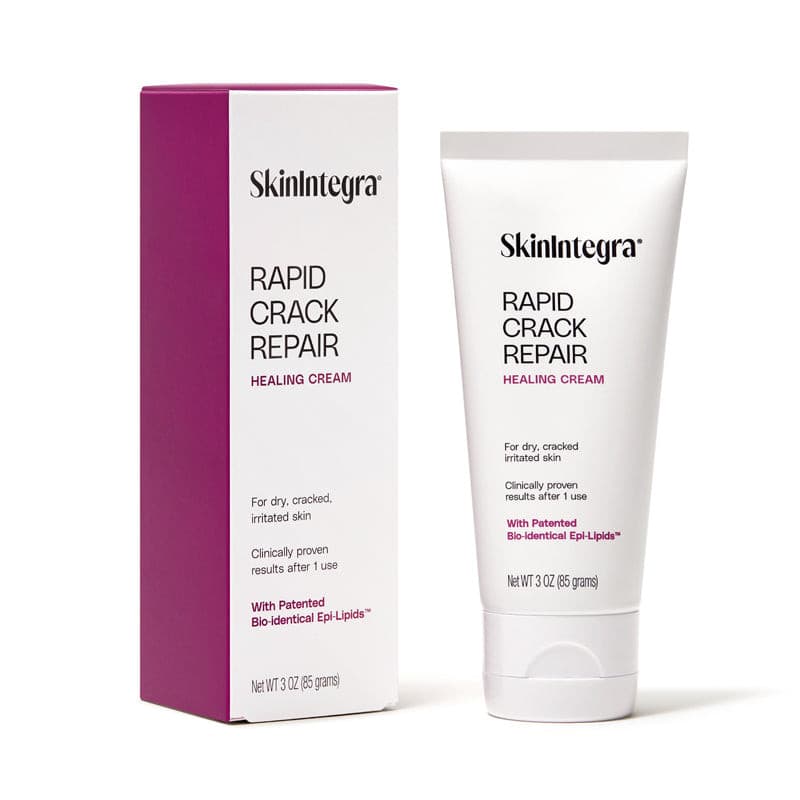
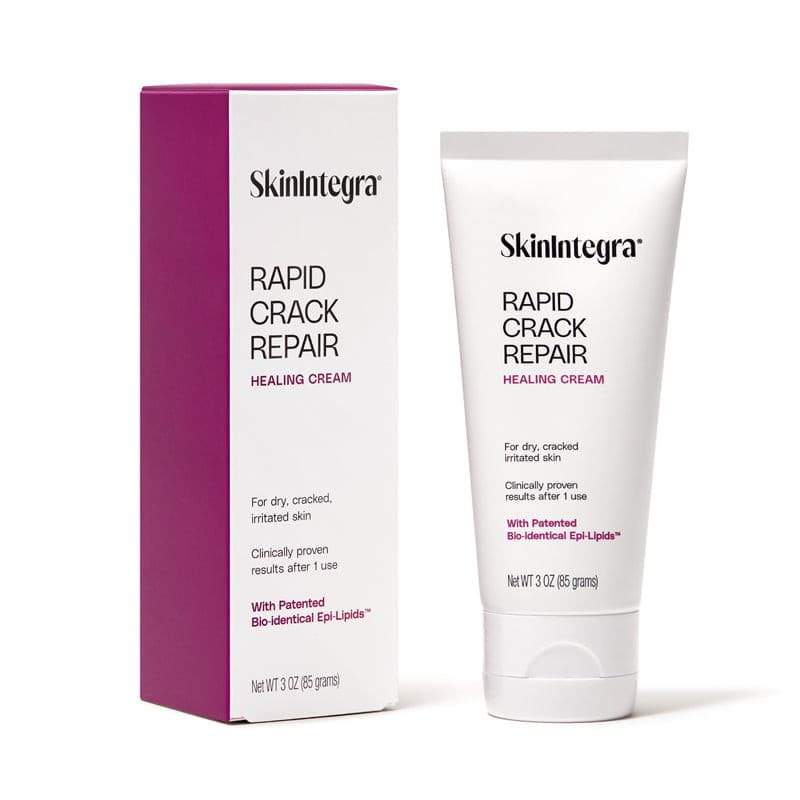
SkinIntegra Rapid Crack Repair Cream was developed for exactly this gap. It is not a stronger exfoliant. It replenishes what is missing.
At its core is SkinIntegra B.I.O.™ (Bio-Identical Oils) — a patented blend of five plant-derived oils (Sacha Inchi, Sea Buckthorn, Rice Bran, Sesame Seed and Jojoba Seed) matched in balance and composition to the skin's own lipids. We profiled what a healthy skin barrier is made of, then selected oils to match it. That is what SkinIntegra B.I.O.™ does.
It also contains 25% urea with lactic acid — a concentration that softens and loosens hardened skin and is widely used on dry, sensitive and diabetic skin, with the lactic acid adding hydration and gentle exfoliation. Unlike 40% urea, which works aggressively and can leave skin feeling dry, SkinIntegra absorbs quickly and leaves skin feeling immediately moisturized.
It is formulated without salicylic acid, and is fragrance-free, paraben-free, alcohol-free, petrolatum-free and dye-free.
What the clinical evidence shows
In a head-to-head trial published in the Journal of the American Podiatric Medical Association, 48 adults with deeply cracked feet used either Rapid Crack Repair or a 40% urea cream, twice a day for four weeks.
Rapid Crack Repair did as well as 40% urea — at a lower strength, and well tolerated throughout. Among the 22 adults who used it, 91% showed some improvement within two weeks. By four weeks, podiatrists were seeing less dryness in 82% and less cracking in 73%, and no one had new or worsening redness, burning, stinging or itching.
SkinIntegra Rapid Crack Repair Cream carries the Seal of Approval from the American Podiatric Medical Association (APMA). Medical professionals at major hospitals across the United States also recommend it.
For skin that stays dry and cracked, or that looks better for a few days and then looks the same again, the missing piece is usually not more exfoliation. It is replenishing what the barrier is short of.

Apply twice daily to clean, dry feet, avoiding the spaces between your toes: work it into the hardened area around the crack — the skin on either side is what has to change. More on how SkinIntegra works.
Shop SkinIntegra Rapid Crack Repair Cream →
If It Is Fungus You Are Trying to Treat
This is the most common reason people try a vinegar soak, and it deserves a straight answer: a vinegar soak is not an established treatment for a fungal infection. It does not clear a nail or skin infection on its own, and while it fails to, the acid is working on the surrounding skin. Where vinegar appears in clinical use at all, it sits beside a real treatment rather than replacing one.
For people with diabetes there is a second problem with waiting. A fungal infection breaks down the skin between the toes and around the nail, and broken skin on a diabetic foot is the opening this whole article is about. Weeks spent on a home remedy are weeks the infection has to work.
What actually helps:
Get it identified. Thickened yellow nails are usually fungal, but not always — and the look alone does not settle it. A podiatrist can tell you what you are dealing with, which decides the treatment.
Use a real antifungal. Topical for skin, and for nails a clinician will advise whether topical treatment is realistic or whether something else is needed. This is the part that addresses the fungus.
Look after the skin at the same time. Antifungal treatment handles the infection; it does nothing for a barrier that is dry, cracked and under strain. The two jobs run in parallel. Our guide to treating athlete's foot safely covers how they fit together.
Keep the webbing between the toes dry. Fungus thrives on damp skin, which is exactly what a long soak leaves behind. Dry carefully there, and put nothing in that space — no cream, no oil, no powder unless a clinician has said so.
If It Is Hard Skin You Are Trying to Shift
The other half of the readers here are not worried about infection at all. They have thick, rough heels, and they want them smooth.
The logic behind the soak is sound as far as it goes: water softens hardened skin, and acid loosens it further, so soaking should make it easier to shift. It does, briefly. What it also does is knock the lipids out of place in the skin around and underneath — the skin that is holding the heel together. Thick skin on a heel is not an inert layer sitting on top; it is continuous with skin that is already short of what it needs.
So the soak buys an evening of smoothness and leaves the foot drier than it found it. Repeat it weekly through the spring and you are not softening a callus — you are maintaining the conditions that built it. This is the same pattern behind DIY foot peels and graters and blade files, both of which carry the same shape of risk on a diabetic foot.
What actually helps:
Daily barrier care, not weekly removal. Hardened skin softens when the skin underneath stops being short of lipids. That is a routine measured in weeks, applied on days the feet look fine as well as days they do not.
A medical pedicure for anything substantial. For significant callus or a crack that will not close, a podiatry-supervised treatment with sterile instruments is the safe route — see our guide to safe pedicure options for diabetic feet.
Start in autumn, not March. If smooth feet by summer is the goal, the routine that gets you there begins months earlier. The last-minute soak is the version that does damage.
If You Have Already Been Soaking
Most people reading this have done it at least once. That is not a reason to panic, and it is not a reason to go looking for damage with a blade or a file.
Stop the long soaks, and keep washing. Brief daily washing in lukewarm water protects the foot. Prolonged submersion works against it. The difference is minutes, not ingredients.
Dry thoroughly, especially between the toes. This is the single most repeated warning among patients who have lived with diabetic feet for years, and it matches published clinical guidance exactly.
Put the cream everywhere except between the toes. Heels and soles are where the dryness sits. The webbing between the toes needs to stay dry.
Look at your feet in good light, daily. Use a mirror for the soles. You are checking for redness, a new split, a change in colour, or any area that looks shiny, tight or raw.
Do not apply the cream to broken, burning or raw skin. A barrier cream is for intact skin, including the hardened skin around a crack. If the skin is open, weeping, burned or painful, that is a clinician's job, not a cream's.
When to See a Podiatrist
Seek an appointment promptly if you notice:
Any crack, sore or wound on the feet that is not improving within a few days
Redness, warmth or swelling spreading beyond a crack or scratch
Discharge, odour or increasing pain around a skin break
Skin that feels tight, raw or burned after a soak
A thickened or discoloured nail, or itchy raw skin between the toes
Numbness, tingling or burning in the feet — possible early neuropathy
If a clinician has prescribed a vinegar or acetic acid regimen for a specific wound, follow their instructions rather than anything here or anywhere else online. It is worth asking them to write down the dilution, the number of minutes, and what should make you stop early. Instructions are easy to carry home in pieces, and a written note keeps all of it in one place.
Frequently Asked Questions
Can diabetic patients soak their feet in vinegar?
Home vinegar foot soaking is not advisable for people with diabetes. Vinegar works on the lipids that hold the outer layer of skin together, and prolonged submersion loosens that structure on its own, so the two effects compound. Where neuropathy has reduced sensation, an acid burn may not be felt while it is happening. This is separate from a measured acetic acid regimen prescribed by a clinician for a diagnosed wound, which is supervised wound care rather than home foot care.
Is a vinegar soak safe for diabetic patients with toenail fungus?
No, and it is also not effective. A vinegar soak is not an established treatment for nail fungus on its own. For people with diabetes the delay matters, because a fungal infection breaks down skin and broken skin on a diabetic foot is an entry point. A podiatrist can identify what is actually going on and start treatment that works.
What is the apple cider vinegar trick for diabetic patients?
The phrase usually refers to social media recipes promising that apple cider vinegar foot soaks will treat fungus, soften hard skin, or in some versions affect blood sugar or weight. No clinical evidence supports a foot soak doing any of those things. The published use of acetic acid in diabetic foot care is a clinician-applied topical treatment for infected wounds — not a home soak, and not a treatment for the condition itself.
Does a vinegar foot soak remove dead skin?
It softens hardened skin while the foot is wet, which is why it appears to work. What it also does is knock the lipids in the surrounding skin out of place, leaving the foot drier than before. The softness lasts an evening; the damage underneath does not undo itself. On a diabetic foot this is a poor trade, and repeating it weekly maintains the dryness that built the hard skin in the first place.
How long is it safe to soak your feet in vinegar?
If you have diabetes, there is no length of time that makes it a good idea — the time is not what creates the risk, the soaking is. Even a short soak in a weak solution works on the same structure that keeps the outer layer of skin strong, and on a foot that may not register stinging or heat properly, there is no reliable signal telling you when to stop. If a podiatrist has prescribed a soak for a particular wound, follow the instructions they gave you.
If not vinegar, is there a foot soak that is safe?
Prolonged soaking is discouraged regardless of what is in the water, because the submersion itself loosens the skin barrier. Brief daily washing in lukewarm water, thorough drying including between the toes, and a barrier cream applied to slightly damp skin addresses the dryness that drives most people to soak — without the barrier damage. See our guide to Epsom salt foot soaks and diabetes.
My podiatrist told me to soak in vinegar. Should I stop?
No — follow your podiatrist. A clinician who has examined your foot and prescribed a dilute acetic acid regimen for a specific wound is doing something this article is not describing. Acetic acid has a documented role in treating infected diabetic foot wounds under supervision. What has no support is copying that idea at home, at an unknown strength, on skin nobody has examined.
Why do my feet feel drier after soaking them?
Because they are. During a soak the cells of the outer layer swell with water, and that is what feels soft. At the same time the lipids holding those cells together are knocked out of place, so they stop holding moisture in as well. When the foot dries the swelling goes, and what is left behind is a weaker outer layer than you started with. The softness is temporary. The damage underneath it lasts until the barrier is replenished.
Related Articles
Epsom Salt and Diabetic Patients: What Podiatrists Say
Diabetic Athlete's Foot: Urea and Antifungal Treatment


