


40% urea cream has a strong reputation for a reason. At high concentrations, urea breaks down thick, hardened skin effectively — and for people dealing with severe calluses or cracked heels, the results can be significant.
But not everyone has the same experience. Some people use it consistently for weeks before seeing any results — and because it works aggressively, extended use can cause stinging, redness, or irritation before the skin improves. And for many people — particularly those with diabetes, eczema, or skin that has simply become chronically dry — no matter how faithfully they apply it, the underlying problem keeps coming back.
The difference usually comes down to one thing: whether the problem is a buildup of hardened skin, or a breakdown of the skin barrier itself.
40% urea is very good at treating the first issue. It has limited ability to address the second — and for some skin types, it can make it worse.

Why people turn to 40% urea for cracked heels
Cracked heels are common, uncomfortable, and frustrating. Many people seek relief, especially when standard lotions fail to make a noticeable difference.
40% urea creams are often chosen because they:
-
Are known to soften thick, hardened skin effectively
-
Are widely available over the counter and online
-
Are frequently recommended in forums or product reviews for "severe" dryness
-
Appear inexpensive compared to prescription treatments
Urea itself is a well-studied dermatologic ingredient, and at high concentrations it can break down dense callus effectively. However, speed alone is not the goal in diabetic foot care. Safety, tolerance, and preservation of the skin barrier matter just as much — if not more.
What is urea and why is it used in skin care?
Urea is a naturally occurring molecule that plays a critical role in healthy skin. It is one of the skin’s natural moisturizing compounds — the group that helps the outer layer retain water, stay flexible, and work as an effective barrier.

Urea's two key functions
Urea has two distinct actions, depending on concentration:
-
Humectant (hydration support): at lower concentrations, urea attracts and binds water within the skin, helping to improve softness, elasticity, and comfort.
-
Exfoliation: at higher concentrations, urea loosens the bonds between dead skin cells, so thickened or callused skin sheds more easily.
This dual nature is why urea is widely used in dermatology — but also why concentration matters greatly, especially for diabetic skin. For a comparison of urea with other common moisturizing ingredients, see our article on urea vs ammonium lactate for cracked heels.
How urea works at different strengths
One reason 40% urea is often misunderstood is that urea behaves very differently depending on concentration.
Low-strength urea (≤10%)
-
Acts primarily as a humectant
-
Draws water into the skin
-
Improves hydration and flexibility
-
Generally well tolerated for daily use
Moderate-strength urea (10–25%)
-
Hydrates, and lifts dead skin gently
-
Softens thickened skin gradually
-
Helps improve texture without excessive barrier disruption
-
Commonly recommended for diabetic feet
High-strength urea (40% and above)
-
Works as a strong exfoliant
-
Breaks down compacted callus effectively
-
Can thin protective skin layers with repeated use
For people with diabetes, the jump from moderate to high-strength urea is significant. The risk is not urea itself, but how aggressively it alters already-compromised skin.
There is a broader point here, and it is not only about diabetes. On skin that needs ongoing care rather than a one-off reduction of very thick callus, the stronger concentration is mostly buying speed. It gets there faster, and it spends more of the barrier on the way. A moderate concentration softens more gradually and leaves more of the skin intact — which matters more the longer you have to keep using it.
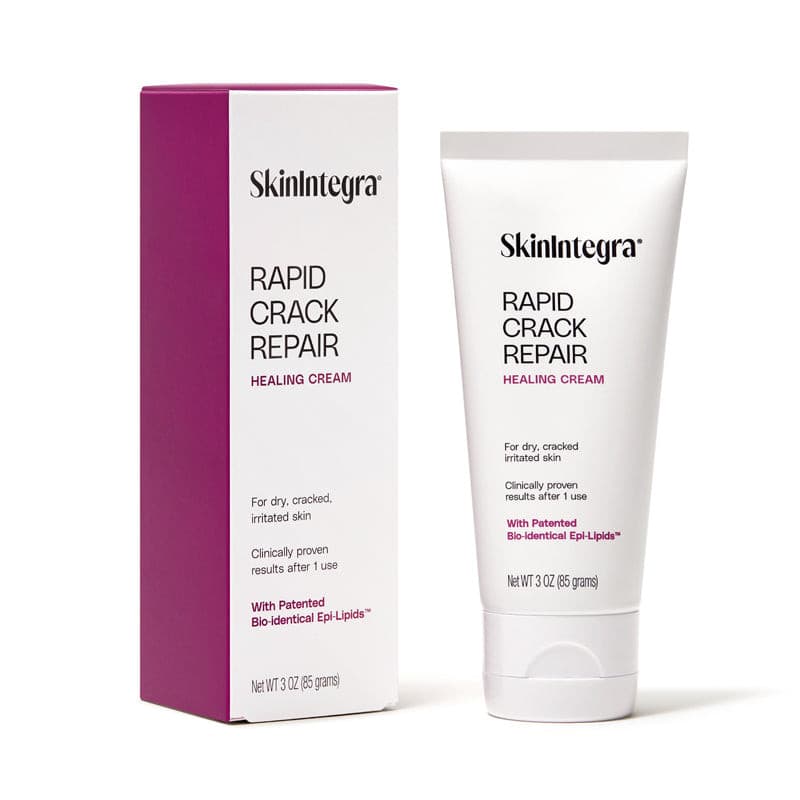
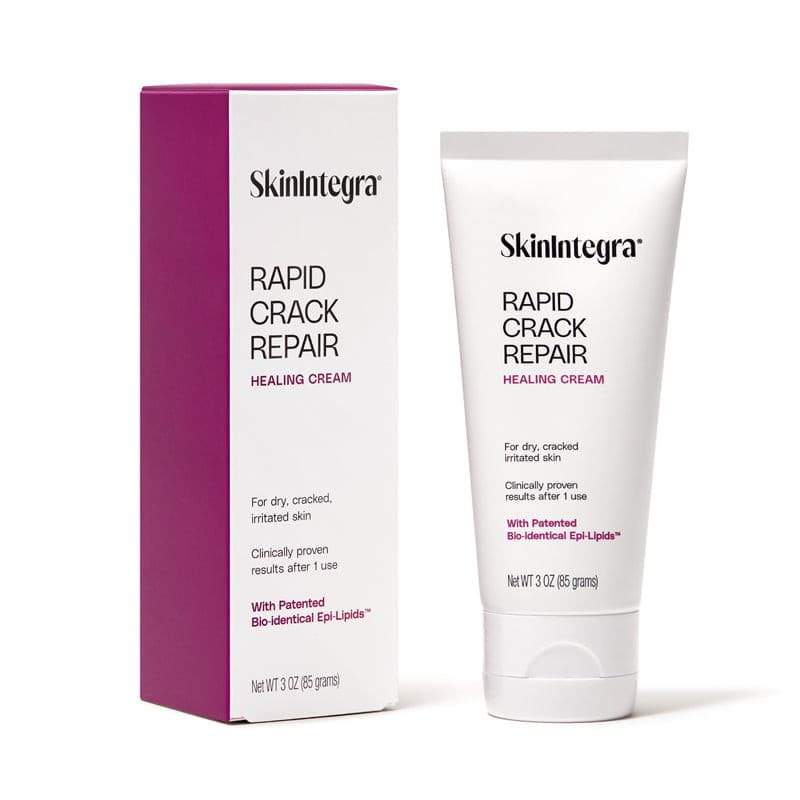
That moderate band is where SkinIntegra® Rapid Crack Repair Cream sits, at 25% urea. More on that further down this page.
Why diabetic skin requires special care
Diabetic skin is not simply "dry skin." It is biologically altered in ways that increase vulnerability.

1. A weakened skin barrier
The barrier on a foot with diabetes holds water less well than it should, and recovers more slowly when it is disturbed. That shows up as chronic dryness, scaling, and reduced resilience — especially on weight-bearing areas like the heels, where the skin is thickest and under the most pressure. We go through the mechanism behind it in why diabetic feet stay dry. It also means an exfoliant that a healthy heel shrugs off can leave this skin worse than it found it.
2. Slower skin repair
Skin on a foot with diabetes tends to repair more slowly, so a small crack can persist for weeks and worsen instead of settling. That is its own subject, and we cover it in full in why diabetic skin heals slowly.
3. Reduced sensation (peripheral neuropathy)
Neuropathy can dull pain and temperature sensation in the feet, which is why a deep heel crack can go unnoticed until it is serious. It means:
-
Irritation may go unnoticed
-
Over-exfoliation may not be felt
-
Skin damage can progress silently
4. Higher risk of infection
Cracks and splits create entry points for bacteria and fungi. In diabetic skin, even minor openings can escalate into serious infections if the barrier is compromised. See our article on how to heal bleeding cracked heels for guidance on managing skin breaks safely.
Together, these factors explain why preserving skin integrity is a central goal of diabetic foot care.
Risks of extended 40% urea use in people with diabetes
For short-term, provider-directed use, 40% urea may be appropriate in select cases. However, routine or extended use carries risks, particularly for diabetic skin.
Common side effects
-
Burning or stinging
-
Redness and irritation
-
Increased sensitivity
More serious concerns
-
Tiny cracks opening in the skin around callused areas
-
Breakdown of surrounding healthy skin
-
Delayed healing due to barrier disruption
Added risk from combination products
Many over-the-counter 40% urea creams also contain salicylic acid, a potent exfoliant that is contraindicated for people with diabetes. Salicylic acid can penetrate intact tissue, increasing the risk of chemical injury, ulceration, and infection.
Salicylic acid is contraindicated for people with diabetes — learn more about the risks of combination products.
A common but dangerous assumption
Because neuropathy can reduce pain perception, some patients assume that if a product does not sting, it must be safe. Unfortunately, lack of pain does not mean lack of damage in diabetic skin.
When 40% urea may be appropriate
This article does not suggest that 40% urea should never be used. It can be appropriate in a range of situations:
-
Very thick, localized callus
-
Only on intact skin
-
Short-term use
-
Under podiatrist or clinician supervision — see our guide on safe foot care for people with diabetes
Think of 40% urea as a powerful, targeted treatment for specific areas of very thick skin — not a general-purpose moisturizer. For most people with diabetes, daily or long-term use is not recommended. For how callus is managed safely alongside it, see managing diabetic foot calluses.
A shift in diabetic foot care: barrier repair over aggressive exfoliation
Modern diabetic foot care has evolved. Rather than focusing solely on removing thick skin as aggressively as possible, clinicians increasingly emphasize supporting the skin barrier while softening callus gradually.
This approach often includes:
-
Moderate urea concentrations (10–25%)
-
Gentle alpha-hydroxy acids such as lactic acid
-
Replenishing what the barrier has lost, rather than removing more of it
-
Avoidance of harsh exfoliants and irritants
Skin barrier repair is essential in diabetic foot care — learn why this approach is changing clinical practice.
This strategy aims to improve skin quality without increasing the risk of breakdown.
What 40% Urea Cannot Replace
The outer layer of your skin works like a brick wall. The cells are the bricks, each holding water. Between them sits a mortar your skin makes out of lipids. Lose either and the wall goes stiff, and stiff skin splits under pressure.
The sole has no oil glands. Sweat is its only supply, and it carries more than water — it delivers the compounds that help the outer layer hold water in. Diabetes reduces sweating in the feet, for some people a little and for others almost entirely, and it cannot be judged by looking. Less sweat means less of both.
Water only stays if something holds it, and the mortar is what does that. On skin that is already dry and cracking, added water leaves about as fast as it arrives.
Moisturizers soften the surface for a while. Urea creams thin the hardened plate. Both help — but neither replenishes the lipids the barrier is short of, and the wall needs water and mortar together, so the skin stiffens again and the crack reopens.
SkinIntegra Rapid Crack Repair Cream was developed for exactly this gap. It is not a stronger exfoliant. It replenishes what is missing.
At its core is SkinIntegra B.I.O.™ (Bio-Identical Oils) — a patented blend of five plant-derived oils (Sacha Inchi, Sea Buckthorn, Rice Bran, Sesame Seed and Jojoba Seed) matched in balance and composition to the skin’s own lipids. We profiled what a healthy skin barrier is made of, then selected oils to match it. That is what SkinIntegra B.I.O.™ does.
It also contains 25% urea with lactic acid — a concentration that softens and loosens hardened skin and is widely used on dry, sensitive and diabetic skin, with the lactic acid adding hydration and gentle exfoliation. Unlike 40% urea, which works aggressively and can leave skin feeling dry, SkinIntegra absorbs quickly and leaves skin feeling immediately moisturized.
It is formulated without salicylic acid, and is fragrance-free, paraben-free, alcohol-free, petrolatum-free and dye-free.
What the clinical evidence shows
In a head-to-head trial published in the Journal of the American Podiatric Medical Association, 48 adults with deeply cracked feet used either Rapid Crack Repair or a 40% urea cream, twice a day for four weeks.
Rapid Crack Repair did as well as 40% urea — at a lower strength, and well tolerated throughout. Among the 22 adults who used it, 91% showed some improvement within two weeks. By four weeks, podiatrists were seeing less dryness in 82% and less cracking in 73%, and no one had new or worsening redness, burning, stinging or itching.
SkinIntegra Rapid Crack Repair Cream carries the Seal of Approval from the American Podiatric Medical Association (APMA). Medical professionals at major hospitals across the United States also recommend it.
For skin that stays dry and cracked, or that looks better for a few days and then looks the same again, the missing piece is usually not more exfoliation. It is replenishing what the barrier is short of.

Apply twice daily: work it into the hardened area around the crack — the skin on either side is what has to change.
If you are already using 40% urea every day
A lot of people arrive at this page part-way through exactly that. The heels looked better for a while, then stopped improving, and now the skin around the callus stings when the cream goes on. Four things are worth doing.
Stop the daily application. High-strength urea was designed to reduce thick callus over a short course, not to be a nightly moisturizer. Daily use past that point works on the healthy skin around the callus as readily as on the callus itself.
Keep it for the thick spot only, if you keep it at all. Apply it to the callus and not to the skin around it, on intact skin, and stop once the thickness has come down.
Move daily care to a moderate concentration. Something in the 20–25% range does the softening you actually need day to day, and leaves more of the barrier in place while it does.
Check what else is in the tube. If the label lists salicylic acid and you have diabetes, stop using it and speak to your podiatrist — that combination carries a risk the urea alone does not.
If the skin is already broken, red, warm, or weeping, that is not a product question. See a clinician, and see one promptly if you have diabetes.
Frequently Asked Questions
What are the disadvantages of urea foot cream?
Urea foot creams are effective at softening thick, callused skin — but they come with notable drawbacks:
-
Skin irritation and stinging: at higher concentrations (30–40%), urea can cause redness, stinging, and burning, particularly on sensitive or already-compromised skin
-
Over-exfoliation: used too frequently or at too high a concentration, urea can strip healthy surrounding skin and disrupt the skin barrier rather than support it
-
Risk for diabetic skin: high-dose urea increases the risk of tiny cracks opening and of healthy surrounding skin breaking down — and any open crack on diabetic skin carries a higher infection risk
-
Odor: some high-concentration urea creams release a faint ammonia-like smell on application, which most people find dissipates quickly but some find unpleasant
Is 40% urea cream too strong for feet?
For healthy skin with thick calluses, 40% urea can be effective for short-term use. For skin that is already compromised — due to diabetes, eczema, chronic dryness, or aging — it is often too aggressive. It can thin the surrounding healthy skin, open tiny cracks in it, and slow recovery. Concentrations in the 20–25% range soften thickened skin effectively and are better tolerated over the longer stretches of use that ongoing dryness needs.
Can I use 40% urea cream daily?
Daily long-term use is not recommended, particularly for diabetic or sensitive skin. 40% urea works aggressively — with repeated daily application it can break down healthy skin tissue surrounding the callused area, increasing rather than decreasing the risk of cracking and irritation. If daily application is needed for ongoing dry skin management, a lower concentration is safer and better tolerated.
How long does 40% urea take to work?
Most people begin to see softening of thick or callused skin after two to three weeks of consistent use. However, if the underlying issue is a depleted skin barrier rather than surface buildup alone, 40% urea may show limited results regardless of how long it is used — because exfoliation addresses the symptom rather than the cause.
Can diabetic patients use urea cream on their feet?
Yes — urea is widely recommended for diabetic foot care, but concentration matters. Urea in the 20–25% range is widely used on diabetic skin: enough to soften thickened skin and support the barrier, without the aggressive exfoliation that higher concentrations produce. 40% urea can be used short-term under podiatric guidance, but is generally not recommended for routine daily care on diabetic feet due to the risk of irritation, tiny cracks opening, and barrier breakdown. For a broader overview of diabetic foot care and skin health, see our complete guide.


