


You take your sock off and there it is. A red line where there should not be one, a dark spot, or a patch that looks wet. Maybe you caught yourself with the nail clippers. Maybe you have no idea when it happened.
If you have diabetes, the next hour matters more than the injury probably looks like it deserves. Not because a small break in the skin is an emergency — usually it is not — but because the two things that would normally tell you how bad it is, pain and how quickly it closes over, are the two things diabetes interferes with.
This page is about what to do right now: how to work out what you are looking at, what to do in the first ten minutes, and how to tell a call-tonight from a call-in-the-morning.
What You Are Actually Looking At
Three different things bring people to this page, and they do not look alike.
A cut. You clipped too close, stepped on something, or caught the skin pulling a shoe on. The edges are clean and you can usually say when it happened.
A crack. Dry, thickened skin that split under the pressure of walking. The edges are ragged and pale, there is hard skin around it, and it did not happen in a moment — it opened over days. Our article on why thickened skin splits under load covers how that happens.
Skin that has given way under a callus. A round or oval opening at a spot that takes your weight, often ringed by yellow or brown hard skin. This one looks least like an injury and needs the most respect, because the pressure that caused it is still there every time you stand up.
Here is the part that matters: the first hour is the same for all three. Clean it, cover it, take the weight off it, and work out whether it needs a phone call. What differs is what you do about the cause afterwards, and that is further down this page.
How deep is it?
You cannot always tell, and that is fine. But three levels are worth knowing, because they decide how urgently someone needs to look at it.
Inside the hard outer layer. The thickened skin you can see on a heel or a pad is the top of the epidermis, not something sitting on top of it. A crack that stays inside that layer has damaged the skin barrier but not the living skin underneath. It does not bleed.
Through the epidermis. Now it is a break in the skin, whatever it looks like, and bacteria have a route in. Most cuts and most open cracks reach this level.
Into the dermis. The layer below, where the blood supply sits. It bleeds, it would normally hurt, and it meets the clinical definition of a foot ulcer — a break that goes through the epidermis and into part of the dermis. Our guide to how long a diabetic foot ulcer takes to heal explains what that involves.
If you do not feel your feet well, do not use pain to judge depth. A foot you cannot fully feel will not tell you when something has gone deep.

The First Ten Minutes
1. Sit down and look at it properly
- Take your weight off that foot before you do anything else
- Get it under good light — daylight or a lamp, not the corner of a dim room
- Use a hand mirror, or ask someone, if you cannot see the underside clearly
If it is deep, if it will not stop bleeding after ten minutes of pressure, or if something is still in it, stop here and get medical attention now.
2. Stop any bleeding
- Press firmly with a clean cloth or gauze
- Raise the foot above the level of your heart if you can
- Hold the pressure for five to ten minutes without lifting it to peek
3. Clean it
Wash the area with mild soap and lukewarm water, then pat it dry with a clean cloth. Our guide to cleaning diabetic feet safely covers the everyday version of this.
Skip the hydrogen peroxide, the rubbing alcohol and the iodine. They kill bacteria, and they also damage the living tissue your body needs in order to close the break. Mild soap and lukewarm water do the job without that cost.
4. Check the shoe before you cover it
Run your hand right through the shoe you were wearing, toe to heel, before the dressing goes on. A stone, a raised seam, a torn lining or a nail working up through the sole will do the same thing again tomorrow. There is more on dealing with the cause further down this page.
5. Cover it
If it is shallow:
- Apply a thin layer of an over-the-counter antibiotic ointment such as Neosporin or Polysporin
- Cover it with a sterile, non-stick dressing
- Change the dressing at least once a day, and any time it gets wet or dirty
If it is deeper — past the top layer of skin, gaping rather than closing, or longer than half an inch:
- Cover it with sterile gauze and no ointment; a deeper wound needs to be seen before anything goes on it
- Secure it with medical tape and keep the dressing clean and dry
- Call your podiatrist or doctor now, or go to urgent care if you cannot reach them
6. Take the weight off it
Every step presses on the break and works it open again. On the sole this matters most, because your body weight goes through it with each stride.
When to Call, and What to Say
People with diabetes need a lower threshold for picking up the phone than the general population. It is always better to check in early about something that turns out to be fine.
Call today
- Redness, swelling or warmth spreading out from the break, or red streaks running away from it
- Pus, drainage, or any odor
- Dark, black or grey tissue in or around it
- Fever, chills, or feeling unwell in yourself
- It is deep, it will not stop bleeding, or it sits on a weight-bearing part of the sole
- You have no idea how it happened and you do not feel that foot well
Call within a day or two
- It is no better after a few days of care
- There is hard skin around it that keeps splitting
- You are not sure whether it is improving, and you would rather someone else decided
What to tell them on the phone
Triage works better when you lead with the details that matter. Have these ready:
- That you have diabetes. Say it first, before anything else. Whoever answers may not have your history in front of them, and it changes how urgently everything else on this list is taken
- Where it is — top of the foot, sole, heel, between the toes, beside a nail
- How big, and whether it bleeds
- How long it has been there, or that you do not know
- Whether you can feel that part of your foot
- Anything coming out of it, and whether there is an odor
- Your most recent blood sugar readings, and any fever
If there is already redness, warmth or drainage, our guide on when a break in the skin needs an antibiotic covers what a clinician will be weighing up.
Why the Skin Around It Keeps Giving Way
That covers the break itself. The other half of this is the skin on either side of it — because on a diabetic foot, that skin is usually the reason there was a break at all, and a dressing does nothing to change its condition.
Diabetes damages the nerves that tell the sweat glands in your feet to work, and their output falls gradually, often long before you would notice anything. That matters more on a foot than anywhere else, because the soles have no oil glands at all. Sweat is their only supply, and it carries more than water — it delivers the natural moisturizing compounds that help the outer layer hold water in. Our article on why diabetic feet stay dry goes through this in detail.
The outer layer of your skin works like a brick wall. The cells are the bricks, each holding water. Between them sits a mortar your skin makes out of lipids. Lose either and the wall goes stiff, and stiff skin splits under pressure.
Water only stays if something holds it, and the mortar is what does that. On skin that is already dry and cracking, added water leaves about as fast as it arrives.
Moisturizers add water to the surface. Urea creams soften the hardened skin. Both help — but neither replenishes the lipids the barrier is short of, and the wall needs water and mortar together, so the skin stiffens again and the next crack opens.
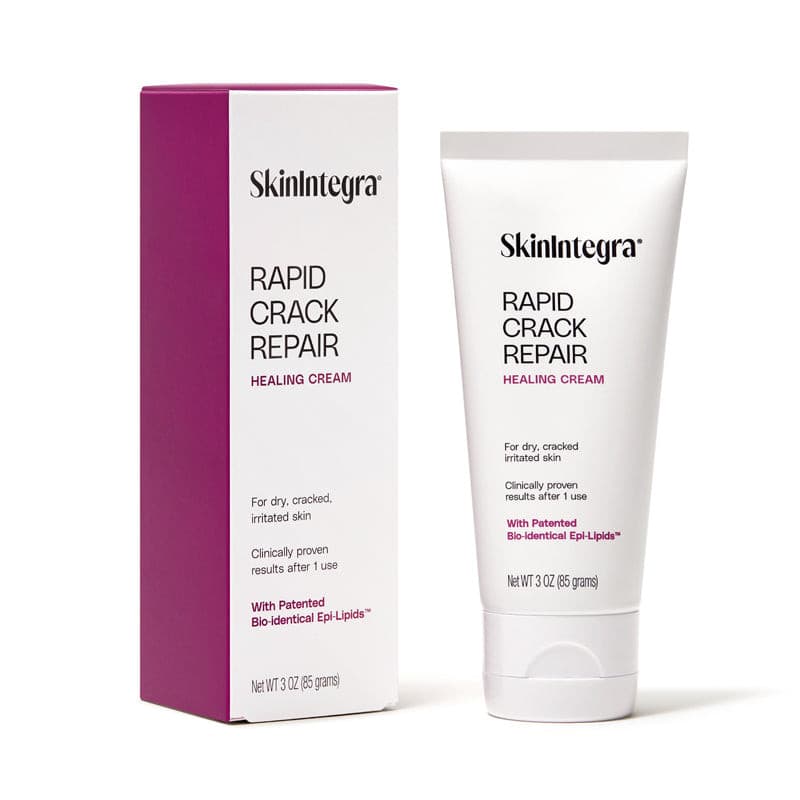
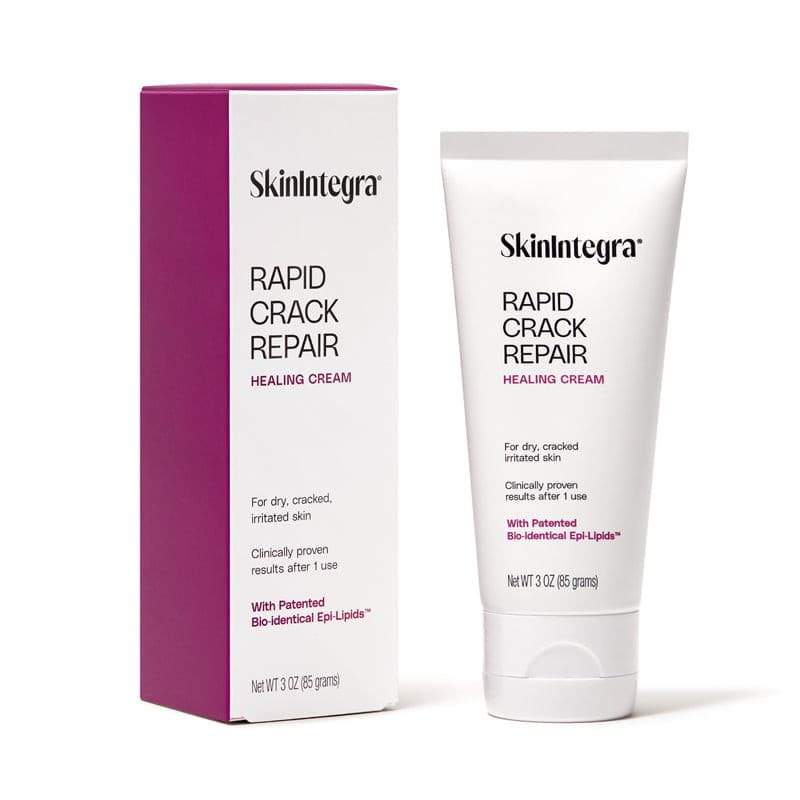
SkinIntegra Rapid Crack Repair Cream was developed for exactly this gap. It is not a stronger exfoliant. It replenishes what is missing.
At its core is SkinIntegra B.I.O.™ (Bio-Identical Oils) — a patented blend of five plant-derived oils (Sacha Inchi, Sea Buckthorn, Rice Bran, Sesame Seed and Jojoba Seed) matched in balance and composition to the skin's own lipids. We profiled what a healthy skin barrier is made of, then selected oils to match it. That is what SkinIntegra B.I.O.™ does.
It also contains 25% urea with lactic acid — a concentration that softens and loosens hardened skin and is widely used on dry, sensitive and diabetic skin, with the lactic acid adding hydration and gentle exfoliation. Unlike 40% urea, which works aggressively and can leave skin feeling dry, SkinIntegra absorbs quickly and leaves skin feeling immediately moisturized.
It is formulated without salicylic acid, and is fragrance-free, paraben-free, alcohol-free, petrolatum-free and dye-free.
What the clinical evidence shows
In a head-to-head trial published in the Journal of the American Podiatric Medical Association, 48 adults with deeply cracked feet used either Rapid Crack Repair or a 40% urea cream, twice a day for four weeks.
Rapid Crack Repair did as well as 40% urea — at a lower strength, and well tolerated throughout. Among the 22 adults who used it, 91% showed some improvement within two weeks. By four weeks, podiatrists were seeing less dryness in 82% and less cracking in 73%, and no one had new or worsening redness, burning, stinging or itching.
SkinIntegra Rapid Crack Repair Cream carries the Seal of Approval from the American Podiatric Medical Association (APMA). Medical professionals at major hospitals across the United States also recommend it.
For skin that stays dry and cracked, or that looks better for a few days and then looks the same again, the missing piece is usually not more exfoliation. It is replenishing what the barrier is short of.

How to use it around a break in the skin: apply it twice a day to the intact skin surrounding the injury, on slightly damp skin, and work it into the hardened area around the break — the skin on either side is what has to change. Do not apply it onto an open wound unless your healthcare provider tells you otherwise. More on why barrier care is the part that lasts.
Dealing With What Caused It
Checking the shoe is the step almost everyone skips, and it is the one that decides whether you are doing this again next week. Once the break is dressed and the immediate part is handled, work out what made it — and deal with that too.
- Turn the shoe over and look inside it. Run your hand right through, toe to heel. A small stone, a raised seam, a torn lining, a nail working its way up through the sole — any of these will keep doing exactly what it just did.
- Check the sock. A thick seam sitting across a toe joint, or a darn, presses in one spot all day.
- If there is hard skin around the break, the cause is pressure, not an accident. The break will keep reopening until that pressure changes — which usually means different footwear, and a podiatrist reducing the hard skin safely rather than you filing it at home.
- If you cannot find a cause at all, that is worth mentioning when you call. A break with no explanation on a foot with reduced sensation is a different conversation from one you can account for.
Looking After It Day to Day
Re-dress it daily
Take the dressing off, wash away the old ointment with soap and water, pat the area dry, and put on fresh ointment — for a shallow break — and a clean dressing. Once it has been improving steadily for a few days, every other day is usually enough.
Look at it every single time
The dressing change is your inspection. Compare it against yesterday, and compare that foot against the other one — a warm spot, or swelling on one side only, is information you will not get from looking at one foot alone.
Check both feet daily, break or no break
Reduced sensation means your feet stop reporting problems to you, so you have to go and look. Check the soles with a mirror, look between the toes, and do not walk barefoot, even indoors. Our guide to cracks that bleed covers what to do when one opens up again.
Stopping the Next One
- Check your feet every day for breaks, blisters, redness or anything that has changed
- Never walk barefoot, indoors included
- Wear shoes that fit, and check inside them before you put them on
- Care for the skin twice daily with a barrier cream, so it stays supple enough to move under load
- Have your nails cut carefully, or see a podiatrist for safe diabetic foot care
- Keep your blood sugar in range, which gives everything else a better chance
- Have a foot examination at least once a year, including the monofilament test that checks whether you have lost protective sensation
Common Mistakes
Assuming it is just a small cut. With reduced sensation you cannot judge how bad it is by how much it hurts. How it looks over the next few days is the better guide.
Reaching for the peroxide. It damages living tissue. Mild soap and lukewarm water.
Carrying on walking on it. Pressure keeps the break open and pushes anything on the surface deeper.
Dressing it and forgetting the shoe. If the cause is still in there, so is the next break.
Ignoring the skin around it. Dry, hard skin beside a break is where the next one starts.
Frequently Asked Questions
Is a crack in my heel the same as a cut?
Not in how it starts, but yes in what it becomes. A cut happens in a moment; a crack opens over days as dry, thickened skin gives way under walking pressure. Once either one goes through the epidermis, you have a break in the skin that bacteria can cross, and the immediate response is the same. What differs is the cause you have to deal with afterwards — a crack means the skin around it needs attention, not just the break.
Can I use Neosporin on a diabetic foot cut?
For a minor, shallow cut, yes — an over-the-counter antibiotic ointment such as Neosporin or Polysporin is appropriate. For anything deeper, cover it with sterile gauze and no ointment, and speak to your doctor before putting anything on it.
How long does a break in the skin on a diabetic foot take to close?
It depends on depth, circulation and blood sugar control. A minor cut may close over in one to two weeks with consistent care. If it is not improving after a few days, call — that is the point at which waiting starts costing you something.
Should I keep it covered or let it air out?
Keep it covered with a clean dressing. A protected, slightly moist wound closes over faster than one left open to the air. Change the dressing daily, or sooner if it gets wet.
Can I apply SkinIntegra directly to an open wound?
No. It is made for intact skin. Apply it to the healthy skin surrounding a break so that skin stays supple, and not onto the open area itself unless your healthcare provider directs otherwise.
What if I cannot feel the break because of neuropathy?
Then your eyes do the job your nerves are no longer doing. Look at both feet every day, use a mirror for the soles, and treat anything you find as real even though it does not hurt. The absence of pain tells you about your nerves, not about your skin.
The Short Version
A break in the skin on a diabetic foot deserves the same response whether it started as a cut, a crack, or skin giving way under a callus. Clean it, cover it, take the weight off it, and find out what caused it before you dress it and carry on.
Then decide who needs to know. Spreading redness, drainage, odor, dark tissue, fever, or a break you cannot account for all mean a call today. Anything that is not clearly improving within a few days means a call as well.
And look after the skin on either side of it. That is where the next one starts.


