


For many people living with diabetes, cracked skin can feel especially frustrating. A small crack on the heel, a split fingertip, or a patch of dry skin may linger for weeks—sometimes reopening just when it seems to be improving. Despite careful hygiene and regular moisturizing, healing can feel stubbornly slow.
If this sounds familiar, you’re not imagining it. Slow skin healing is a common and well-documented challenge in diabetes, and it has far less to do with effort or hygiene than with biology. Diabetes affects circulation, nerve function, inflammation, immune response, and the skin’s protective barrier—each of which plays a critical role in how quickly cracks and wounds heal.
Understanding why diabetic skin heals slowly is the first step toward choosing treatments that truly help—and avoiding approaches that may unintentionally make things worse.
Why slow healing is so common in people with diabetes
Healthy skin repairs itself through a coordinated process: inflammation clears damaged tissue, skin cells migrate to close the wound, new tissue forms, and the barrier re-forms over it. In people with diabetes, this process is often disrupted at multiple stages.
Rather than a single cause, slow healing in diabetic skin is the result of several overlapping factors. When these factors combine—especially in weight-bearing areas like the heels or pressure points on the hands—cracks become more likely to form and much harder to heal completely.
Four reasons cracked skin heals slowly in diabetes
1. Reduced circulation limits oxygen and nutrient delivery
Diabetes can damage small blood vessels, a condition known as microvascular disease. This reduces blood flow to the skin, especially in the feet and lower legs.
Poor circulation means:
-
Less oxygen reaches damaged skin
-
Fewer nutrients are available for repair
-
New tissue forms more slowly
This is why a crack on a diabetic heel often takes longer to close than the same crack on a heel without diabetes. More on the circulation side in peripheral artery disease.
2. Chronic inflammation keeps skin “stuck” in repair mode
Inflammation is a normal part of wound healing—but in diabetes, inflammation often becomes persistent and low-grade. Instead of resolving, the skin remains trapped in an early healing phase.
This chronic inflammation:
-
Delays closure of cracks
-
Weakens newly formed skin
-
Makes healed areas prone to reopening
This helps explain why cracks may appear to improve, only to split again days later.
3. Nerve damage delays awareness and response
Diabetic neuropathy reduces sensation in the feet and hands. Cracks may not cause pain initially, which means they’re often noticed later—after they’ve deepened or become surrounded by thick, rigid callused skin.
Delayed awareness leads to:
-
Delayed treatment
-
Cracks that get deeper before anyone notices
-
Higher infection risk
A crack you cannot feel is the one that gets deep. More on that in neuropathy and cracked heels, and on the wider picture in diabetic foot problems.
4. The skin was already compromised before the crack appeared
Healing is harder when the skin starts from a weaker position. On a foot with diabetes the barrier holds water less well and sits stiffer than it should, so it splits more readily under pressure and has less margin to work with while it repairs.
A compromised skin barrier:
-
Allows cracks to form more easily
-
Slows repair of damaged tissue
-
Increases vulnerability to bacteria and fungi
Why Skin Barrier Repair Is Essential in Diabetic Foot Care
Why moisturizing alone doesn’t last
Many people with diabetes moisturize diligently and still watch the same cracks come back. The reason is simple: hydration alone is not enough.
Basic lotions and ointments primarily work by:
-
Adding surface moisture
-
Sealing water into the outer layer of skin
While this may soften skin temporarily, it does not:
-
Change why the skin split in the first place
-
Do anything about the pressure that keeps reopening it
-
Support healthy skin turnover
Petroleum-based products, for example, can seal a crack closed but do nothing about the condition of the skin around it. Once pressure or dryness increases again, cracks often return.
Should You Use Vaseline on Diabetic Feet?
What actually helps cracked skin improve
Improving cracked skin on a diabetic foot takes a gentle, thorough approach that works on the reasons it is slow rather than on the crack alone.
Restore the skin barrier, not just moisture
Barrier repair means replenishing the components that give skin its strength and flexibility—not just adding water. A barrier in better condition loses less water, flexes instead of splitting, and is less easily irritated.
Avoid irritating already fragile skin
Harsh exfoliants and aggressive treatments may take thick skin down quickly, but on diabetic skin they often leave it red, sore and worse off than before. Gentler options take longer and cost less on the way.
Safely softening the callus around a crack
Thick callus around a crack concentrates pressure on it, driving it deeper and making it slower to close. Reducing this buildup takes the pressure off the crack — but only when done gently.
Options gentle enough for daily use include:
-
Urea at 10–25%, which softens thickened skin while improving hydration
-
Ammonium lactate, which increases skin flexibility and promotes mild exfoliation
These ingredients gradually loosen rigid skin rather than physically removing it.
Higher-strength approaches carry risk. Urea at 40% may irritate fragile diabetic skin if overused — we go through when it does and does not make sense in is 40% urea too strong for diabetic skin. Salicylic acid, found in many corn and callus removers, can cause chemical abrasion and wounds you may not feel.
Why Salicylic Acid Is Contraindicated for Corn and Callus Removal in People with Diabetes
What to avoid when cracks are healing slowly
Avoid:
-
Foot files, pumice stones, or graters without podiatric guidance
-
Prolonged foot soaks
-
Salicylic acid and aggressive acids
-
Ignoring cracks because they “don’t hurt”
Skip Cheese Graters: Safe Callus Care for Diabetic Feet
What the skin around the crack is short of
That covers the healing side of it. The other half is the skin on either side of the crack — because on a foot with diabetes that skin is usually the reason the crack was there, and waiting for a crack to close does nothing to change its condition.
The outer layer of your skin works like a brick wall. The cells are the bricks, each holding water. Between them sits a mortar your skin makes out of lipids. Lose either and the wall goes stiff, and stiff skin splits under pressure.
The sole has no oil glands. Sweat is its only supply, and it carries more than water — it delivers the natural moisturizing compounds that help the outer layer hold water in. Diabetes reduces sweating in the feet, for some people a little and for others almost entirely, and it cannot be judged by looking. Less sweat means less of both.
Water only stays if something holds it, and the mortar is what does that. On skin that is already dry and cracking, added water leaves about as fast as it arrives.
Moisturizers soften the surface for a while. Urea creams thin the hardened plate. Both help — but neither replenishes the lipids the barrier is short of, and the wall needs water and mortar together, so the skin stiffens again and the crack reopens.
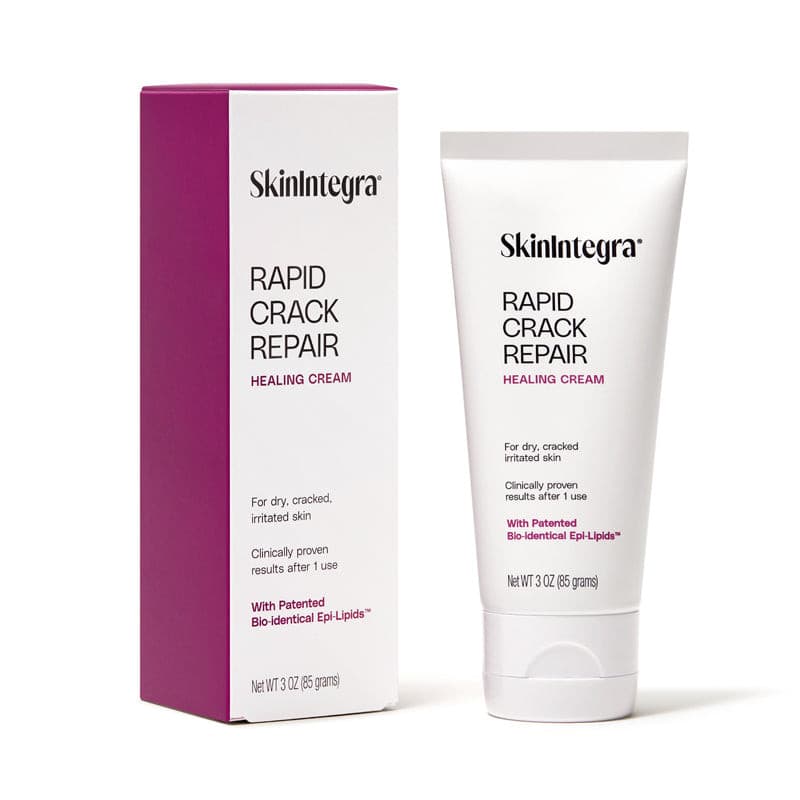
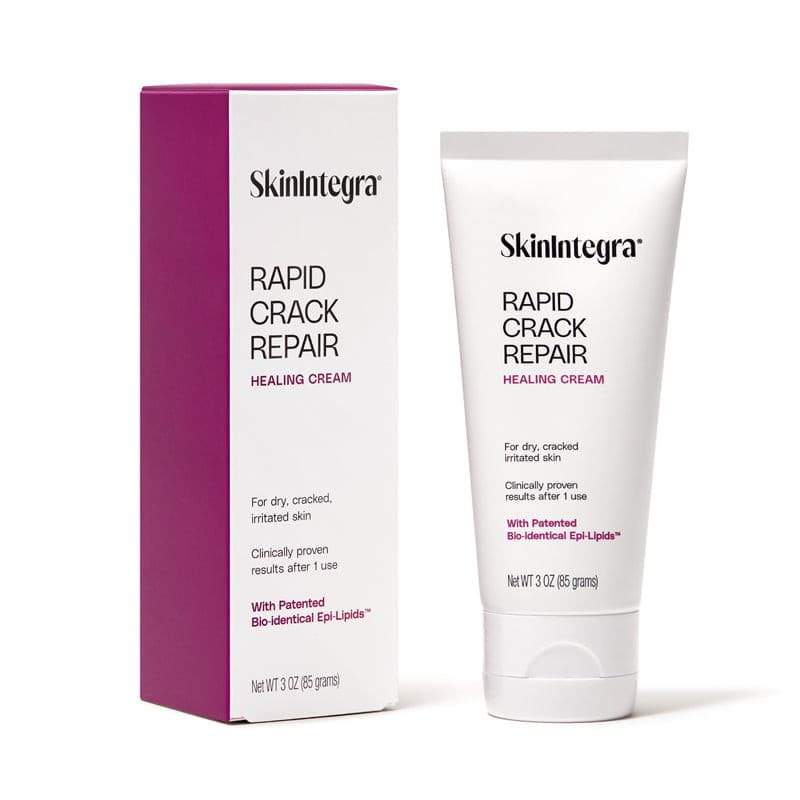
SkinIntegra® Rapid Crack Repair Cream was developed for exactly this gap. It is not a stronger exfoliant. It replenishes what is missing.
At its core is SkinIntegra B.I.O.™ (Bio-Identical Oils) — a patented blend of five plant-derived oils (Sacha Inchi, Sea Buckthorn, Rice Bran, Sesame Seed and Jojoba Seed) matched in balance and composition to the skin’s own lipids. We profiled what a healthy skin barrier is made of, then selected oils to match it. That is what SkinIntegra B.I.O.™ does.
It also contains 25% urea with lactic acid — a concentration that softens and loosens hardened skin and is widely used on dry, sensitive and diabetic skin, with the lactic acid adding hydration and gentle exfoliation. Unlike 40% urea, which works aggressively and can leave skin feeling dry, SkinIntegra absorbs quickly and leaves skin feeling immediately moisturized.
It is formulated without salicylic acid, and is fragrance-free, paraben-free, alcohol-free, petrolatum-free and dye-free.
What the clinical evidence shows
In a head-to-head trial published in the Journal of the American Podiatric Medical Association, 48 adults with deeply cracked feet used either Rapid Crack Repair or a 40% urea cream, twice a day for four weeks.
Rapid Crack Repair did as well as 40% urea — at a lower strength, and well tolerated throughout. Among the 22 adults who used it, 91% showed some improvement within two weeks. By four weeks, podiatrists were seeing less dryness in 82% and less cracking in 73%, and no one had new or worsening redness, burning, stinging or itching.
SkinIntegra Rapid Crack Repair Cream carries the Seal of Approval from the American Podiatric Medical Association (APMA). Medical professionals at major hospitals across the United States also recommend it.
For skin that stays dry and cracked, or that looks better for a few days and then looks the same again, the missing piece is usually not more exfoliation. It is replenishing what the barrier is short of.

Apply twice daily: work it into the hardened area around the crack — the skin on either side is what has to change.
How long is too long
This is the question most people actually arrive with, and it rarely gets answered plainly. There is no single number, but there are useful markers.
A shallow crack in the hardened surface layer, kept moisturized and off the worst of the pressure, usually looks better within a week or two. A deeper split that has reached the living skin underneath takes longer, and it will keep reopening for as long as the skin around it stays stiff — which is why the crack and the skin on either side of it are two different jobs.
The marker worth holding onto: a crack that is no better after two weeks of consistent care is not a slow crack, it is a stuck one. That is the point to stop adjusting your routine and have it looked at, whether or not it hurts. On a foot with diabetes, that threshold comes sooner if there is any redness, warmth, swelling or drainage — those are same-day reasons to call, not two-week ones.
Worth knowing separately: if a break in the skin has gone deep enough to meet the definition of an ulcer, the timelines are different again, and we cover them in how long a diabetic foot ulcer takes to heal.
Taking the pressure off
A heel crack sits under your body weight every time you stand up. Skin cannot close a gap that is being pulled apart several thousand times a day, which is why a crack on a weight-bearing heel can look better in the evening and be open again by mid-morning.
What helps, in rough order of how much difference it makes:
-
Wear something on your feet indoors. Barefoot on a hard floor is the single heaviest load a heel crack takes, and most people do it without thinking.
-
Choose a shoe with a cushioned heel and a closed back. An open-backed shoe lets the heel pad spread sideways on each step, which is what widens a crack at its edges.
-
Ask about offloading if the crack is deep. A podiatrist can pad or offload a specific spot properly, and on a foot with reduced sensation that is worth doing rather than improvising.
-
Keep the callus down, gently. Thick rigid skin around a crack concentrates the load onto it. Softening it gradually spreads the pressure back out.
One thing that sits outside skin care but has more influence on healing speed than anything in this article: blood sugar kept in range gives the skin better conditions to repair in. That belongs with your care team rather than with a cream, but it is worth saying plainly, because it is the largest lever there is.
When slow healing means it’s time to see a podiatrist
Consult a podiatrist if you notice:
-
A deep or bleeding crack
-
Redness, swelling, warmth, or drainage
-
Cracks that worsen or don’t improve
-
Increasing numbness or pain
Getting it looked at early is what keeps a slow crack from becoming something more serious.
Frequently Asked Questions
Is slow skin healing common with diabetes?
Yes. Reduced circulation, persistent low-grade inflammation, nerve damage and a barrier that was already dry and stiff all pull in the same direction. More on the last of those in why diabetic feet stay dry.
Why do cracked heels keep reopening?
Pressure from thick skin and a weakened barrier make healed skin prone to splitting again.
Can cracks in diabetic skin heal completely?
They can. It often takes longer than it would without diabetes, and a crack that keeps reopening is usually telling you the skin around it has not changed — not that it cannot close.
How long should cracked skin take to heal?
It depends on how deep it goes and on whether the pressure and dryness that opened it are still there. The marker that matters more than a number: a crack that is no better after two weeks of consistent care should be looked at rather than waited out.
Can I safely soften calluses if I have diabetes?
Yes—when done gently with ingredients like urea (10–25%) or ammonium lactate. Avoid physical abrasion and salicylic acid unless directed by a podiatrist.
Conclusion: Slow healing doesn’t mean failed healing
Slow-healing skin cracks are common in diabetes—but they’re not inevitable. By understanding the biological reasons healing is delayed and choosing treatments that support the skin barrier rather than irritate it, many people can reduce cracking, improve comfort, and lower their risk of complications.
Gentle, consistent care—combined with a barrier-focused approach—can help diabetic skin regain strength and resilience over time.


