


Almost nobody works it out on the first day. People decide the roof must be leaking above the bed. They check the ceiling, turn the mattress, wonder whether the dog got up in the night. In one family's account, an elderly mother insisted for weeks that the roof was leaking above her bed — until her relatives finally noticed her pant leg was soaked through.
Others notice it differently: a sock that is wet at the end of the day, a damp patch on the footrest, a slick spot on the kitchen floor, or fluid coming out through the side of a shoe. It is clear or straw-colored and slightly sticky. It is not sweat and it is not blood.
The most confusing part is that there is usually no wound to explain it. You look for the cut and cannot find one. The skin simply gave way somewhere too small to see, and fluid started coming out.
So people do the reasonable thing. They put a bandage on it, change the sock, wrap the leg before bed. By morning the wrapping has soaked through, and there are two or three damp patches instead of one.
This is called lymphorrhea, and among nurses and caregivers it goes by a blunter name: weeping legs, or leaky legs. It means the pressure inside your lower leg has finally exceeded what your skin can hold, and fluid is finding its way out through the surface. It is common in older adults with long-standing swelling, and it is one of the few skin changes that genuinely counts as urgent.
If you are reading this about a parent rather than yourself, you are in the right place too. A great many people who search for this are adult children and caregivers who have just found a wet bed, a damp armchair or a puddle on the floor, and are trying to work out how worried to be. The short answer is: worried enough to act this week, and the rest of this article explains why and what to do.
One more thing worth saying plainly. People delay asking about this because they find it embarrassing — it is messy, it ruins bedding, and caregivers describing it online almost always apologize for how unpleasant it is to look at. None of that is a reason to wait. It is a mechanical problem with the skin, it is common, and clinicians who look after legs see it constantly.

Read This First: Weeping Legs Need Medical Attention
Everything else in this article assumes you have done one thing: contacted a clinician. Not next month at a routine review — this week.
Leaking fluid is not a skin problem that happens to involve swelling. It is a swelling problem that has broken through the skin, and the leak will not resolve until the pressure behind it comes down. That means treating the cause, which a cream cannot do. New or worsening leg swelling can also signal heart, kidney or liver changes that need investigating, so this is not a symptom to manage alone at home.
Seek same-day care if you also have: spreading redness or a red streak moving up the leg, small red or purple spots appearing on the skin, skin that feels hot to touch, fever or chills, confusion or unusual drowsiness, a sudden increase in pain, or fluid that has turned cloudy, green or foul-smelling. Those point to cellulitis, a deep skin infection that moves quickly in a leg that is already compromised — and in an older adult, confusion and small red spots can be the first signs that an infection has moved into the bloodstream.
If the person will not go. This is the most common problem caregivers describe, and it is worth planning for rather than arguing about. Call the person's own doctor or nurse first and describe what you are seeing — a visiting nurse or home health nurse is often more acceptable than a hospital, and can start the assessment at home. Ask specifically whether a wound care clinic or home health service can see them. If red spots, fever, confusion or rapidly spreading redness are present, that is no longer a persuasion problem: call 911 and let them assess.
Why Fluid Comes Through Intact Skin
Your lower legs sit at the bottom of the circulatory system, and everything about them works against gravity. Veins carry blood upward through one-way valves. A separate network — the lymphatic system — drains the fluid that constantly seeps out of your capillaries into the surrounding tissue, and returns it to the bloodstream.
When either system falls behind, fluid accumulates in the tissue of the lower leg. That is edema. In chronic venous insufficiency, damaged valves let blood pool and force fluid out into the tissue. In lymphedema, the drainage network itself is damaged or overwhelmed. Heart failure, kidney disease, some medications and long periods of sitting all add to the load.
For a long time, the skin copes. It stretches. But stretched skin is thinned skin, and thinned skin holds less. Two things then happen together.
The pressure keeps rising. Fluid has nowhere to go, so it presses outward against the inside of the skin, hour after hour, day after day.
The barrier gets weaker. Skin under constant stretch cannot maintain the lipid layer that holds it together and holds water in. It becomes dry, tight and shiny, and it starts to crack — often over the shin or around the ankle, where the stretch is greatest.
Eventually the two meet. A small crack, a scratch, a blister that bursts, or simply a weak point gives way, and the fluid that has been pressing outward finds a route. Once the first leak opens, others usually follow, because the pressure that caused it has not changed.
This is why there is so often no visible wound. The opening can be a fraction of a millimeter — a split between skin cells rather than a cut — and it sits under a film of fluid that hides it. You are not missing something obvious. There frequently is nothing obvious to find.
Why It Shows Up at Night
Families often notice this first in bed, and assume something in the room is wet. There are three reasons it announces itself overnight.
Fluid has been collecting in the leg all day while the person sat or stood with it down, so the pressure is at its highest by evening. Compression garments, if they are worn at all, usually come off at bedtime. And during the day, socks, shoes and pants quietly absorb small amounts of fluid — at night there is nothing to absorb it except the sheets.
If someone insists the mattress or the ceiling is wet and you cannot find a source, check their lower legs.
Why Weeping Legs Are Dangerous, Not Just Inconvenient
The wet sock is the least of it. Four things make this a genuine risk rather than a nuisance.
Infection has a direct route in. A leak is an opening in the skin that stays open, on a limb with sluggish circulation and poor immune surveillance. Cellulitis is the most common serious complication, and each episode damages the lymphatic system further — which raises the pressure, which makes the next leak more likely. People who have had one episode are markedly more likely to have another.
Constant moisture destroys the surrounding skin. Skin sitting in fluid becomes macerated: pale, waterlogged and fragile enough to tear on contact with a sock. That widens the damaged area well beyond the original leak.
Leaks become ulcers. A weeping point that stays wet, gets rubbed and never fully closes is on the path to a venous leg ulcer — one of the most stubborn chronic wounds there is, often taking months to heal and frequently recurring. How long an ulcer on the lower limb takes to heal is the clearest illustration of why preventing one is worth the effort.
Wet floors cause falls. This gets overlooked. Fluid runs into socks and slippers and onto hard floors, and the person managing it is often over 70 and already unsteady.
Three of those four risks start in the same place: the dry, stretched, cracking skin around the leak. That skin is the one part of this you can look after at home, and the rest of this article covers how — after the part that matters more.
What Actually Stops the Leaking
The leak stops when the pressure drops. In practice, that means three things a clinician will assess and arrange.
Compression. Correctly fitted compression is the single most effective treatment for weeping legs, because it addresses the cause rather than the symptom. It must be prescribed after a vascular assessment — compression applied to a leg with significant arterial disease can cause serious harm, which is why this is not a decision to make from a shopping website.
Absorbent dressings. The leaking area needs a dressing that can hold fluid and be changed as it saturates, chosen by someone who has seen the leg. Adhesive dressings are usually avoided, because removing them takes fragile skin with them.
Treating the underlying cause. Venous insufficiency, lymphedema, heart failure, kidney disease and medication side effects all need their own management. Skin care supports that work. It does not substitute for it.

When the Cause Is the Heart
Weeping legs are strongly associated with congestive heart failure, and families often encounter that connection at the worst possible moment — in a forum thread, phrased as though leaking legs mean the end is near. That is worth addressing directly, because the fear stops people asking.
Leaking indicates that fluid overload has exceeded what the skin can hold. In heart failure, that usually means the current treatment is no longer keeping up — which is a reason to contact the cardiology or heart failure team promptly, because diuretic doses and fluid management can often be adjusted. It is a signal to act on, not a verdict. In advanced illness, where the aim shifts to comfort, the skin care in this article matters more rather than less: protecting the surrounding skin is what prevents the painful cracking and infection that make the last stretch harder than it needs to be.
The Part Nobody Talks About: The Skin Around the Leak
Here is where most advice stops, and where most of the damage actually happens.
Clinical attention goes to the leaking point, which is right. But the leaking point is a few millimeters across, and the skin at risk is the whole lower leg. That surrounding skin is stretched, lipid-depleted, dry and already cracking — and every one of those cracks is a place the next leak can open and the next infection can start.
The outer layer of your skin works like a brick wall. The cells are the bricks, each holding water. Between them sits a mortar your skin makes out of lipids. Lose either and the wall goes stiff, and stiff skin splits under pressure.
Ordinary moisturizers struggle here for a specific reason. Most of them work by adding water and trapping it with an occlusive film. Skin stretched by chronic swelling is not short of water — it is surrounded by it. What it has lost is the lipid content that lets it flex without cracking: the oils that hold the outer layer together. Adding more water to skin that is already waterlogged does not restore that, and a heavy occlusive over macerated skin makes maceration worse.
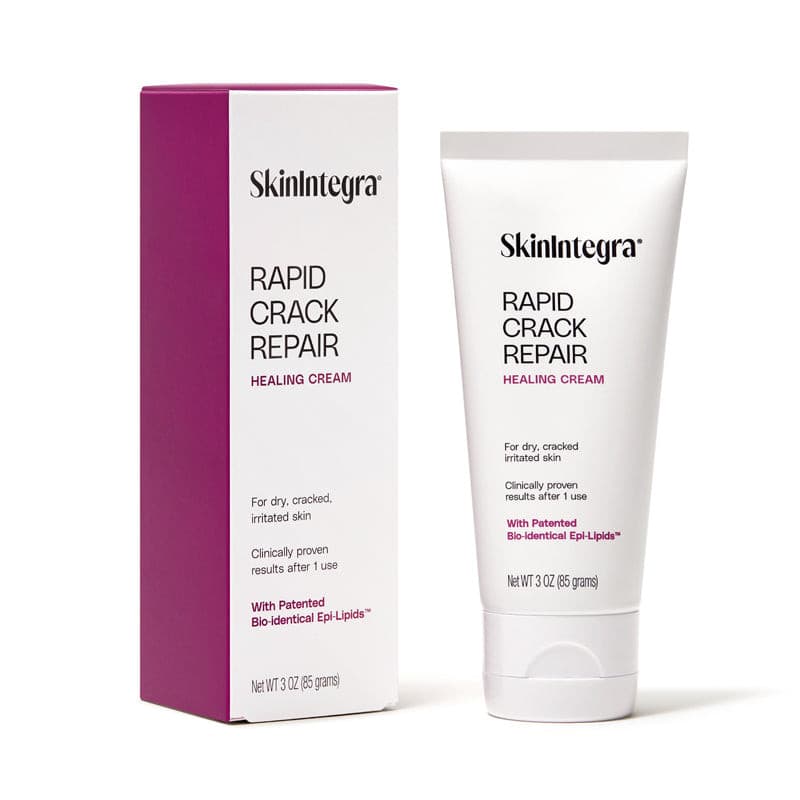
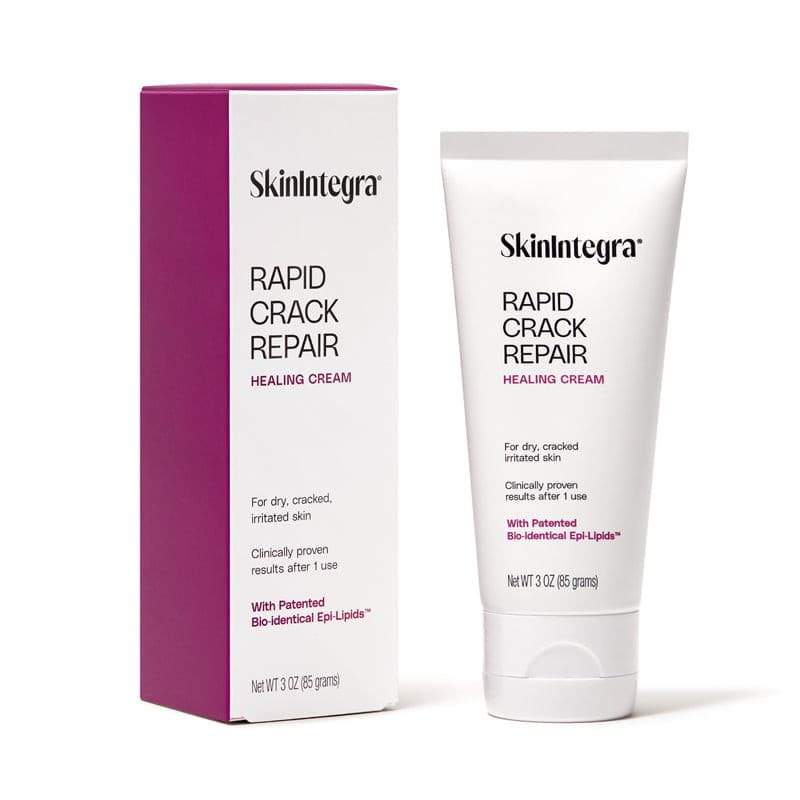
SkinIntegra Rapid Crack Repair Cream was developed for exactly this gap. It is not a stronger exfoliant. It replenishes what is missing.
At its core is SkinIntegra B.I.O.™ (Bio-Identical Oils) — a patented blend of five plant-derived oils (Sacha Inchi, Sea Buckthorn, Rice Bran, Sesame Seed and Jojoba Seed) matched in balance and composition to the skin's own lipids. We profiled what a healthy skin barrier is made of, then selected oils to match it. That is what SkinIntegra B.I.O.™ does.
It also contains 25% urea with lactic acid — a concentration that softens and loosens hardened skin and is widely used on dry, sensitive and diabetic skin, with the lactic acid adding hydration and gentle exfoliation. Unlike 40% urea, which works aggressively and can leave skin feeling dry, SkinIntegra absorbs quickly and leaves skin feeling immediately moisturized.
It is formulated without salicylic acid, and is fragrance-free, paraben-free, alcohol-free, petrolatum-free and dye-free.
What the clinical evidence shows
In a head-to-head trial published in the Journal of the American Podiatric Medical Association, 48 adults with deeply cracked feet used either Rapid Crack Repair or a 40% urea cream, twice a day for four weeks.
Rapid Crack Repair did as well as 40% urea — at a lower strength, and well tolerated throughout. Among the 22 adults who used it, 91% showed some improvement within two weeks. By four weeks, podiatrists were seeing less dryness in 82% and less cracking in 73%, and no one had new or worsening redness, burning, stinging or itching.
SkinIntegra Rapid Crack Repair Cream carries the Seal of Approval from the American Podiatric Medical Association (APMA). Medical professionals at major hospitals across the United States also recommend it.
For skin that stays dry and cracked, or that looks better for a few days and then looks the same again, the missing piece is usually not more exfoliation. It is replenishing what the barrier is short of.

Be precise about where it goes. A barrier cream is for the intact skin surrounding the leak — the shin, the calf, the areas that are dry and cracking but not open. It does not go on the weeping area itself, which needs a dressing your clinician has chosen. Used that way, under compression, its job is to keep the surrounding skin flexible enough not to become the next leak.
Daily Skin Care for a Leaking Leg
Assuming a clinician has assessed the leg and compression is in place, this is what daily care looks like.
Wash gently, with plain water or a soap-free cleanser. Ordinary soap strips what little lipid the skin has left. Use lukewarm water — hot water increases blood flow to the leg and worsens both swelling and itch.
Pat dry. Do not rub. Pay attention to the skin folds and between the toes, where trapped moisture invites fungal infection.
Apply emollient to the intact skin, in downward strokes. Follow the direction of hair growth. Stroking upward pushes product into the follicles and can cause folliculitis on skin this fragile. A lipid-replenishing formula such as SkinIntegra Rapid Crack Repair Cream suits this better than a water-based lotion, because the shortfall is oil rather than water.
Let it absorb before compression goes on. Ten to fifteen minutes. Applying a garment over wet cream traps moisture against the skin and shortens the life of the garment.
Elevate when you can. Legs above hip height for half an hour, a few times a day, moves meaningful amounts of fluid. Sleeping with the foot of the bed slightly raised helps more than a pillow under the ankles, which tends to slip.
Keep moving. The calf muscle is the pump that drives venous return. Ankle circles and heel raises while seated do real work.
Check the leg daily, in good light. You are looking for new leaks, spreading redness, increasing warmth, and any change in the fluid itself. If you cannot see the back of your calf, use a mirror or ask someone.
What Not to Do
Do not pierce blisters or "help" the fluid out. Every puncture is another entry point for bacteria on a limb that cannot defend itself well.
Do not wrap the leg in plastic wrap, sheeting or a trash bag to keep furniture dry. It traps fluid against the skin and accelerates maceration and infection. Absorbent padding, changed often, is the answer.
Do not expect a towel or a bandage to hold it overnight. Caregivers routinely wrap the leg before bed and find it soaked through by morning. That is not a sign you wrapped it badly — a leaking leg can produce a surprising volume, and ordinary wrapping was never going to contain it. It also holds that fluid against the skin for eight hours, which is worse than letting it escape onto absorbent pads. Use disposable absorbent pads under the leg and on the bed until a clinician has supplied proper dressings.
Do not use talcum powder. It cakes in the wet, holds bacteria and irritates broken skin.
Do not rely on petroleum jelly alone. It seals the surface but adds nothing back to a barrier that has lost its lipids, and over macerated skin it makes things worse. We looked at this in detail in should you use Vaseline on compromised skin.
Do not buy compression stockings without an assessment. On a leg with reduced arterial supply, compression can cause tissue damage.
Do not wait to see whether it settles. It rarely does, and the window in which this is straightforward to manage is the first one.
Weeping Legs and Diabetes
If you live with diabetes as well as chronic swelling, every risk on this page is amplified. Elevated blood glucose slows wound healing, blunts the immune response and impairs the skin's ability to maintain its barrier. Neuropathy may mean you feel neither the crack that starts the leak nor the early pain of an infection — and why diabetic skin heals slowly explains what is happening underneath.
That combination shortens the timeline considerably. A leak that a person without diabetes might manage over two weeks can become a cellulitis admission in days. If both conditions apply to you, treat any new leaking as a same-week medical appointment, and read why skin barrier repair is essential in diabetic foot care alongside this article.
When Weeping Legs Are an Emergency
Get urgent, same-day medical care if you notice:
Redness spreading outward from the leak, or a red line traveling up the leg. Skin that is hot to the touch. Fever, chills, confusion or feeling suddenly unwell. Fluid that turns cloudy, green or smells offensive. A sharp increase in pain, or pain that is out of proportion to how the leg looks. Sudden shortness of breath or a rapid rise in swelling in both legs.
The last of those can indicate a cardiac cause and should not wait.
Frequently Asked Questions
What is the clear fluid leaking from my legs?
It is lymph — the fluid that normally circulates through your tissues and drains away through the lymphatic system. When swelling raises the pressure in the lower leg beyond what the skin can contain, that fluid escapes through a crack or weak point in the surface. The medical term is lymphorrhea; nurses often call it weeping or leaky legs. It is usually clear or straw-colored and slightly sticky. Cloudy, green or foul-smelling fluid suggests infection and needs same-day medical attention.
Is lymphorrhea dangerous?
Yes, and it should be treated as urgent rather than routine. The leak is an open route into a limb with poor circulation, which makes cellulitis a real and repeated risk. Persistent leaking also macerates the surrounding skin and can progress to a venous leg ulcer. Beyond the skin itself, new leaking indicates that the swelling behind it has increased, and the cause of that increase — venous disease, lymphedema, heart or kidney changes — needs assessing.
How do you stop weeping legs?
You stop the leak by lowering the pressure that is driving it. Correctly fitted compression, arranged after a vascular assessment, does most of that work, supported by elevation, movement and treatment of the underlying cause. Absorbent dressings manage the fluid while the pressure comes down. Skin care protects the surrounding skin so that new leaks do not open. No cream stops a leak on its own.
Can I put cream on a weeping leg?
Put emollient on the intact skin around the leak, not on the leaking area itself — that needs a dressing chosen by your clinician. The surrounding skin is where creams matter, because it is stretched, lipid-depleted and cracking, and those cracks become the next leak. Choose a fragrance-free formula that replenishes barrier lipids rather than simply sealing the surface — SkinIntegra Rapid Crack Repair Cream meets that standard with SkinIntegra B.I.O.™ — and let it absorb fully before compression goes on.
Why is my leg leaking fluid when there is no wound?
Because the opening does not have to be a wound. Skin stretched by long-standing swelling thins and loses the lipids that hold its cells together, and it can separate at a point far too small to see — then a film of fluid covers it. Most people looking for a cut never find one. The absence of a visible wound does not make the leak less serious: it is still an open route into the leg, and it still means the pressure inside has exceeded what the skin can contain.
My mother's leg is leaking and she refuses to see a doctor. What should I do?
Start with her own doctor or nurse rather than the hospital — a visiting nurse who can come to the house is usually far more acceptable than an emergency room, and can begin the assessment where she is. Ask whether a wound care clinic or a certified lymphedema therapist can take a referral. In the meantime, keep the leg elevated when she is sitting, use disposable absorbent pads rather than wrapping, and photograph the leg daily so any change is visible. If she develops fever, confusion, spreading redness or small red or purple spots, stop negotiating and call 911 — those are signs of infection spreading, and in an older adult that moves fast.
Why does the skin peel after the swelling goes down?
Skin that has been stretched for weeks or months loses the lipid content that holds its outer layer together. When the swelling reduces, that thinned, depleted layer no longer fits the limb underneath and sheds in flakes and sheets. It is a sign the barrier needs replenishing, not a sign of infection. Consistent emollient use through this phase helps keep the peeling from progressing to cracks.
Why do my legs itch as well as leak?
Itching in a swollen leg comes from the barrier failing rather than from anything on the surface, which is why washing more makes it worse. Stretched skin loses water rapidly and inflames, and the nerve endings in that inflamed skin fire without an external trigger. Scratching then opens the very cracks that start the next leak. We cover the mechanism in itchy, cracked skin from lymphedema.
Will this happen again?
It can, and prevention is largely about the two things that caused it: pressure and barrier strength. Consistent compression keeps the pressure down. Daily emollient care keeps the skin flexible enough to tolerate the pressure that remains. Most repeat leaks follow a period when one or both slipped — a garment that stopped being worn in hot weather, or two weeks without moisturizing.
The Takeaway
Fluid leaking through the skin of your leg is not a minor skin complaint, and it is not something to manage quietly with a thicker sock. It is a sign that swelling has overwhelmed the skin's ability to contain it, and it needs a clinical assessment this week.
What you control day to day is the skin around the leak. Keep it supple, keep it intact, and you remove most of the places where the next leak and the next infection would otherwise start.
Shop SkinIntegra Rapid Crack Repair Cream →
Related Articles
Why you shouldn't ignore itchy, cracked skin from lymphedema


