


You notice your feet are peeling. You’ve been moisturizing — maybe even religiously, every night with socks on — and it’s still happening. There’s no itch, no obvious wound, nothing that looks alarming. And yet something feels off. For people with diabetes, that quiet uncertainty is worth paying attention to. The question most people in this situation ask — “Is this just dry skin, or is it something I need to worry about?” — does not always have a simple answer. In diabetic feet, the absence of symptoms can itself be the signal.
Peeling skin on diabetic feet is not a cosmetic nuisance. It is a sign that the skin barrier is under stress — and the fact that it doesn’t itch or hurt is not reassuring. Peripheral neuropathy can reduce sensation enough to mask an active fungal infection or early skin breakdown, meaning what looks like dry skin may be something that needs clinical attention. This guide explains every cause of peeling feet in people with diabetes, what the no-itch presentation means specifically, and how to treat it safely.
What Causes Peeling Skin on Feet?

Peeling skin on the soles of the feet has several distinct causes, and treatment depends on identifying the right one. For people with diabetes, the causes below are listed in order of clinical priority — the ones that carry the most consequence if missed come first.
-
Autonomic neuropathy and chronic dryness: Diabetes damages the autonomic nerves controlling sweat glands in the feet. When those nerves fail, the feet lose natural moisture production — not because of low fluid intake or dry weather, but because the neurological mechanism is impaired. The result is skin that stays dry regardless of fluid intake or the weather.
-
Fungal infection (athlete's foot) — with or without itch: Elevated blood sugar creates an environment where dermatophytes thrive, making people with diabetes significantly more susceptible to athlete's foot. Crucially, peripheral neuropathy can reduce the itch sensation that normally identifies a fungal infection — meaning diabetic patients may have active athlete's foot presenting only as peeling, with no itch at all. This is one reason the no-itch presentation of peeling feet in a diabetic patient deserves clinical assessment rather than assumption that it is simply dry skin. For guidance on managing fungal infections safely, see our guide on treating athlete's foot with urea and antifungal cream.
-
A barrier under strain, and slower repair: Skin that has dried out and stiffened flakes and peels, and once it does, any break in it — including peeling — takes longer to close. On a foot with diabetes, reduced circulation and a slower immune response add to that delay.
-
Calluses and thick skin: Thick skin builds up on pressure points — the heels, balls of feet, and big toes — as a protective response to friction. Over time this thickened skin can crack and peel, especially if it becomes dry. In people with diabetes, cracked callus creates a direct bacterial entry point in tissue with poor circulation and impaired immune response. Thickened skin also pulls at its own edges as the foot flexes, and that tension is what opens the cracks — which on a foot with poor circulation are documented precursors to serious infection.
-
Dry skin from external factors: Low humidity, hot showers, harsh soaps, and cold weather all strip moisture from the skin and contribute to peeling in the general population. For people with diabetes, these factors compound the neurological dryness caused by autonomic neuropathy — making environmental triggers more significant than they would be in healthy skin.
-
Vitamin and mineral deficiencies: Vitamin B3 (niacin), vitamin C, and zinc deficiencies are linked to peeling skin on the feet. Omega-3 fatty acid deficiency leads to dry, flaky skin that peels easily. If peeling persists despite good hydration and moisturizing, a nutritional cause is worth discussing with your doctor. See our guide on vitamin deficiencies linked to cracked heels.
-
Eczema or psoriasis: Chronic inflammatory skin conditions can cause recurring peeling, scaling, and sensitivity on the soles. Psoriasis on the feet produces thick, red patches with silvery scales that peel. Eczema causes dry, itchy patches that flake and crack. Both conditions require medical management for long-term control.
-
Footwear and hyperhidrosis: Shoes that trap moisture or cause friction can lead to blisters, peeling, and skin breakdown. Excessive sweating (hyperhidrosis) creates a chronically damp environment that weakens the skin barrier and encourages fungal growth. Note that autonomic neuropathy in diabetes can cause paradoxical hyperhidrosis in some patients — excessive sweating in one area alongside dryness in another — which is worth mentioning to your podiatrist if you notice this pattern.
Several of these causes need a podiatrist. Most of the rest come back to the same place — a skin barrier that is no longer holding together the way it should. What that means, and what it takes to change it, is covered further down.
Is Peeling Skin on Feet an Early Warning Sign of Diabetes?
Peeling feet alone do not diagnose diabetes, but persistent or recurring peeling — especially with no obvious external cause — can be an early sign of diabetes-related skin changes that deserve attention. The skin is often one of the first places diabetes becomes visible, before other symptoms are noticed.
-
Autonomic neuropathy reduces sweat gland activity, leaving feet chronically dry regardless of environmental conditions
-
Reduced circulation limits what reaches the skin cells, which tends to leave the barrier slower to keep itself in order
-
Impaired immune function makes fungal infections more likely, harder to clear, and less symptomatic — neuropathy masks the itch that normally signals infection
-
Slow wound healing means any skin break, including peeling, takes longer to repair and carries higher infection risk
If you have unexplained recurring peeling on your feet and have not been tested for diabetes, it is worth raising with your doctor — particularly if the peeling is painless or you have noticed other symptoms like increased thirst, fatigue, or slow-healing cuts. See our full guide on understanding dry diabetic feet for how diabetes affects foot skin in detail.
See a podiatrist promptly if you have diabetes and notice:
-
Peeling that reveals raw, red, or broken skin underneath
-
Any sign of infection — warmth, swelling, pus, or odor
-
Peeling that is not improving after 7–10 days of consistent treatment
-
Numbness, tingling, or loss of sensation in the feet alongside peeling
Peeling Skin on the Bottom of Feet With No Itch: What It Means
For people with diabetes, no-itch peeling is not reassuring — it may be a neuropathy warning sign. Peripheral neuropathy can reduce or eliminate the itch sensation that normally identifies a fungal infection or inflammatory condition. This means a diabetic patient may have active athlete's foot, eczema, or early skin breakdown presenting only as peeling — with no itch to signal the problem. The absence of itch in diabetic peeling feet should prompt clinical assessment, not reassurance.
For the general population, no-itch peeling on the bottom of the feet is most commonly explained by:
-
Dry skin or dehydration: the most common cause of non-itchy peeling, especially in winter or dry climates.
-
Vitamin deficiency: nutritional causes rarely produce itching but cause persistent peeling.
-
Diabetes-related skin changes: as above — neuropathy reduces sensation, meaning peeling may occur without any feeling of itch or irritation, even when an underlying infection is present.
-
Thick skin peeling painfully: when callus on the sole or heel becomes severely thickened, its edges crack and the skin peels in sheets. This presentation — thick, peeling skin that is sore rather than itchy — is distinct from dry skin peeling and from athlete’s foot. It needs urea to soften the thickened layer, and on a foot with diabetes it warrants podiatric assessment to manage the callus safely.
-
Psoriasis: plaques on the sole peel in thick sheets and are typically more sore than itchy.
-
Contact dermatitis: a reaction to shoe materials or socks that causes peeling without obvious itch.
If your feet are peeling on the bottom with no itch and no obvious skin condition — particularly if the peeling is persistent, recurring, or accompanied by any numbness — diabetes or a nutritional deficiency are worth investigating.
How to Tell If It's Athlete's Foot or Dry Skin
This distinction matters particularly for people with diabetes, because the treatment is completely different and using the wrong approach delays healing.
-
Athlete's foot: typically starts between the toes; may involve redness, blistering, and scaling; usually itchy — though neuropathy can mask this in diabetic patients; contagious and requires antifungal treatment.
-
Dry skin / barrier failure: tends to appear on the soles and heels; no redness or blistering; peeling is diffuse rather than confined to the spaces between the toes; improves with consistent moisturizing.
-
Fungal infection without itch (diabetic presentation): may appear identical to dry skin — diffuse, non-red, no obvious inflammation. If standard moisturizing does not improve peeling within 7–10 days, a podiatric assessment to rule out fungal infection is warranted.
If you have diabetes and are unsure whether your peeling is fungal or not, see a podiatrist before self-treating. See our full guide on treating athlete's foot safely with urea and antifungal cream.
How to Treat Peeling Skin on Diabetic Feet
Urea creams — the usual first step
Urea is the most clinically supported ingredient for peeling, dry and thickened foot skin. It works in two ways at once: it is a humectant, drawing water into the outer layer of the skin, and at higher concentrations it softens and loosens the dead, hardened skin that is peeling away. For diabetic feet, concentrations of 10–25% are generally recommended — enough to soften peeling skin without over-stripping what is left of the barrier. To understand why concentration matters, see our guide on choosing between urea and ammonium lactate for cracked heels.
Best cream for peeling skin on diabetic feet
If you have been moisturizing every night and the peeling keeps coming back, the cream is probably not the thing that failed. It is worth understanding what the skin on the bottom of your foot is actually made of, because that is what decides whether a cream holds.
The outer layer of your skin works like a brick wall. The cells are the bricks, each holding water. Between them sits a mortar your skin makes out of lipids. Lose either and the wall goes stiff, and stiff skin splits under pressure.
Diabetes damages the small nerves that run the sweat glands in the feet. That matters more on the sole than anywhere else on the body, because the sole has no oil glands at all — sweat is its only supply, and sweat carries natural moisturizing compounds as well as water. As those nerves fail, less of both reaches the surface. This is not about drinking more water or the weather. The delivery itself has slowed down, and no amount of surface moisture restarts it.
Water only stays if something holds it, and the mortar is what does that. On skin that is already dry and cracking, added water leaves about as fast as it arrives.
That is why a standard lotion helps for a night and looks the same again by the weekend. It puts water on the surface of a wall that has lost its mortar, and the water leaves. Urea creams do more — they hold water in the outer layer and soften the hardened skin that is peeling. Both help — but neither replenishes the lipids the barrier is short of, and the wall needs water and mortar together, so the skin stiffens again and the peeling returns.
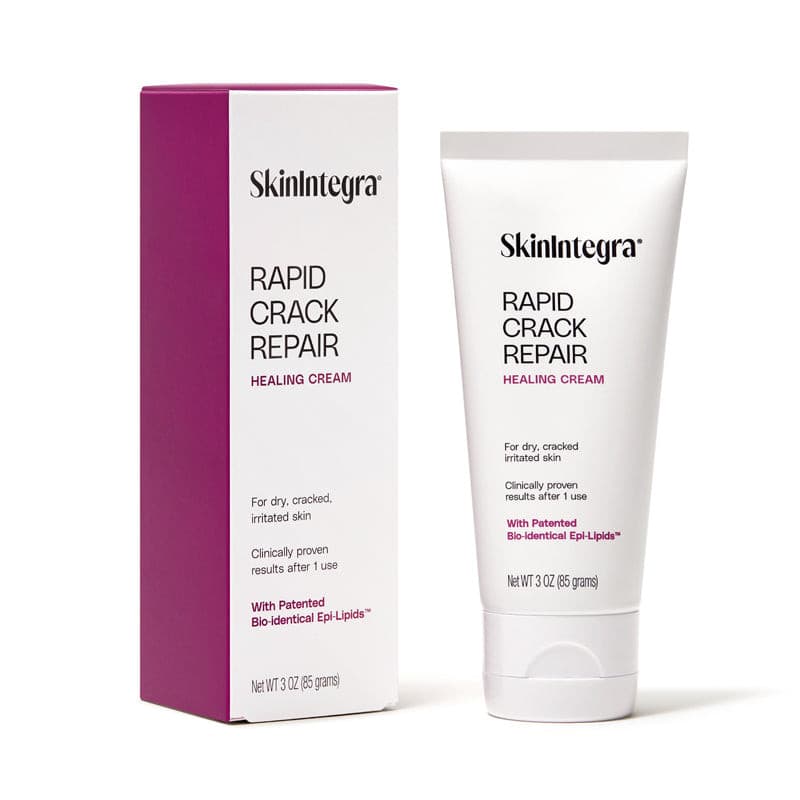
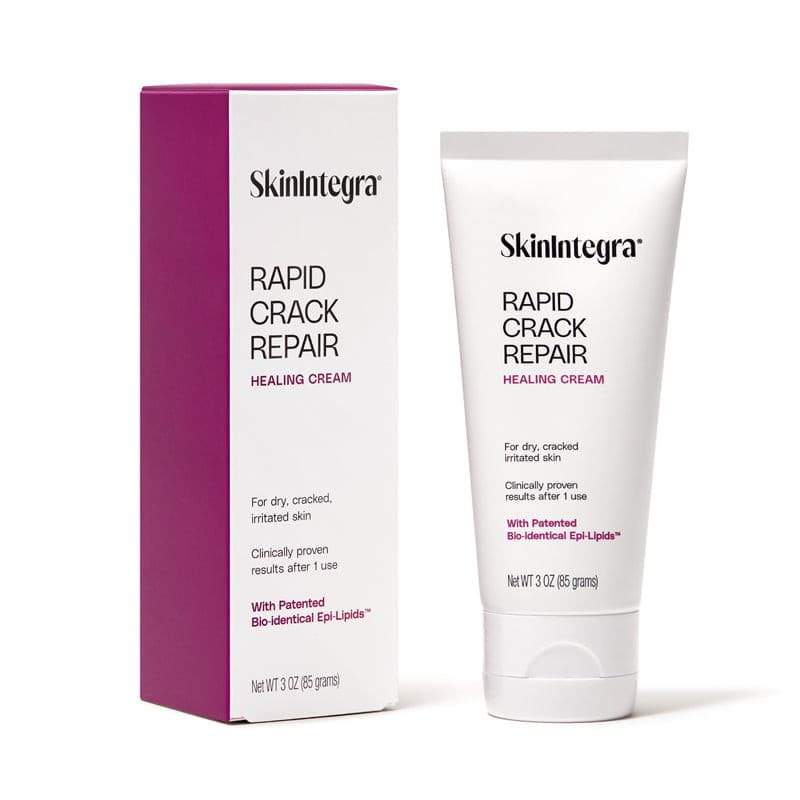
SkinIntegra® Rapid Crack Repair Cream was developed for exactly this gap. It is not a stronger exfoliant. It replenishes what is missing.
At its core is SkinIntegra B.I.O.™ (Bio-Identical Oils) — a patented blend of five plant-derived oils (Sacha Inchi, Sea Buckthorn, Rice Bran, Sesame Seed and Jojoba Seed) matched in balance and composition to the skin’s own lipids. We profiled what a healthy skin barrier is made of, then selected oils to match it. That is what SkinIntegra B.I.O.™ does.
It also contains 25% urea with lactic acid — a concentration that softens and loosens hardened skin and is widely used on dry, sensitive and diabetic skin, with the lactic acid adding hydration and gentle exfoliation. Unlike 40% urea, which works aggressively and can leave skin feeling dry, SkinIntegra absorbs quickly and leaves skin feeling immediately moisturized.
It is formulated without salicylic acid, and is fragrance-free, paraben-free, alcohol-free, petrolatum-free and dye-free.
What the clinical evidence shows
In a head-to-head trial published in the Journal of the American Podiatric Medical Association, 48 adults with deeply cracked feet used either Rapid Crack Repair or a 40% urea cream, twice a day for four weeks.
Rapid Crack Repair did as well as 40% urea — at a lower strength, and well tolerated throughout. Among the 22 adults who used it, 91% showed some improvement within two weeks. By four weeks, podiatrists were seeing less dryness in 82% and less cracking in 73%, and no one had new or worsening redness, burning, stinging or itching.
SkinIntegra Rapid Crack Repair Cream carries the Seal of Approval from the American Podiatric Medical Association (APMA). Medical professionals at major hospitals across the United States also recommend it.
For skin that stays dry and cracked, or that looks better for a few days and then looks the same again, the missing piece is usually not more exfoliation. It is replenishing what the barrier is short of.

Apply it once or twice a day after washing and drying your feet, and work it into the hardened area around the crack — the skin on either side is what has to change.
Shop SkinIntegra Rapid Crack Repair Cream →
For more on why this happens on the foot specifically, see why diabetic feet stay dry even with moisturizer.
Antifungal Creams
If athlete's foot is confirmed or suspected, use an OTC antifungal cream (clotrimazole, terbinafine, or miconazole) consistently for at least 2–4 weeks — even after symptoms clear. Pair with a urea moisturizer to address the dry, peeling skin left behind by the infection. See our full guide on treating athlete's foot with urea and antifungal cream.
Foot Soaks — Proceed with Caution
For most people, a brief warm water foot soak can soften skin before moisturizing. However, for people with diabetes, prolonged soaking weakens the skin barrier and increases infection risk. Epsom salt foot soaks in particular are not recommended for diabetic feet — they can draw moisture out of skin rather than replenishing it.
Safe Exfoliation
Avoid cheese-grater foot files, metal scrapers, or Ped Eggs — these cause micro-cuts that create infection entry points, and in diabetic feet physical exfoliation tools carry serious risks. Use chemical exfoliants like urea or lactic acid instead, which dissolve dead skin cells without physical abrasion.
If you have diabetes: never use salicylic acid products (including medicated foot pads or callus removers) on peeling or cracked feet. Salicylic acid is contraindicated for diabetic skin and can cause serious skin damage.
Learn why: why salicylic acid is unsafe for diabetic skin
When to See a Doctor About Peeling Feet

Most cases of peeling feet can be managed at home. However, see a podiatrist or healthcare provider if:
-
Peeling is deep, painful, or has exposed raw skin
-
There are signs of infection — redness spreading from the area, warmth, swelling, or discharge
-
You have diabetes and peeling has not improved after 7–10 days of consistent treatment
-
Peeling is recurring despite regular moisturizing
-
You notice numbness, tingling, or discoloration alongside the peeling
-
You suspect a systemic cause — thyroid disorder, kidney disease, or liver disease
Frequently Asked Questions
What causes peeling skin on feet?
The most common causes are dry skin, athlete's foot (fungal infection), vitamin deficiencies (especially B3, C, and zinc), eczema or psoriasis, callus buildup, and diabetes-related skin changes. For people with diabetes, autonomic neuropathy — which reduces sweat gland function — is a primary cause of the chronic dryness and peeling that standard moisturizers do not settle. Treatment depends on identifying the correct cause.
Is peeling skin on feet an early sign of diabetes?
It can be. Persistent or recurring peeling — particularly with no obvious external cause and no itch — is a recognized early manifestation of diabetic skin changes. Autonomic neuropathy reduces the feet's natural moisture production and poor circulation slows skin repair. If you have unexplained recurring peeling and have not been tested for diabetes, raise it with your doctor — especially if accompanied by increased thirst, fatigue, or slow-healing cuts.
What does it mean when feet peel with no itch?
No-itch peeling is commonly caused by dry skin, vitamin deficiency, psoriasis, or contact dermatitis. For people with diabetes, no-itch peeling carries additional clinical significance: peripheral neuropathy can reduce the itch sensation that normally identifies a fungal infection, meaning active athlete's foot may present only as peeling in diabetic patients. If you have diabetes and your feet are peeling without itching, a podiatric assessment is appropriate before concluding it is simple dry skin.
What causes thick skin peeling off the bottom of feet?
Thick, peeling skin on the sole or heel is typically caused by callus buildup that has become dry and begun to separate. The hyperkeratotic (thickened) skin layer builds up under pressure points and, when chronically dry, peels in sheets. Psoriasis can also produce this presentation. On a foot with diabetes, thickened peeling skin at the heel or ball of the foot warrants podiatric assessment — the edges of a callus crack open, and on skin with poor circulation and slower healing those cracks are direct bacterial entry points.
What deficiency causes skin to peel off the bottom of feet?
Vitamin B3 (niacin), vitamin C, and zinc are the deficiencies most commonly linked to peeling skin on the feet. Omega-3 fatty acid deficiency also leads to dry, flaking skin. If you have persistent peeling with no obvious external cause, ask your doctor about a nutritional panel. Our article on vitamin deficiencies and cracked heels covers this in detail.
What is the best cream for peeling skin on feet?
A urea-based cream at 10–25% is the usual starting point for peeling feet. For diabetic or sensitive skin, look for one that pairs the urea with lipids — the oils the barrier is short of — rather than urea alone, and that leaves out salicylic acid and fragrance. SkinIntegra Rapid Crack Repair Cream pairs 25% urea with lactic acid and a blend of five plant-derived oils matched to the skin’s own lipids, and carries the Seal of Approval from the American Podiatric Medical Association.
Is it safe to soak peeling feet?
For most people, a brief warm water soak is fine. For people with diabetes, prolonged foot soaking is not recommended — it softens and weakens the skin barrier, increasing the risk of skin breakdown and infection. Epsom salt soaks are particularly discouraged for diabetic feet. See our full guide: Epsom salt foot soaks and diabetes — friend or foe?.
Related Articles
How to treat athlete's foot safely with urea and antifungal cream
Understanding dry diabetic feet — causes and solutions
Vitamin deficiencies linked to cracked heels
Why salicylic acid is unsafe for diabetic skin
Epsom salt foot soaks and diabetes — friend or foe?
Avoid cheese-grater foot files: safe callus care for diabetic feet


