


If your lower legs are persistently itchy, discolored, or dry despite regular moisturizing, you may be looking at more than a circulation inconvenience. Chronic venous insufficiency (CVI) — also called venous stasis, and known in the UK as varicose eczema or gravitational eczema — is more common than most people realize: according to the Society for Vascular Surgery, it may affect up to 40% of the US population. CVI causes a specific type of skin inflammation called stasis dermatitis. Left unmanaged, it does not stay uncomfortable. It progresses. And what begins as itching and skin discoloration can end as a venous leg ulcer — one of the most difficult chronic wounds in outpatient medicine to treat.
This article explains exactly why that progression happens, how to recognize the warning signs at each stage, and what daily skin care can do to interrupt it.

What Venous Insufficiency Does to Your Skin
Healthy leg veins return blood to the heart against gravity using a system of one-way valves. In chronic venous insufficiency, those valves are damaged or weakened — blood pools in the lower leg veins instead of moving efficiently upward. The resulting venous hypertension (abnormally high pressure in the leg veins) forces fluid, proteins, and red blood cells out of the capillaries and into the surrounding tissue.
The skin bears the consequences of this directly. Sustained venous hypertension leads to:
-
Edema — swelling as fluid accumulates in the tissue around the ankle and lower leg.
-
Chronic inflammation — the immune response to extravasated proteins and red blood cells triggers persistent low-grade inflammation in the dermis.
-
Skin barrier deterioration — the inflammatory environment, combined with the physical stretching of edematous tissue, progressively weakens the stratum corneum. The skin becomes dry, fragile, and prone to cracking.
- Hemosiderin deposition — extravasated red blood cells break down in the tissue, releasing hemoglobin that degrades into hemosiderin. This iron compound deposits permanently in the dermis, producing the characteristic reddish-brown or dark brown skin discoloration that signals established venous disease.
This last sign — hemosiderin staining — is not a bruise and will not resolve with standard moisturizers. It is a marker of structural tissue damage that has already occurred below the surface.
What Is Stasis Dermatitis?
Stasis dermatitis is the clinical name for the skin inflammation that develops as a direct consequence of sustained venous hypertension. It is also called venous stasis dermatitis, venous eczema, gravitational eczema, or varicose eczema — all terms for the same condition. It most commonly affects the area around the medial malleolus (the inner ankle) and the lower third of the leg.
In its early stages, stasis dermatitis presents as:
-
Persistent itching and heaviness — typically worse at the end of the day or after prolonged standing.
-
Redness, scaling, and dry skin — on the lower leg or ankle, often initially mistaken for eczema or contact dermatitis.
- Mild swelling — that resolves overnight but returns through the day.
As the condition progresses without adequate management:
-
Lichenification — the skin thickens and becomes leathery as a result of chronic scratching and inflammation.
-
Permanent hemosiderin staining — brown or orange-brown patches that do not fade with standard treatment.
-
Increasing skin fragility — the skin surface cracks easily with minor trauma or scratching, creating direct entry points for bacteria.
- Lipodermatosclerosis — in advanced cases, the dermis and subcutaneous tissue beneath the medial malleolus harden and tether to underlying structures. The leg takes on an 'inverted champagne bottle' shape: narrow above the ankle, swollen above. At this stage, venous ulceration is a significant and proximate risk.
Why the Skin Barrier Fails: The Fibrin Cuffing Mechanism
Alongside hemosiderin deposition, a second process quietly damages the skin from below. When venous pressure is chronically high, a clotting protein called fibrin leaks out of the capillaries and builds up as a coating around the tiny blood vessels in the skin. Think of it like a thin film wrapping around the vessels — it does not block blood flow, but it does block the exchange of oxygen and nutrients between the blood and the surrounding skin cells.
The result is skin that is effectively starved, even though blood is circulating normally. Without a steady supply of what it needs to repair itself, the skin cannot regenerate the fats, proteins, and moisture-binding compounds that keep it intact and flexible. It becomes progressively thinner, drier, and easier to crack — not because of anything happening on the surface, but because of what is being withheld from below.
This is why applying a standard moisturizer to stasis dermatitis skin often feels like an uphill battle. The dryness and fragility are being driven from beneath the surface, not from outside. What topical care can do is keep the outer skin layer as strong as possible — reducing the chance of cracking and the bacterial entry that follows. The underlying venous disease requires medical management; the skin barrier is what daily care can protect.
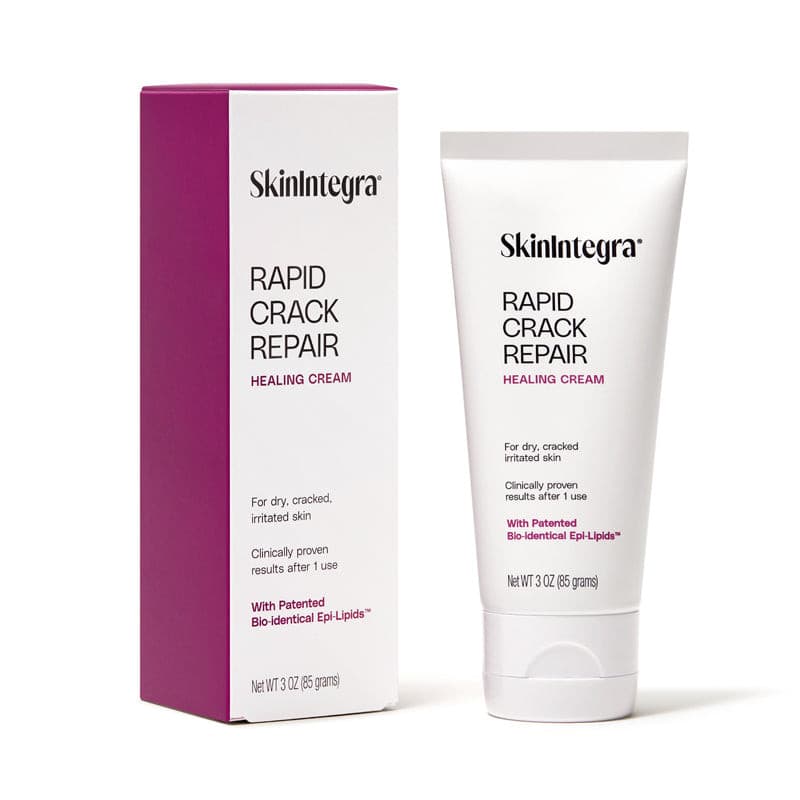
This is also why the choice of product matters. Skin that cannot rebuild its own oils needs those oils put back — not sealed over. SkinIntegra Rapid Crack Repair Cream replaces them directly with Bio-Identical Oils, a patented blend of five whole plant oils matched to the composition of healthy skin. More on how that works below.
The Cellulitis Risk: Why Stasis Dermatitis Is More Than Inflammation
The most immediately serious complication of stasis dermatitis is cellulitis — a bacterial infection of the skin and underlying tissue. When stasis dermatitis causes the skin barrier to crack or fissure, bacteria — most commonly Streptococcus or Staphylococcus — enter through the break. In the chronic inflammatory, edematous environment of venous insufficiency, local immune defenses are already compromised. Infections establish and spread more readily than in healthy tissue.
Cellulitis in the context of venous insufficiency is:
-
Frequently recurrent — once you have had one episode, the damaged skin and lymphatic drainage make further episodes significantly more likely.
-
Potentially rapidly progressing — spreading infection can require hospitalization and intravenous antibiotics.
- A driver of further skin deterioration — each episode of cellulitis inflames and damages the already-fragile skin, accelerating the progression toward venous ulceration.
Maintaining skin barrier integrity is one of the primary strategies for reducing cellulitis risk in patients with chronic venous disease — and barrier breakdown is both a cause and a consequence of recurrent infection.
Stasis Dermatitis vs. Cellulitis: A Critical Distinction
One of the most clinically important — and consistently under explained — aspects of stasis dermatitis is how closely it mimics cellulitis. Both conditions can produce redness, warmth, swelling, and scaling on the lower leg. Misidentifying one as the other carries real consequences: treating stasis dermatitis as cellulitis means unnecessary antibiotics; treating cellulitis as stasis dermatitis means a progressing infection goes untreated.
The key distinguishing features:
-
Stasis dermatitis is almost always bilateral — affecting both legs, even if one side is more severe. Cellulitis is almost always unilateral — affecting one leg only.
- Stasis dermatitis develops gradually over weeks to months. Cellulitis typically develops acutely over hours to days.
-
Systemic symptoms — cellulitis is often accompanied by fever, chills, and a general feeling of illness. Stasis dermatitis is not.
- Cellulitis produces a spreading border of redness that can be marked with a pen to track progression. Stasis dermatitis produces diffuse, stable discoloration.
If you are uncertain — or if you have bilateral redness that develops acute new symptoms on one side — seek medical evaluation promptly. The distinction matters and should not be self-managed.
Why Standard Skin Care Is Not Enough
The standard advice for dry, itchy legs — apply a regular moisturizer, avoid hot showers, wear loose clothing — addresses the surface symptom without touching the underlying mechanism. Standard moisturizers add temporary surface hydration. They do not replenish the structural lipids and natural moisturizing factors that the venous disease environment prevents the skin from maintaining. They do not compensate for the fibrin cuffing that impairs nutrient delivery to skin cells. And they do not provide the barrier reinforcement that keeps bacteria out of a skin surface that is being continuously stressed by edema and inflammation.
For patients with venous insufficiency, the goal of skin care is not comfort — it is infection prevention. Keeping the skin barrier intact is a clinical intervention that reduces the risk of the bacterial entry point that leads to cellulitis. That requires a formulation designed for structurally compromised skin, not one designed for surface dryness.
The same principle governs skin care in conditions with comparable barrier failure dynamics. For a detailed explanation of why standard moisturizers fall short for compromised skin barriers, see our article on why itchy, cracked skin from lymphedema needs early care — the barrier failure and cellulitis risk mechanics are closely parallel.
Replacing What the Skin Can No Longer Make

Fibrin cuffing starves the skin of what it needs to rebuild itself. The oils that hold the barrier together are the first thing it stops producing — and no amount of surface hydration replaces them.
SkinIntegra Rapid Crack Repair Cream was built around that specific problem. It works on two levels at once:
Bio-Identical Oils — five whole plant oils. This is the part standard moisturizers do not have. Researchers identified the specific lipids that compromised skin loses, then selected five whole plant oils — including patented Sacha Inchi and Sea Buckthorn — to match them. Think of the skin barrier as a brick wall: the cells are the bricks, and these oils are the mortar. Venous disease washes the mortar out. Bio-Identical Oils put it back, so the wall holds together instead of crumbling at the first scratch.
25% urea and lactic acid — the surface layer. Urea at 25% draws moisture deep into the skin and softens the thickened, scaling patches that build up on the lower leg. Lactic acid gently renews the surface and supports the skin's natural protective pH. Together they clear and hydrate the outer layer while the oils restore what sits beneath it.
For legs already sensitized by chronic inflammation, the formulation is fragrance-free, paraben-free, alcohol-free, petrolatum-free, and hypoallergenic — which matters here, because skin with stasis dermatitis reacts badly to the fragrances and preservatives in ordinary lotions.
In an independent clinical study of 48 adults, blinded podiatrist investigators found that SkinIntegra improved dryness and cracking significantly faster than high-strength Urea-40 — at both two weeks and four weeks, and with less irritation. It carries the APMA Seal of Acceptance from the American Podiatric Medical Association, and podiatrists and wound care providers recommend it nationwide.
Consistent daily use is essential to protect and maintain the skin barrier — particularly in venous insufficiency, where the underlying disease works against the skin every day. For a full explanation of why barrier repair counts as a clinical intervention rather than a cosmetic step, see our article on why skin barrier repair is essential for compromised skin.
Shop SkinIntegra Rapid Crack Repair Cream →
Consistent daily use is essential to protect and maintain the skin barrier — particularly in conditions like venous insufficiency where the underlying disease continuously works against the skin's ability to maintain itself. For a full explanation of why barrier repair is a clinical intervention rather than a cosmetic step, see our article on why skin barrier repair is essential for compromised skin.
Case and images courtesy of Dr. Priya Parthasarathy. Board certified podiatrist. 2026. Used with permission. Patient post wound closure from venous statis ulcer applied Rapid Crack Repair for 4 weeks for maintenance.

Daily Skin Care for Venous Insufficiency
A consistent daily routine is the primary defense against skin deterioration and the infections it invites:
-
Cleanse gently — wash with lukewarm water and a mild, fragrance-free cleanser. Avoid hot water and scrubbing. Pat dry and dry thoroughly between the toes.
-
Apply barrier repair cream immediately after washing — while the skin is still slightly damp, so the oils absorb rather than sit on the surface. Work downward toward the foot. Apply SkinIntegra Rapid Crack Repair Cream twice daily, and at night after you remove compression garments, so it absorbs undisturbed.
- Wear compression garments consistently — compression reduces venous hypertension, edema, and the mechanical stretching that accelerates barrier breakdown. Never apply over infected, weeping, or ulcerated skin without medical guidance.
-
Elevate the legs — above heart level for 20–30 minutes two to three times daily to reduce edema and lower the mechanical stress on the skin.
- Inspect daily — check both lower legs for new redness, breaks, warmth, or any wound not closing within a few days. Early identification gives more management options.
When to See a Doctor
Daily skin care at home is essential, but some situations require prompt medical evaluation:
-
Acute unilateral redness, warmth, or swelling — particularly with fever or feeling unwell, this pattern suggests cellulitis rather than stasis dermatitis and should not be self-managed.
-
Any skin break that does not begin to close within 3–5 days — cracks, fissures, or scratches that persist are open infection entry points.
-
Weeping, crusting, or discharge — signs of possible infection or significant barrier failure requiring medical assessment.
-
Skin hardening or tethering above the medial ankle — lipodermatosclerosis is a sign of advanced venous disease that warrants vascular assessment.
- Any open wound on the lower leg — venous leg ulcers require specialist wound care, not home management.
The threshold for seeking care is lower in patients with comorbid diabetes, lymphedema, or peripheral arterial disease, where healing is further impaired and infection risk is compounded. For patients with both venous insufficiency and diabetes, see our article on how diabetic neuropathy compounds skin barrier risk.
Frequently Asked Questions
How do I stop my venous stasis from itching?
Apply a barrier repair cream twice daily to maintain the skin and reduce the dryness and inflammation driving the itch cycle. Compression garments worn consistently reduce the venous hypertension behind the skin changes. Avoid scratching — it creates micro-tears that worsen the barrier and raise infection risk. If itching persists, speak with your doctor — some cases benefit from short-term topical corticosteroids under medical supervision.
Does venous insufficiency cause itchy skin?
Yes — itching is one of the most common early symptoms of stasis dermatitis. Venous hypertension forces fluid and inflammatory proteins into the dermis, triggering chronic inflammation and progressive barrier breakdown. The resulting dry, inflamed skin irritates nerve fibers and produces persistent itching, typically worse later in the day and at night.
Can poor circulation cause legs to itch?
Yes, but the cause matters for treatment. Venous insufficiency causes blood to pool in the lower leg, triggering the inflammation of stasis dermatitis. Peripheral arterial disease (PAD) starves the skin of oxygen, producing a different type of dryness. Both cause itching but require different approaches — compression helps venous disease but can worsen arterial disease. If you are unsure which applies to you, seek medical assessment before starting compression therapy.
What is the life expectancy of venous insufficiency?
Venous insufficiency is chronic but not directly life-limiting. The condition itself does not shorten life expectancy. Its complications — recurrent cellulitis, venous leg ulcers, and deep vein thrombosis — can have serious health consequences if unmanaged. The focus is on preventing those complications through compression, elevation, regular medical review, and daily skin barrier care.
What is the best skin care routine for venous insufficiency?
Cleanse gently with lukewarm water and a fragrance-free cleanser, dry thoroughly, then apply a barrier repair cream to slightly damp skin. Look for a formulation that replaces the skin's lost oils rather than just adding water — one combining plant-oil lipids with urea and lactic acid, and no added fragrance. SkinIntegra Rapid Crack Repair Cream meets that standard. Apply compression over fully absorbed cream. Inspect the skin daily and elevate the legs regularly to reduce swelling.
Related Articles
• Why You Shouldn't Ignore Itchy, Cracked Skin from Lymphedema
• Why Skin Barrier Repair Is Essential in Diabetic Foot Care


