


You notice it one morning — the skin on one or two fingers has started peeling. Not itchy, not painful. Just quietly coming away in thin layers that no lotion seems to fix.
You try a richer hand cream. You apply it more often. Weeks later, the same two fingers are still peeling, and you're starting to wonder whether this is something you should actually be worried about — or whether you're just missing something obvious.
The answer is usually the second one. But what you're missing probably isn't a better moisturizer. It's understanding why your skin is peeling in the first place.
Persistent finger skin peeling almost always comes down to a specific kind of barrier breakdown — and once you understand what is driving it, the right approach becomes much clearer.

Peeling and cracking are not the same thing
Before getting into causes, it is worth separating peeling from cracking — they have different causes, different risks, and they call for different responses.
Cracking happens when the skin becomes so dry and rigid that it splits under mechanical pressure. The skin tears along lines of stress, usually at the fingertips or heels. That is the kind of damage that can bleed, hurt, and open a route for infection.
Peeling works differently. It happens at the surface, when the outermost layer of skin — the stratum corneum — loses the natural oils that hold its individual cells together. Those cells shed in thin sheets instead of staying bonded in place.
The result looks like dry skin, and standard moisturizers address it like dry skin. What is actually happening is a structural shortfall in the skin's barrier, and surface hydration alone does not close a structural gap.
If cracking is your main concern, our article on cracked and split fingertips covers that in detail. This article focuses on peeling specifically — and why it so often persists despite consistent moisturizing.
What is actually happening when fingers peel
Whatever is causing the peeling — a skin condition, a health condition, your job, or a medication — the underlying failure is usually the same.
The skin's outer layer is held together by a mix of natural oils and lipids. Think of them as the mortar between bricks. They keep the skin cells bonded, hold moisture in, and keep irritants out.
When those lipids run short, the cells lose their grip on each other. Instead of shedding invisibly the way healthy skin does, they come away in visible layers. The barrier turns permeable, moisture escapes, and the skin grows increasingly sensitive to things that never bothered it before.
That shortfall builds in several ways:
- Inflammation from eczema or psoriasis breaks down the lipid layer from within.
- Autonomic nerve damage in diabetes reduces the skin's ability to produce its own oils.
- Repeated wet work — handwashing, gloving, sanitizer — strips the lipids faster than the skin can make them.
- Certain medications interfere with the processes that maintain the skin's lipid balance.
Standard moisturizers put water back at the surface. They do not replenish the lipid layer itself, which is why they bring temporary relief but do not stop the peeling from returning.
That is the part almost every routine misses, and it is worth understanding before you look at what is driving the shortfall in your own case.
Why regular hand cream does not settle this
Most hand creams and lotions work by drawing water into the skin and slowing its evaporation. They make the skin feel softer — sometimes immediately, sometimes for a few hours. They do not address what is actually missing.
The lipid layer that holds the skin's surface together is not the same thing as water content. It is a specific mix of oils and fatty acids that the skin either produces itself or needs replenished from outside. Standard moisturizers do not carry the right ingredients to do that.
This is why the "tried everything and nothing works" experience is so common:
- Humectants such as glycerin draw water in. They do not replenish the lipid layer.
- Occlusives such as petroleum and shea butter seal in existing moisture. They do not restore what has been lost.
- Standard emollients soften the surface. They leave the shortfall underneath untouched.
What persistent peeling needs is a formula that restores the lipid structure, eases the surface buildup that gathers over damaged skin, and keeps the skin hydrated — rather than adding moisture on top of a barrier that is still short of oils.
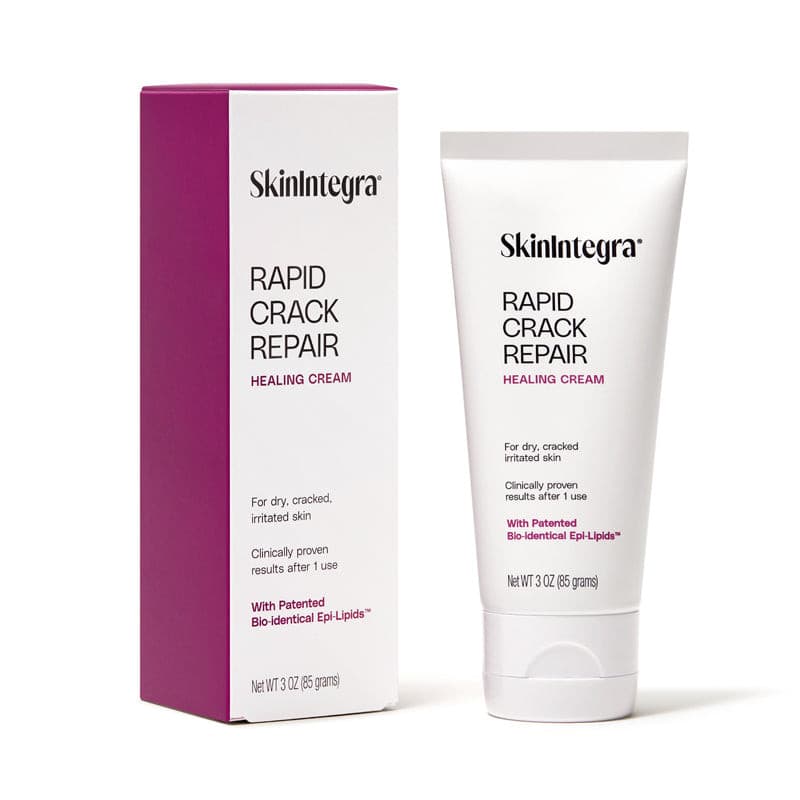
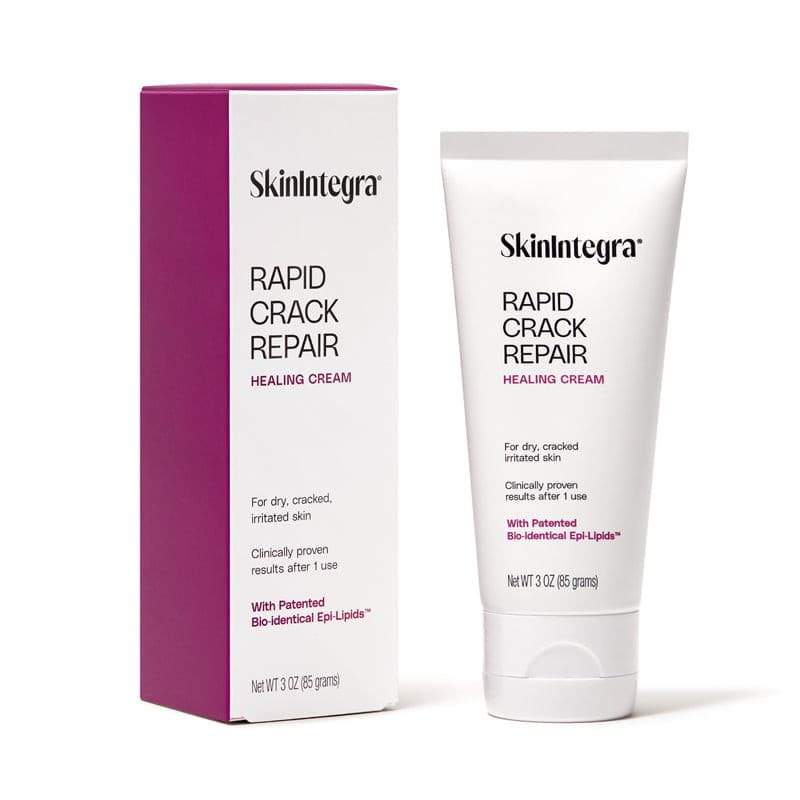
Where SkinIntegra Rapid Crack Repair Cream fits
A lipid shortfall is the common thread across very different causes of peeling — inflammation, repeated wet work, reduced oil production. In each case the skin is short of the oils it normally makes for itself, which is why a formula built for compromised skin at the extremities applies at the fingers as readily as at the feet.
Hand creams add water and slow its escape. Exfoliating creams clear the flaking surface. Both help for a while — but neither replenishes the lipids the barrier is short of, so the cells lose their grip again and the peeling returns.
SkinIntegra Rapid Crack Repair Cream was developed for exactly this gap. It is not a stronger exfoliant. It replenishes what is missing.
At its core is Bio-Identical Oils™ — a patented blend of five plant-derived oils (Sacha Inchi, Sea Buckthorn, Rice Bran, Sesame Seed and Jojoba Seed) matched in balance and composition to the skin's own lipids. We profiled what a healthy skin barrier is made of, then selected oils to match it. That is what Bio-Identical Oils™ do.
It also contains 25% urea with lactic acid — a concentration that softens and loosens hardened skin and is widely used on dry, sensitive and diabetic skin, with the lactic acid adding hydration and gentle exfoliation. Unlike 40% urea, which works aggressively and can leave skin feeling dry, SkinIntegra absorbs quickly and leaves skin feeling immediately moisturized.
It is formulated without salicylic acid, and is fragrance-free, paraben-free, alcohol-free, petrolatum-free and dye-free.
What the clinical evidence shows
In a randomized, double-blind study published in the Journal of the American Podiatric Medical Association, 48 adults with deeply cracked skin on the feet used Rapid Crack Repair or 40% urea twice daily for 28 days. Assessed by podiatrists at two and four weeks, Rapid Crack Repair matched 40% urea on dryness and cracking at a lower urea concentration, and was well tolerated over extended use. In our own small pilot study, participants with diabetic skin reported visible improvement in the appearance of dryness and cracking within 24 hours.
Both of those studies ran on feet. What carries across to the fingers is the mechanism rather than the measurement — the lipid shortfall behind persistent peeling is the same at both extremities.
SkinIntegra Rapid Crack Repair Cream carries the Seal of Approval from the American Podiatric Medical Association (APMA).
For skin that stays dry and peeling, or that looks better for a few days and then looks the same again, the missing piece is usually not more moisture. It is replenishing what the barrier is short of.

As the barrier is replenished, the skin usually looks and feels better — less tight, less flaky — because the outer layer is holding together again rather than shedding. On hands that stay wet through the day, applying after each wash does more than a single application at bedtime.
What is driving the shortfall differs from person to person, and the cause shapes how you go about it. The sections below cover the four patterns that account for most persistent finger peeling.
Eczema and psoriasis on the hands
These are two distinct conditions, but both make the skin peel, and both do it through inflammation that breaks the barrier down from the inside out.
Eczema (hand dermatitis)
Hand eczema turns the skin red, dry and inflamed, with the surface layer breaking down in patches. On the fingers this often shows up as peeling — sometimes with little redness or itch, especially in milder episodes.
Without active barrier care between flares, the cycle tends to tighten:
- Each episode leaves the lipid layer shorter than before.
- The barrier threshold drops, so milder triggers start to provoke a reaction.
- The peeling takes longer to settle with each cycle.
The American Academy of Dermatology notes that hand eczema often needs ongoing barrier support rather than attention only during active flares.
Psoriasis on the fingers
Psoriasis drives rapid skin cell turnover that builds up in patches. On the fingers it often shows as persistent peeling, thickened skin, and sometimes painful splitting at the fingertip edges or around the nails. Because inflammation rather than dryness drives the peeling, standard dry-skin routines have limited effect, and barrier care matters more here rather than less.
Healthcare workers and wet-work exposure
If your hands are regularly wet — through handwashing, wearing gloves, using hand sanitizer, or working with cleaning products — your skin sits in a constant cycle of lipid stripping.

Each wash, each glove removal, each application of sanitizer takes a small amount of natural oil off the skin surface. The skin usually keeps up — unless the exposure is frequent and continuous, which is the reality for most healthcare workers, caregivers, cleaners and food handlers.
The result is a barrier that never fully recovers between exposures:
- The fingertips and finger edges peel and flake.
- The skin grows more sensitive to water, soap and sanitizer.
- Standard hand creams bring short-term relief but do not replenish what has been stripped.
For more on this specific pattern, see our guide on managing cracked and peeling skin for healthcare workers.
Diabetes and nerve-related skin changes
Diabetes affects the skin in several ways, and one of the less obvious ones is how it interferes with the skin's natural oil production, particularly at the fingertips. The American Diabetes Association notes that skin complications are among the most common issues associated with diabetes, and that looking after the skin barrier is an important part of managing the condition.
The nerves that control oil and sweat glands in the skin belong to the autonomic nervous system. Over time, diabetes can damage those nerves — a condition called autonomic neuropathy. As the glands become less active, the skin stops producing the oils it needs to hold its own barrier together.
At the fingertips this shows up as persistent dryness and peeling that does not respond to standard moisturizers, because the problem is not a lack of water in the skin. It is a lack of the oils the skin normally makes for itself. Feet end up in the same position by a different route — the soles have no oil glands at all and rely on sweat instead, which is why diabetic feet stay dry no matter what you put on them.
A few things make this particularly important for people with diabetes:
- Reduced sensation means peeling and cracking can go unnoticed longer than it otherwise would.
- Any break in the skin barrier — even a small one — carries a higher infection risk.
- Elevated blood sugar affects circulation and immune response, so healing runs slower.
For a deeper look at how this unfolds, see our article on why diabetic skin heals slowly, and on why barrier repair is the part that lasts.
Could your medication be a factor?
This one often goes unrecognized — but the question "has anyone else started a new medication and noticed skin flaking on their fingers?" comes up regularly in diabetes and chronic illness communities online.
Some commonly prescribed medications affect the skin's ability to hold its barrier together:
- Metformin can interfere with the body's absorption of vitamin B12 over time. Low B12 affects cell renewal, including in the skin, and can contribute to dryness and peeling at the extremities.
- Statins are associated with dry skin, and sometimes peeling, as a documented side effect in some people.
- Blood pressure medications of some types can cause dryness and altered skin texture, particularly with long-term use.
Doctors prescribe these for good reasons. But if your finger skin started peeling around the time you started a new prescription, mention it to your doctor or pharmacist. There may be alternatives, or additional skin support that works alongside your current medication.
When to see a doctor

Most finger skin peeling is a barrier problem, manageable with the right approach. See a doctor or dermatologist if:
- The peeling is spreading beyond the fingers to the palms, wrists or other areas.
- There is redness, swelling or warmth around the peeling skin — signs of infection.
- The peeling began soon after starting a new medication and is getting worse.
- You have diabetes and notice any break in the skin that is not healing normally.
- The peeling comes with joint pain, nail changes or skin thickening, which can point to psoriatic arthritis.
- Over-the-counter approaches have made no difference after several weeks of consistent use.
People with diabetes in particular should not leave a break in the finger skin to resolve on its own. Even a small crack at a fingertip can turn into a more significant problem when healing runs slower and infection risk is higher — here is when cracked skin needs an antibiotic.
Frequently asked questions
What is peeling fingers a symptom of?
Peeling fingers most commonly signal barrier breakdown — the natural oils that hold the skin's outer layer together have run short. Common causes include eczema or psoriasis, diabetes-related changes to oil gland function, prolonged wet-work exposure, certain medications, and nutritional deficiencies in vitamins B2, B3 or B12.
Which deficiency causes skin peeling on fingers?
Several deficiencies can contribute:
- Vitamin B12 can be depleted by long-term metformin use, affecting skin cell renewal and causing peeling at the extremities.
- Vitamin B3 (niacin) and B2 (riboflavin) at low levels are associated with skin dryness, cracking and peeling.
- Essential fatty acids are needed for the skin to maintain its lipid layer, and low intake can leave the skin persistently dry and peeling.
A doctor can check for deficiencies with a simple blood test.
How do you improve peeling skin on your fingers?
The most effective approach depends on the cause, but the key steps for most cases are:
- Identify the cause. Eczema, psoriasis, diabetes, wet work and medication side effects each point toward a slightly different approach.
- Move from surface moisturizing to barrier care. A formula that restores the lipid layer and eases surface buildup addresses the shortfall that standard lotions leave untouched.
- Protect between exposures. If wet work is a factor, applying after each wash does more than moisturizing at the end of the day.
- Do not pull or file the peeling skin. That removes more of an already compromised barrier and usually sets you back.
Is peeling fingertips a sign of diabetes?
It can be. Over time, diabetes can damage the nerve fibers that control the skin's oil glands, particularly at the fingertips. As those glands become less active, the skin loses the oils it normally produces for itself, and persistent peeling follows despite regular moisturizing.
Peeling fingertips alone are not diagnostic of diabetes, but if you have the condition and standard moisturizers are not helping, this mechanism is a likely contributing factor.
Why do my fingertips keep peeling even with moisturizer?
Because moisturizer addresses water loss, not lipid loss. The skin's outer layer is held together by natural oils and fatty acids that standard moisturizers — even rich ones — do not replenish. They improve how the skin feels for a few hours, but the shortfall remains and the peeling returns.
If consistent moisturizing has not made a lasting difference, the approach more likely to help is one that restores the lipid structure and eases the surface buildup that gathers over a depleted barrier.


