


By the end of a day on your feet, you are not really walking — you are negotiating. Weight on the outside edge, then the toes, then anywhere but the split across the heel. Getting to the bathroom at two in the morning takes planning. The ointment your doctor prescribed spends more of the day on the inside of your sock than on your skin, and when you pull the sock off there is a small drift of dead skin in the bottom of it. You have probably cancelled something — a walk, a trip, a day out — because you already knew what the walking would cost.
It helps to start with one fact: what is happening on your soles is not dry skin. Psoriasis is an inflammation problem, and it drives your skin to build itself far faster than it can build itself properly. That shapes everything below — what a dermatologist can do about the psoriasis, and what you can do every day for the skin the psoriasis leaves behind.
What Is Psoriasis and Why Does It Affect the Feet?
Psoriasis is a chronic autoimmune condition that speeds up skin cell turnover, causing thick, red, scaly patches. While it shows up most often on elbows or knees, the soles of the feet can also be affected — this is called palmoplantar psoriasis.
When it affects your feet, psoriasis may be:
- Painful and itchy
- Misdiagnosed as athlete’s foot or eczema
- Slow to settle because of pressure, friction, or deep cracks
Two things make the feet harder than anywhere else. Your soles carry your weight all day, so a patch of stiff skin gets bent and loaded thousands of times before you sit down. And the skin there is the thickest on your body, which means anything you put on the surface has further to go before it makes a difference.
If psoriasis affects your hands as well, see our companion guide to psoriasis on the hands and palms.
Psoriasis and Diabetes: Why Foot Care Is Even More Critical
People with diabetes have a higher prevalence of psoriasis and are more prone to skin barrier problems such as dryness, cracking, and delayed healing. Reduced circulation and peripheral neuropathy can make cracks from psoriasis more likely to get infected and harder to close.
If you have diabetes, that changes the stakes rather than the routine. A split heel you cannot feel is a split heel you will not protect, so a daily look at your soles matters more here than it does for most people — and anything abrasive, or any product carrying salicylic acid, needs your podiatrist’s say-so first.
Signs and Symptoms of Psoriasis on Feet
Dry, cracked feet can be a sign of psoriasis, particularly alongside:
- Thick, red, scaly patches on the soles, sides, or tops of feet
- Cracked heels that may bleed — see why cracked heels bleed
- Burning, stinging, or intense itching
- Nail changes such as pitting, discoloration, or thickening
- Discomfort when walking or wearing shoes
Psoriasis, Athlete’s Foot, or Eczema?
These three get mistaken for each other constantly, and people often spend months treating the wrong one. There is no test you can do at home, but there are patterns clinicians use.
Psoriasis tends to appear on both feet in matching places, with well-defined edges — you can usually see where the patch stops and normal skin starts. Nail pitting on the same foot is a strong hint.
Athlete’s foot is often on one foot rather than both, and the edge of the rash is less defined. There is a well-described pattern in which someone has it on both feet but only one hand.
Dyshidrotic eczema shows up as small, clear, fluid-filled blisters, usually intensely itchy, favouring the sides of the toes and the arch.
Two honest caveats. The overlap is real enough that dermatologists confirm it with a skin scraping rather than by eye, and the standard scraping test misses a fair number of fungal infections, so a negative result is not the end of the question. And having psoriasis does not make you more likely to catch athlete’s foot — a study comparing psoriasis patients with people who did not have it found much the same rate in both groups. The two simply coexist often, because both are common.
One thing worth knowing: a foot rash that has not settled after a full course of antifungal cream is a reason to have it looked at, not a reason to keep buying antifungal cream. It may be psoriasis. It may equally be a fungal infection that needs a tablet rather than a cream, which is common once the toenails are involved.
Palmoplantar Pustulosis: When the Patches Blister Instead
Some people get something that looks different from a plaque. Crops of small yellow pustules appear on the arch, the heel, or the fleshy pad below the thumb. They are sterile — there is no infection in them, which is why antibiotics do nothing — and they dry to brown spots, peel away, and leave tender skin behind, then start again.
This is palmoplantar pustulosis. It was grouped with psoriasis for years and is still often described that way, but the genetics, the immune signals and the way it responds to treatment increasingly point to a condition of its own. It affects mostly women, most often from middle age onward.
The clearest link anyone has found is smoking. A very large study following people who quit found that giving up cut the risk of developing the condition substantially. That is a finding about avoiding it rather than about clearing it once it has started, so it is worth raising with your doctor rather than treating as a cure.
What Triggers Psoriasis Flare-Ups on the Feet?
Identifying triggers helps you manage psoriasis on the heels and reduce flare-ups. Common triggers include:
- Friction or trauma from tight shoes or walking barefoot
- Dry, cold weather
- Stress
- Skin infections, fungal or bacterial
- Smoking or alcohol use
Why injury to the skin deserves special attention: the Koebner phenomenon
Psoriasis has a habit that catches people out. Injure a patch of skin — even skin that was completely clear — and a brand-new plaque can appear at that exact spot days or weeks later. Dermatologists call this the Koebner phenomenon, and psoriasis is the condition it shows up in most often. Cuts, scratches, burns, sunburn, injections and surgical wounds can all set it off.
On the feet, that means a blister from a tight shoe, a nick from nail clippers, or a heel scrubbed raw with a pumice stone can each become the site of your next patch. It is the single best reason to protect the skin on your soles rather than attack what is already there — and it shapes most of the advice that follows. Cleveland Clinic’s guide to the Koebner phenomenon covers it in more detail.
At-Home Skin Care for Psoriatic Feet
None of this acts on the psoriasis. What it does is keep the skin on your soles in better shape while your dermatologist’s treatment does its work.
Step 1: Soften thickened skin with urea, not with a file
Urea in the 10–25% range softens and loosens hardened skin while drawing water into it, without the irritation risk of harsher formulas. It loosens the bonds holding the thickened layer together so it thins gradually, which matters more here than almost anywhere else: chemical softening carries none of the abrasion that can seed a new plaque where you scrubbed.
Step 2: Practice smart foot hygiene
- Wash feet daily with lukewarm water and a mild cleanser
- Dry thoroughly — especially between the toes
- Avoid long foot soaks if you have diabetes or open cracks — see why foot soaking can backfire
- Rotate shoes to reduce moisture buildup
Step 3: Calm inflammation and itch
- Use cold compresses for temporary relief
- Apply OTC hydrocortisone sparingly for flare-ups
- Avoid harsh scrubbing and pumice stones — physical abrasion is exactly the kind of injury that seeds a new plaque
Step 4: Consider over-the-counter options
- Coal tar preparations, which slow skin cell growth
- Salicylic acid — with caution, and not if you have diabetes unless your podiatrist has approved it
- Short-term topical corticosteroids for acute flare-ups
Your dermatologist’s treatment is what acts on the psoriasis. None of the daily care above changes the disease — what it changes is the state of the skin the disease leaves behind, and on a sole carrying your weight, that is what decides whether a patch of skin bends or splits.
What Psoriatic Foot Skin Is Short Of
The outer layer of your skin works like a brick wall. The cells are the bricks, each holding water. Between them sits a mortar your skin makes out of lipids. Lose either and the wall goes stiff, and stiff skin splits under pressure.
Psoriasis builds that wall too fast. Healthy skin takes roughly a month to turn over; psoriatic skin can do it in a matter of days, and the mortar cannot be made properly at that speed. When researchers compared psoriasis patches with unaffected skin, they found less lipid in the plaques and a shorter, less stable form of it — and the further the lipid profile had shifted, the more water the skin lost straight out through its surface. On the sole, that thin mortar sits under your entire body weight.
Water only stays if something holds it, and the mortar is what does that. On skin that is already dry and cracking, added water leaves about as fast as it arrives.
Moisturizers soften the surface for a while. Urea creams loosen the thickened, flaking skin. Both help — but neither replenishes the lipids the barrier is short of, and the wall needs water and mortar together, so the skin dries out and the heel splits again.
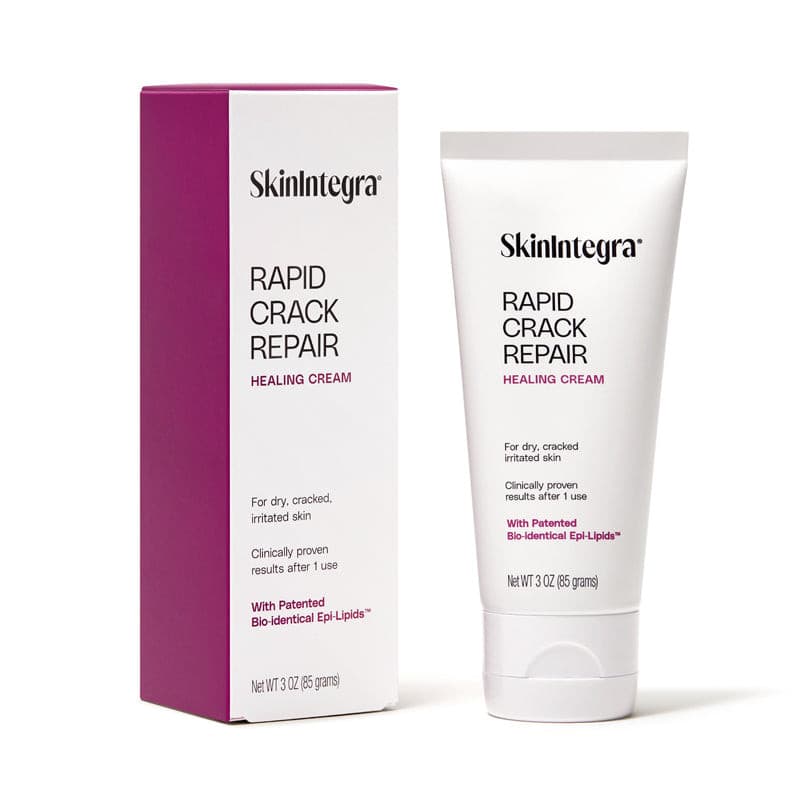
SkinIntegra® Rapid Crack Repair Cream was developed for exactly this gap. It is not a stronger exfoliant. It replenishes what is missing.
At its core is SkinIntegra B.I.O.™ (Bio-Identical Oils) — a patented blend of five plant-derived oils (Sacha Inchi, Sea Buckthorn, Rice Bran, Sesame Seed and Jojoba Seed) matched in balance and composition to the skin’s own lipids. We profiled what a healthy skin barrier is made of, then selected oils to match it. That is what SkinIntegra B.I.O.™ does.
It also contains 25% urea with lactic acid — a concentration that softens and loosens hardened skin and is widely used on dry, sensitive and diabetic skin, with the lactic acid adding hydration and gentle exfoliation. Unlike 40% urea, which works aggressively and can leave skin feeling dry, SkinIntegra absorbs quickly and leaves skin feeling immediately moisturized.
It is formulated without salicylic acid, and is fragrance-free, paraben-free, alcohol-free, petrolatum-free and dye-free.
What the clinical evidence shows
In a head-to-head trial published in the Journal of the American Podiatric Medical Association, 48 adults with deeply cracked feet used either Rapid Crack Repair or a 40% urea cream, twice a day for four weeks.
Rapid Crack Repair did as well as 40% urea — at a lower strength, and well tolerated throughout. Among the 22 adults who used it, 91% showed some improvement within two weeks. By four weeks, podiatrists were seeing less dryness in 82% and less cracking in 73%, and no one had new or worsening redness, burning, stinging or itching.
SkinIntegra Rapid Crack Repair Cream carries the Seal of Approval from the American Podiatric Medical Association (APMA). Medical professionals at major hospitals across the United States also recommend it.
For skin that stays dry and cracked, or that looks better for a few days and then looks the same again, the missing piece is usually not more exfoliation. It is replenishing what the barrier is short of.

Work it into the thickened, scaling skin across the sole and heel — that is the skin that has to change. Keep it off any crack that is open or bleeding, and out from between the toes, where the skin stays damp.
It is a skin care cream, not a psoriasis treatment, and it does not replace anything your dermatologist prescribes.
Six Weeks of Daily Skin Care: A Podiatrist’s Case
A 72-year-old woman with a 50-year history of plaque psoriasis on both feet used SkinIntegra twice daily alongside the care her podiatrist had already prescribed. At six weeks, follow-up photographs show the skin surface markedly less dry and rough, with visibly less cracking.

Case and images courtesy of Dr. Karen A. Langone, DPM, DABPM, FACPM, FAAPSM, immediate past president of the American Association for Women Podiatrists. Used with permission.
Educational case. SkinIntegra Rapid Crack Repair Cream is a skin care cream for dry, cracked skin — it is not a treatment for psoriasis, and it does not replace anything your dermatologist or podiatrist prescribes. Individual results vary.
When Topical Treatment Stops Working
A lot of people with psoriasis on their feet spend years being treated as a mild case, because the rule of thumb dermatologists once used was how much of your body is covered. On that measure two soles barely register.
That rule has changed, and it is worth knowing. An international panel of psoriasis specialists re-drew the definition in 2020. Under it, you are a candidate for systemic treatment — tablets or injections rather than creams — if any one of three things is true: at least a tenth of your skin is involved, topical treatment has failed, or the psoriasis sits in what they call a special area. Palms and soles are named on that list, alongside the face, nails, scalp and genitals.
The reason is that a plaque on your sole costs you more than the same plaque on your back. It decides whether you can stand through a shift or walk to the shops.
What comes next, in rough order:
- Targeted light treatment. Narrowband UVB or excimer laser aimed at the hands and feet rather than the whole body. Guidelines support targeted phototherapy for localized plaques.
- Tablets. Acitretin is often the first tried for palmoplantar disease. Cyclosporine is the one named in US guidelines for stubborn palmoplantar psoriasis specifically. Methotrexate and apremilast are also used.
- Biologics. Injected drugs targeting particular immune signals. In trials on palmoplantar plaque psoriasis, the IL-17 and IL-23 blockers have performed best.
Two realistic expectations. Timelines run in months rather than weeks — acitretin is usually judged at three to six months, biologic trials at around four. And palmoplantar pustulosis, the blistering form described above, is considerably harder: across the trials done so far, most drugs have not clearly beaten placebo on their main measure, which is a reason to have it named correctly before anyone settles on a plan.
Toenails, and the Heel Pain That Is Not the Skin
Psoriasis reaches the toenails often, and the changes are easy to mistake for a fungal infection. Small dents in the nail surface and a yellow-pink patch under the nail that looks like a drop of oil both point toward psoriasis. Nail lifting away from its bed, and chalky debris building up underneath, happen in both conditions and tell you very little on their own. A nail clipping sent for testing settles it, and the two can be present together, so one answer does not rule out the other. Our guide to brittle and damaged toenails covers the day-to-day care.
Nail involvement is also worth mentioning to your doctor for a different reason. In a long-running population study, people with psoriasis affecting the nails went on to develop psoriatic arthritis at close to three times the rate of those without it. The absolute risk stays low — a few per cent over a decade — so this is a reason to mention it, not to worry about it.
And one thing belongs on a page about heels specifically. Psoriatic arthritis commonly inflames the places where tendons anchor into bone, and the Achilles insertion at the back of the heel is one of the most affected. About one person in three with psoriatic arthritis develops it. If you have heel pain that does not fit the state of your skin — pain deep in the back of the heel, or under it, that is worst when you first stand up — say so at your next appointment rather than filing it under bad shoes. Johns Hopkins Arthritis Center describes the pattern.
When to See a Doctor
Seek medical advice if:
- Cracks bleed or show signs of infection
- OTC remedies fail after 2–3 weeks
- You have diabetes or an immune-compromising condition
- You’re unsure whether it’s psoriasis or a fungal infection
- A joint or a heel hurts in a way the skin does not explain
Lifestyle Tips for Managing Psoriasis on Feet
- Wear breathable footwear in leather or mesh
- Stay hydrated
- Trim nails carefully to avoid trauma — a nick from the clippers can seed a new plaque
- Manage stress with yoga, meditation, or deep breathing
- Maintain a healthy weight to reduce heel pressure
- If you smoke, ask your doctor about stopping — the link with the blistering form of the condition is the strongest one known
Frequently Asked Questions
Is dry cracked feet a symptom of psoriasis?
It can be, especially alongside thick, scaly patches with well-defined edges, appearing on both feet in matching places. Pitting in the toenails on the same foot adds to the picture. Dry, cracked feet on their own have many other causes, so the pattern matters more than any single sign.
What’s the best cream for cracked, scaling skin from psoriasis?
There is no single answer, but there are two things worth looking for together. Urea in the 10–25% range softens thickened, scaling skin without abrasion. Barrier lipids matched to the ones healthy skin makes for itself address the other half of the problem — the mortar the skin is short of. A product that does only one of the two tends to help for a few days at a time. Whatever you use, it sits alongside what your dermatologist has prescribed rather than in place of it.
Can I exfoliate cracked skin from foot psoriasis?
Not physically. Scrubbing, pumice stones and foot files risk triggering the Koebner phenomenon — the pattern in which injuring psoriatic skin causes a brand-new plaque to form at the injured spot. Use a chemical softener such as urea instead: it loosens hardened skin gradually rather than abrading it away.
What is the Koebner phenomenon?
It is the tendency for a new psoriasis plaque to appear at the site of a skin injury, days or weeks after the injury happens — even on skin that was clear beforehand. Cuts, scratches, burns, sunburn and friction can all trigger it, and psoriasis is the condition it occurs in most often. On the feet it is the reason to avoid abrasive tools and badly fitting shoes.
How do I tell psoriasis on my feet from athlete’s foot?
Psoriasis usually appears on both feet in matching places, with edges you can see clearly. Athlete’s foot is more often on one foot, with a less defined border. Neither pattern is reliable enough to act on alone — a skin scraping is how it gets confirmed. If a foot rash has not settled after a full course of antifungal cream, that is a reason to get it looked at rather than to keep treating it as a fungal infection.
Does having diabetes make psoriasis on the feet worse?
Diabetes can weaken the skin barrier, reduce circulation, and slow healing, which makes cracks from psoriasis more likely to become deeper, infected, and harder to manage. Reduced feeling in the feet compounds it, because a split you cannot feel is one you will not protect. Daily inspection of your soles matters more if you have both.
Are those small yellow blisters on my arch still psoriasis?
They may be palmoplantar pustulosis. The pustules are sterile — there is no infection in them — and they dry to brown spots and peel, leaving tender skin behind. It was long grouped with psoriasis and is now increasingly regarded as a related but separate condition, which matters because it responds differently to treatment. It needs naming correctly by a dermatologist.
Does psoriasis on the feet ever go away?
Psoriasis is a chronic condition, so the realistic goal is long stretches of quiet skin rather than a permanent end to it. How long the quiet stretches last depends mostly on what your dermatologist is treating you with, and on staying off the triggers — abrasion above all — that start the cycle again.
Living With Psoriasis on Your Feet
Psoriasis on your feet does not just hurt — it decides what you do with your day. Two things move that: getting the psoriasis itself properly treated, which may mean pushing past creams if creams have stopped working, and looking after the skin in between, without abrading it. Together they give the skin on your soles its best chance to stay intact and comfortable.


