


Most articles about cracked heels are written for people who can feel them. This one is not. If you have diabetes and peripheral neuropathy, a heel fissure is not a minor inconvenience you will notice when it becomes painful — it is a wound you may not feel at all, deepening quietly until bacteria have already entered. Understanding why this happens, and what to do about it, is the purpose of this guide.
What Peripheral Neuropathy Does to Your Feet
Peripheral neuropathy is nerve damage that affects the hands and feet. In people with diabetes, it is caused by prolonged high blood sugar gradually damaging the peripheral nerves — the long fibers that carry sensation from your feet to your brain. According to the American Diabetes Association, neuropathy is one of the most common complications of diabetes, affecting up to 50% of people with the condition over time.
The damage is not simply numbness, though numbness is part of it. Clinically, the relevant threshold is called loss of protective sensation (LOPS) — the point at which a patient can no longer reliably detect minor skin trauma. Below this threshold, the normal pain signals that would prompt you to look at your foot, adjust your shoe, or seek care are absent or severely muted.

Podiatrists screen for LOPS using the 10-gram monofilament test — a thin filament pressed against specific points on the sole of the foot. Patients who cannot feel it at multiple points have crossed into the clinical risk zone. If you have diabetes and have not been tested recently, this is worth raising with your care team.
Neuropathy does not affect only sensation. It also affects the autonomic nerves — the branch of the nervous system that controls automatic functions the body normally handles without conscious input, including sweat production. This second mechanism is the one most directly responsible for why diabetic feet crack.
Why Diabetic Skin Cracks: The Anhidrosis Mechanism
Healthy skin stays supple because it sweats. Sweat glands in the feet produce moisture that maintains the skin's natural water content and keeps the outermost layer — the stratum corneum — flexible enough to resist cracking under pressure and movement. In diabetic patients with autonomic neuropathy, the nerves that signal sweat glands to function are damaged. The result is anhidrosis — a near-complete loss of sweat production in the feet.
This is not the same as having dry skin from environmental causes. Environmental dryness responds to moisturizers because the skin's underlying production capacity is intact. Anhidrosis does not — the sweat glands themselves have lost their nerve signal. The skin dries from the inside out, regardless of how much topical product is applied to the surface.
Compounding this is the effect of sustained high blood sugar on the skin's structural components. Hyperglycemia impairs the skin's ability to synthesize and retain urea, lactic acid, and the fatty acids that form the lipid matrix of the stratum corneum. These are not cosmetic components — they are the building blocks of the skin's protective barrier. When they are depleted, the skin becomes brittle, loses elasticity, and begins to crack, particularly at the heels where mechanical pressure from walking is concentrated.
For a deeper explanation of the three mechanisms driving dryness in diabetic skin, see our article on understanding dry diabetic feet.
The Danger of a Crack You Cannot Feel
In a patient without neuropathy, a deepening heel fissure announces itself. There is discomfort when standing, sharpness when walking barefoot, pain that directs attention to the problem before it becomes serious. In a patient with LOPS, none of those signals arrive.
A superficial crack in the epidermis is a cosmetic problem. A crack that reaches the dermis — the deeper layer where blood vessels and nerve endings are present — is an open wound. In the absence of pain, a heel fissure can progress from superficial to dermal without the patient noticing. Once the dermis is exposed, bacteria have direct access to living tissue.
The infection risk in diabetic patients is compounded by a second impairment: the immune response at the wound site is functionally blunted. In poorly controlled diabetes, neutrophil migration to the site of injury is slowed, angiogenesis is reduced, and the inflammatory signaling that normally produces visible warning signs — redness, heat, swelling — is muted. This means an infected heel fissure in a diabetic patient may present with none of the classic signs of infection, even as the bacteria advance.
Clinical escalation path: Heel fissure deepens past the epidermis → bacteria enter through the open wound → local infection develops with no reliable pain or visible inflammation → cellulitis spreads through surrounding tissue → osteomyelitis (bone infection) takes hold → surgical debridement or amputation may be required. Each step can occur without the patient feeling that anything is wrong.
This is the clinical reality that most general skin articles are not written for. The danger is not the crack — it is the silence around it.
Why Standard Skin Treatments Fall Short
The standard advice for cracked heels — apply a thick moisturizer, use a heel balm, try petroleum jelly — is advice designed for a different skin problem. It assumes the skin is dry because of external conditions: cold weather, low humidity, hot showers, harsh soaps. Address the external cause and the skin recovers.
Diabetic neuropathic skin is dry for a different reason: the nerves that sustain its moisture production have been damaged. Applying a surface moisturizer to anhidrotic skin is like watering a plant whose roots have been cut. The surface may feel temporarily softer, but the underlying deficit is unaddressed.
Petroleum jelly (Vaseline) is a common example. It is an effective occlusive — it seals the skin surface and slows water loss from the outer layers. But it provides no barrier-mimicking lipids, no urea to replenish natural moisturizing factors, no lactic acid to support the stratum corneum. For healthy skin with mild dryness, it is a reasonable short-term solution. For diabetic neuropathic skin with a structural barrier deficit, it addresses the symptom without touching the cause. Our article on why Vaseline falls short for diabetic feet explains this distinction in detail.
High-concentration urea creams (40% and above) take a different approach — they are keratolytic, breaking down thickened skin. They can be effective under podiatric supervision for callus management, but they are not formulated for daily barrier repair and can cause irritation or over-exfoliation on already compromised skin. The question for daily preventive care is not how to strip back damaged skin, but how to rebuild and maintain the barrier that prevents damage from occurring.
What Safe Daily Skin Care Looks Like
For diabetic patients with peripheral neuropathy, daily foot skin care is not optional maintenance — it is a clinical prevention step. The goal is to keep the skin barrier intact so that fissures do not develop in the first place.
Daily inspection
Because LOPS means you cannot rely on pain to alert you to a developing problem, visual inspection becomes your primary detection tool. Check both feet each day — soles, heels, and between the toes — using a mirror if bending is difficult, or asking a family member or caregiver if vision or mobility limits self-inspection. Look for new cracks, skin color changes, swelling, or any break in the skin. Any wound that does not close within a few days warrants podiatric evaluation.
Washing
Wash feet daily with lukewarm — not hot — water and a mild, fragrance-free cleanser. Do not soak. Prolonged submersion weakens the skin barrier through osmotic action, stripping residual lipids from the stratum corneum. Brief washing followed by thorough drying is the safe protocol. Dry carefully between the toes, where retained moisture creates conditions for fungal infection.
Barrier repair cream
Apply a clinically formulated barrier repair cream immediately after washing, while the skin is still slightly damp. Timing matters — damp skin allows active ingredients to penetrate more effectively. The choice of product matters more for diabetic neuropathic skin than for healthy skin, because the barrier deficit is structural, not just surface-level. Look for a formulation that contains urea (to replenish natural moisturizing factors and maintain suppleness), lactic acid (to support the moisture-binding layer of the stratum corneum), and barrier-mimicking lipids (to restore the structural lipid matrix).
Footwear
Never walk barefoot, including indoors. With LOPS, you cannot feel sharp objects, rough surfaces, or the early pressure of a developing blister. Properly fitted shoes with cushioning reduce mechanical stress at the heel and sole — the sites most vulnerable to fissure formation. Avoid open-back footwear that allows the heel to contact surfaces without protection.
A Barrier Repair Formula Built from Diabetic Skin Research

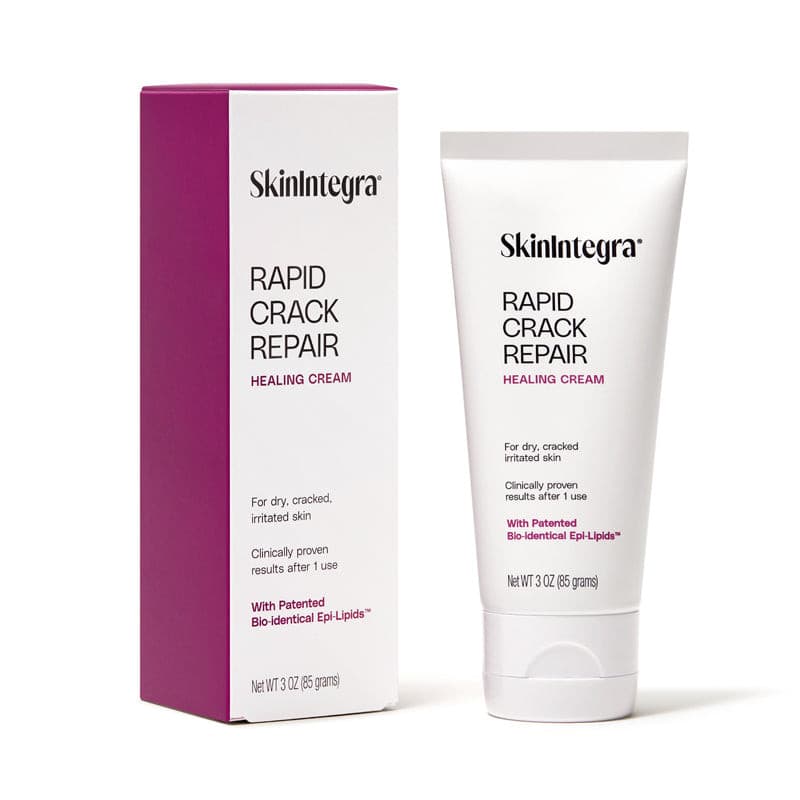
SkinIntegra Rapid Crack Repair Cream was not formulated as a general skincare product adapted for diabetic patients. It was developed by a chemist with decades of skincare research experience who studied diabetic skin specifically — and who understood firsthand what is at stake when routine care fails. The formula was built from the ground up to replenish what diabetic skin is actually missing.
For patients with neuropathy, this distinction matters clinically. A standard moisturizer compensates for environmental dryness. A formula designed around diabetic skin physiology addresses the structural deficit: the depleted urea and lactic acid, the impaired lipid matrix, the compromised stratum corneum that cannot sustain itself. SkinIntegra's patented full-spectrum barrier repair formula combines 25% urea and lactic acid to hydrate and renew, skin-mimicking lipids to restore barrier integrity, and vitamins and antioxidants to support healing — fragrance-free, preservative-free, and hypoallergenic for daily use on sensitive diabetic skin.
In an independent double-blind clinical trial, SkinIntegra outperformed a 40% urea cream — the highest-strength standard-of-care product for diabetic skin — in both speed and quality of improvement. In a separate trial conducted exclusively with diabetic patients, 100% of participants showed measurable improvement within 24 hours of use — a result that is particularly meaningful in a delayed-healing context. SkinIntegra holds the APMA Seal of Acceptance from the American Podiatric Medical Association and is trusted by podiatrists nationwide.
For an explanation of why the skin barrier matters so fundamentally in diabetic foot care, see our article on why skin barrier repair is essential for diabetic feet. Consistent daily use is essential to protect and maintain the skin barrier — particularly for patients whose autonomic neuropathy means their skin cannot sustain its own moisture production.
When to See a Podiatrist
Daily skin care at home is the foundation of prevention. But for diabetic patients with peripheral neuropathy, some situations require professional evaluation rather than home management:
• Any heel crack that does not close or improve within 3–5 days
• Redness, warmth, or swelling around a crack — even mild — which may indicate infection in a context where inflammatory signals are already muted
• Any wound, blister, or break in the skin that you cannot see clearly or reach to clean and dress
• Thickened callus build-up on the heels or soles, which can conceal underlying skin breakdown
• Any change in skin color — darkening, bluish or grey tones — which may indicate impaired circulation at the wound site
• You have not been screened for LOPS recently — ask your podiatrist about the monofilament test
The threshold for seeking care is lower for diabetic patients with neuropathy than for the general population. The absence of pain is not reassurance — it is the problem.
Frequently Asked Questions
Can peripheral neuropathy cause cracked heels?
Yes — through two distinct mechanisms. Sensory neuropathy causes loss of protective sensation, meaning heel fissures can deepen without the patient feeling pain. Autonomic neuropathy damages the sudomotor nerves that control sweat production, causing anhidrosis — a near-complete loss of sweat in the feet. Without this natural moisture source, skin becomes chronically dry and brittle, cracking under the mechanical pressure of walking. Together, these mechanisms make peripheral neuropathy one of the most significant risk factors for serious heel fissures in diabetic patients.
At what stage of diabetes does neuropathy start?
Peripheral neuropathy can begin in the early stages of diabetes, and in some cases may be present at the time of diagnosis — particularly in patients with Type 2 diabetes who had elevated blood sugar for years before diagnosis. Regular screening — including the monofilament test — is recommended as part of annual diabetic foot care regardless of symptoms, because nerve damage often develops gradually and without obvious warning.
Can diabetic neuropathy be reversed?
Diabetic peripheral neuropathy is not fully reversible once established, but its progression can be slowed significantly through tight blood sugar control, blood pressure management, and cardiovascular risk reduction. Some early-stage small-fibre nerve damage may show partial recovery with sustained glucose improvement. The practical implication for skin care is that even if neuropathy cannot be reversed, its most dangerous consequence — undetected skin breakdown — can be managed through consistent daily inspection, appropriate barrier repair, and timely podiatric care.
What cream is safe for diabetic cracked heels?
The most appropriate creams for diabetic cracked heels are those formulated specifically for compromised skin barriers — not general moisturizers or high-concentration keratolytic products. Look for formulations containing urea (ideally 10–25%, for barrier replenishment rather than aggressive keratolysis), lactic acid (to support the moisture-binding layer of the stratum corneum), and barrier-mimicking lipids. The product should be fragrance-free, preservative-free, and tested for use on sensitive or diabetic skin. High-concentration urea creams (40% and above) are best used under podiatric supervision rather than daily at home. Petroleum-based products like Vaseline are not adequate for neuropathic skin with a structural barrier deficit.
How often should diabetic patients check their feet for cracks?
Daily. Visual inspection of both feet — soles, heels, and between the toes — should be a fixed part of the daily routine, ideally at the same time as washing and moisturising. For patients with limited flexibility, a long-handled mirror allows inspection of the sole without bending. Any crack, color change, swelling, or wound that does not close within a few days should be evaluated by a podiatrist. Daily inspection is particularly important for patients who have already been diagnosed with LOPS, where the normal pain signal that would otherwise prompt attention is absent. For more on managing neuropathic symptoms in the feet, see our article on itchy feet at night and neuropathy.
Related Articles
• Itchy Feet at Night and Neuropathy
• Why Vaseline Falls Short for Diabetic Feet
• Why Skin Barrier Repair Is Essential in Diabetic Foot Care


